

2 Gas Adsorption: Basic Principles and Experimental
Considerations
Adsorption phenomenon occurs when a solid surface is exposed to a fluid, and it is
defined as the increase in the density of that fluid close to the interface [5]. The
inverse process is called desorption. Depending on the forces involved, the adsorption can be either physical (physisorption) or chemical (chemisorption). The former
involves Van der Waals forces, whereas the latter leads to the formation of chemical
bonds. Physisorption process, which is reversible and non-localized, is used in the
textural characterization of solids, allowing to study the exposed surface to the fluid.
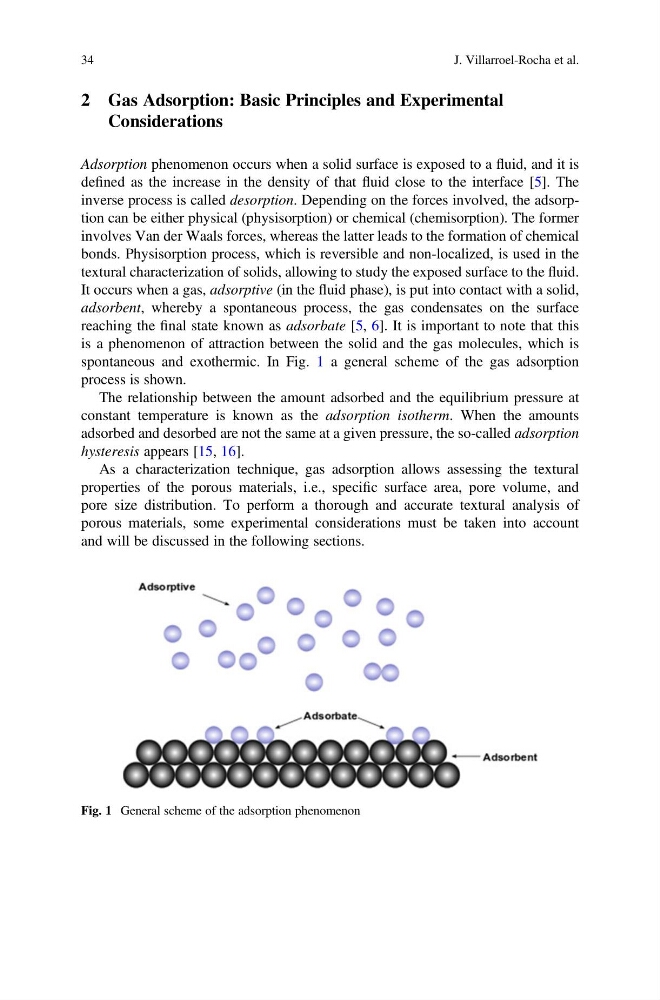
It occurs when a gas, adsorptive (in the fluid phase), is put into contact with a solid,
adsorbent, whereby a spontaneous process, the gas condensates on the surface
reaching the final state known as adsorbate [5, 6]. It is important to note that this
is a phenomenon of attraction between the solid and the gas molecules, which is
spontaneous and exothermic. In Fig. 1 a general scheme of the gas adsorption
process is shown.
The relationship between the amount adsorbed and the equilibrium pressure at
constant temperature is known as the adsorption isotherm. When the amounts
adsorbed and desorbed are not the same at a given pressure, the so-called adsorption
hysteresis appears [15, 16].
As a characterization technique, gas adsorption allows assessing the textural
properties of the porous materials, i.e., specific surface area, pore volume, and
pore size distribution. To perform a thorough and accurate textural analysis of
porous materials, some experimental considerations must be taken into account
and will be discussed in the following sections.
Fig. 1 General scheme of the adsorption phenomenon
34
J. Villarroel-Rocha et al.
Considerations
Adsorption phenomenon occurs when a solid surface is exposed to a fluid, and it is
defined as the increase in the density of that fluid close to the interface [5]. The
inverse process is called desorption. Depending on the forces involved, the adsorption can be either physical (physisorption) or chemical (chemisorption). The former
involves Van der Waals forces, whereas the latter leads to the formation of chemical
bonds. Physisorption process, which is reversible and non-localized, is used in the
textural characterization of solids, allowing to study the exposed surface to the fluid.
It occurs when a gas, adsorptive (in the fluid phase), is put into contact with a solid,
adsorbent, whereby a spontaneous process, the gas condensates on the surface
reaching the final state known as adsorbate [5, 6]. It is important to note that this
is a phenomenon of attraction between the solid and the gas molecules, which is
spontaneous and exothermic. In Fig. 1 a general scheme of the gas adsorption
process is shown.
The relationship between the amount adsorbed and the equilibrium pressure at
constant temperature is known as the adsorption isotherm. When the amounts
adsorbed and desorbed are not the same at a given pressure, the so-called adsorption
hysteresis appears [15, 16].
As a characterization technique, gas adsorption allows assessing the textural
properties of the porous materials, i.e., specific surface area, pore volume, and
pore size distribution. To perform a thorough and accurate textural analysis of
porous materials, some experimental considerations must be taken into account
and will be discussed in the following sections.
Fig. 1 General scheme of the adsorption phenomenon
34
J. Villarroel-Rocha et al.