

5.1 Tuning Selectivity
Although the industrial performance of a given zeolitic adsorbent is impacted by
many different parameters (related to the nature of the zeolite but also to the
operating conditions), selectivity is the one impacting in a strongest way the final
performance. Therefore, the research for selective adsorbents has traditionally
attracted the researchers’ attention. Since the choice of commercially available
zeolite topologies is relatively small, the main degree of freedom is the modification
of the extraframework cation distribution. As an example, in the field of air separation, different studies dealing with the cationic exchange of zeolites A and X are
available. MgA zeolites [29] exchanged up to 75% presented significantly higher
separation factors than that of the reference CaA. In the same manner, LiLSX an LiX
zeolites show increased N 2 adsorption capacities as the Si/Al ratio becomes closer to
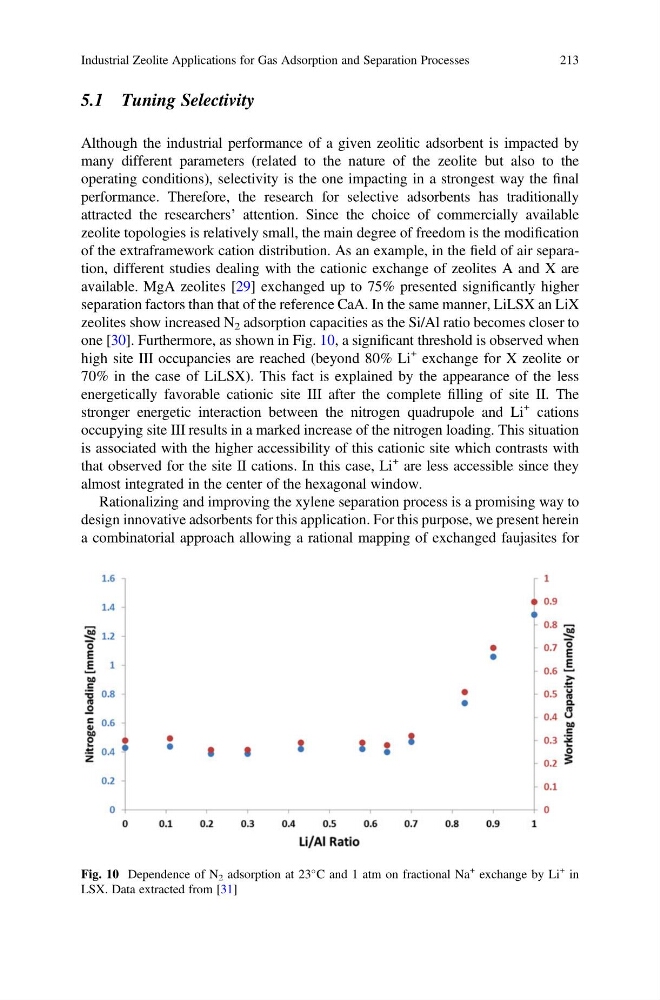
one [30]. Furthermore, as shown in Fig. 10, a significant threshold is observed when
high site III occupancies are reached (beyond 80% Li
+ exchange for X zeolite or
70% in the case of LiLSX). This fact is explained by the appearance of the less
energetically favorable cationic site III after the complete filling of site II. The
stronger energetic interaction between the nitrogen quadrupole and Li
+ cations
occupying site III results in a marked increase of the nitrogen loading. This situation
is associated with the higher accessibility of this cationic site which contrasts with
that observed for the site II cations. In this case, Li
+ are less accessible since they
almost integrated in the center of the hexagonal window.
Rationalizing and improving the xylene separation process is a promising way to
design innovative adsorbents for this application. For this purpose, we present herein
a combinatorial approach allowing a rational mapping of exchanged faujasites for
Fig. 10 Dependence of N 2 adsorption at 23
C and 1 atm on fractional Na
+ exchange by Li
+ in
LSX. Data extracted from [31]
Industrial Zeolite Applications for Gas Adsorption and Separation Processes
213
Although the industrial performance of a given zeolitic adsorbent is impacted by
many different parameters (related to the nature of the zeolite but also to the
operating conditions), selectivity is the one impacting in a strongest way the final
performance. Therefore, the research for selective adsorbents has traditionally
attracted the researchers’ attention. Since the choice of commercially available
zeolite topologies is relatively small, the main degree of freedom is the modification
of the extraframework cation distribution. As an example, in the field of air separation, different studies dealing with the cationic exchange of zeolites A and X are
available. MgA zeolites [29] exchanged up to 75% presented significantly higher
separation factors than that of the reference CaA. In the same manner, LiLSX an LiX
zeolites show increased N 2 adsorption capacities as the Si/Al ratio becomes closer to
one [30]. Furthermore, as shown in Fig. 10, a significant threshold is observed when
high site III occupancies are reached (beyond 80% Li
+ exchange for X zeolite or
70% in the case of LiLSX). This fact is explained by the appearance of the less
energetically favorable cationic site III after the complete filling of site II. The
stronger energetic interaction between the nitrogen quadrupole and Li
+ cations
occupying site III results in a marked increase of the nitrogen loading. This situation
is associated with the higher accessibility of this cationic site which contrasts with
that observed for the site II cations. In this case, Li
+ are less accessible since they
almost integrated in the center of the hexagonal window.
Rationalizing and improving the xylene separation process is a promising way to
design innovative adsorbents for this application. For this purpose, we present herein
a combinatorial approach allowing a rational mapping of exchanged faujasites for
Fig. 10 Dependence of N 2 adsorption at 23
C and 1 atm on fractional Na
+ exchange by Li
+ in
LSX. Data extracted from [31]
Industrial Zeolite Applications for Gas Adsorption and Separation Processes
213