

4.5 n-Paraffin/i-Paraffin Separation
The separation of the normal (linear) paraffins from the cuts containing their
branched and cyclic counterparts found its application in different fields such as
the upgrading of gasoline (normal paraffins contribute to the decrease of the octane
number), solvent production, or still the production of LAB (linear alkylbenzenes)based detergents.
Different process variations are available to provide n-paraffin/i-paraffin separation. In the case of solvent production, PSA technology allows separating [24] cuts
containing 20 to 40% n-paraffins either by means of vacuum countercurrent desorption or more frequently by means of a purge gas. The choice of the latter is done
depending on the adsorption strength of the feed mixture. Thus, inert gases or short
linear paraffins can be employed as desorbing agents. These are subsequently easily
separated by distillation.
When referring to the gasoline upgrading field, usually an integrated scheme
between the isomerization and the n-paraffin/i-paraffin separation units is proposed.
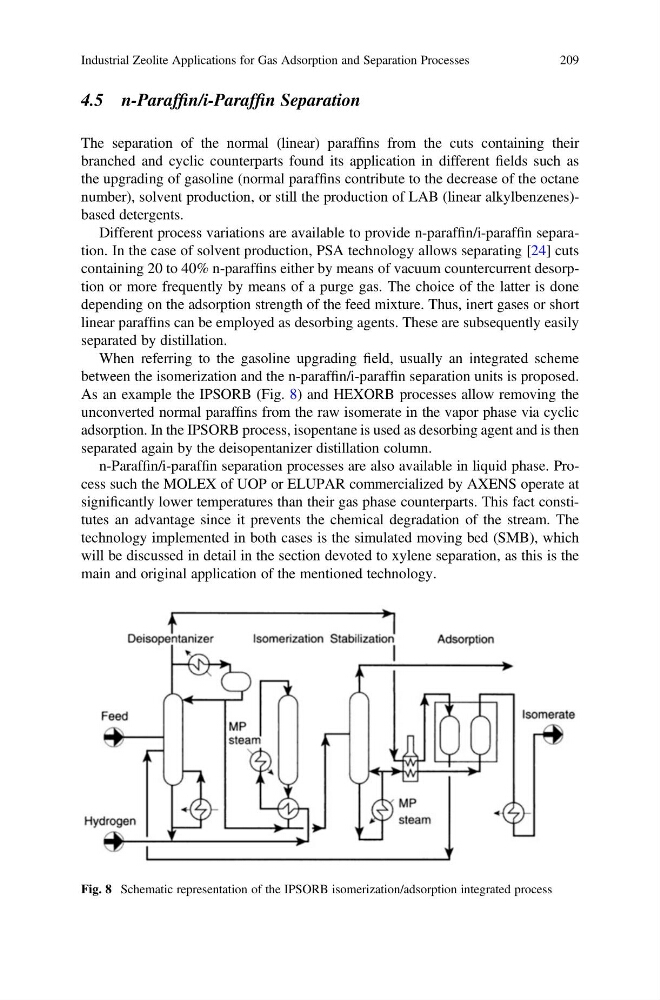
As an example the IPSORB (Fig. 8) and HEXORB processes allow removing the
unconverted normal paraffins from the raw isomerate in the vapor phase via cyclic
adsorption. In the IPSORB process, isopentane is used as desorbing agent and is then
separated again by the deisopentanizer distillation column.
n-Paraffin/i-paraffin separation processes are also available in liquid phase. Process such the MOLEX of UOP or ELUPAR commercialized by AXENS operate at
significantly lower temperatures than their gas phase counterparts. This fact constitutes an advantage since it prevents the chemical degradation of the stream. The
technology implemented in both cases is the simulated moving bed (SMB), which
will be discussed in detail in the section devoted to xylene separation, as this is the
main and original application of the mentioned technology.
Fig. 8 Schematic representation of the IPSORB isomerization/adsorption integrated process
Industrial Zeolite Applications for Gas Adsorption and Separation Processes
209
The separation of the normal (linear) paraffins from the cuts containing their
branched and cyclic counterparts found its application in different fields such as
the upgrading of gasoline (normal paraffins contribute to the decrease of the octane
number), solvent production, or still the production of LAB (linear alkylbenzenes)based detergents.
Different process variations are available to provide n-paraffin/i-paraffin separation. In the case of solvent production, PSA technology allows separating [24] cuts
containing 20 to 40% n-paraffins either by means of vacuum countercurrent desorption or more frequently by means of a purge gas. The choice of the latter is done
depending on the adsorption strength of the feed mixture. Thus, inert gases or short
linear paraffins can be employed as desorbing agents. These are subsequently easily
separated by distillation.
When referring to the gasoline upgrading field, usually an integrated scheme
between the isomerization and the n-paraffin/i-paraffin separation units is proposed.
As an example the IPSORB (Fig. 8) and HEXORB processes allow removing the
unconverted normal paraffins from the raw isomerate in the vapor phase via cyclic
adsorption. In the IPSORB process, isopentane is used as desorbing agent and is then
separated again by the deisopentanizer distillation column.
n-Paraffin/i-paraffin separation processes are also available in liquid phase. Process such the MOLEX of UOP or ELUPAR commercialized by AXENS operate at
significantly lower temperatures than their gas phase counterparts. This fact constitutes an advantage since it prevents the chemical degradation of the stream. The
technology implemented in both cases is the simulated moving bed (SMB), which
will be discussed in detail in the section devoted to xylene separation, as this is the
main and original application of the mentioned technology.
Fig. 8 Schematic representation of the IPSORB isomerization/adsorption integrated process
Industrial Zeolite Applications for Gas Adsorption and Separation Processes
209