

The demand for zeolitic materials is primarily covered by several companies from
the USA, Europe, and Japan. Some of the major actors in the field of synthetic
zeolites are among others UOP (Honeywell), ARKEMA, BASF, TOSOH,
CLARIANT, or ZEOLYST. In the general context of adsorbent materials, some
others like AXENS, CALGON, or CABOT must be added.
2 What Is Expected from an Ideal Industrial Adsorbent
Independently of the chosen separation technology, when implementing a zeolite in
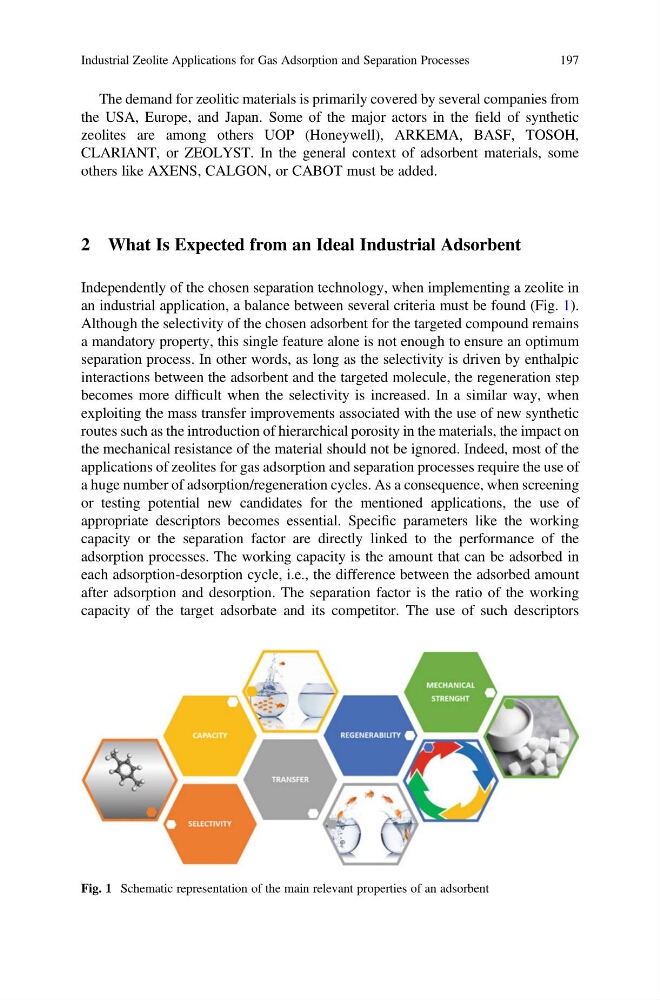
an industrial application, a balance between several criteria must be found (Fig. 1).
Although the selectivity of the chosen adsorbent for the targeted compound remains
a mandatory property, this single feature alone is not enough to ensure an optimum
separation process. In other words, as long as the selectivity is driven by enthalpic
interactions between the adsorbent and the targeted molecule, the regeneration step
becomes more difficult when the selectivity is increased. In a similar way, when
exploiting the mass transfer improvements associated with the use of new synthetic
routes such as the introduction of hierarchical porosity in the materials, the impact on
the mechanical resistance of the material should not be ignored. Indeed, most of the
applications of zeolites for gas adsorption and separation processes require the use of
a huge number of adsorption/regeneration cycles. As a consequence, when screening
or testing potential new candidates for the mentioned applications, the use of
appropriate descriptors becomes essential. Specific parameters like the working
capacity or the separation factor are directly linked to the performance of the
adsorption processes. The working capacity is the amount that can be adsorbed in
each adsorption-desorption cycle, i.e., the difference between the adsorbed amount
after adsorption and desorption. The separation factor is the ratio of the working
capacity of the target adsorbate and its competitor. The use of such descriptors
Fig. 1 Schematic representation of the main relevant properties of an adsorbent
Industrial Zeolite Applications for Gas Adsorption and Separation Processes
197
the USA, Europe, and Japan. Some of the major actors in the field of synthetic
zeolites are among others UOP (Honeywell), ARKEMA, BASF, TOSOH,
CLARIANT, or ZEOLYST. In the general context of adsorbent materials, some
others like AXENS, CALGON, or CABOT must be added.
2 What Is Expected from an Ideal Industrial Adsorbent
Independently of the chosen separation technology, when implementing a zeolite in
an industrial application, a balance between several criteria must be found (Fig. 1).
Although the selectivity of the chosen adsorbent for the targeted compound remains
a mandatory property, this single feature alone is not enough to ensure an optimum
separation process. In other words, as long as the selectivity is driven by enthalpic
interactions between the adsorbent and the targeted molecule, the regeneration step
becomes more difficult when the selectivity is increased. In a similar way, when
exploiting the mass transfer improvements associated with the use of new synthetic
routes such as the introduction of hierarchical porosity in the materials, the impact on
the mechanical resistance of the material should not be ignored. Indeed, most of the
applications of zeolites for gas adsorption and separation processes require the use of
a huge number of adsorption/regeneration cycles. As a consequence, when screening
or testing potential new candidates for the mentioned applications, the use of
appropriate descriptors becomes essential. Specific parameters like the working
capacity or the separation factor are directly linked to the performance of the
adsorption processes. The working capacity is the amount that can be adsorbed in
each adsorption-desorption cycle, i.e., the difference between the adsorbed amount
after adsorption and desorption. The separation factor is the ratio of the working
capacity of the target adsorbate and its competitor. The use of such descriptors
Fig. 1 Schematic representation of the main relevant properties of an adsorbent
Industrial Zeolite Applications for Gas Adsorption and Separation Processes
197