

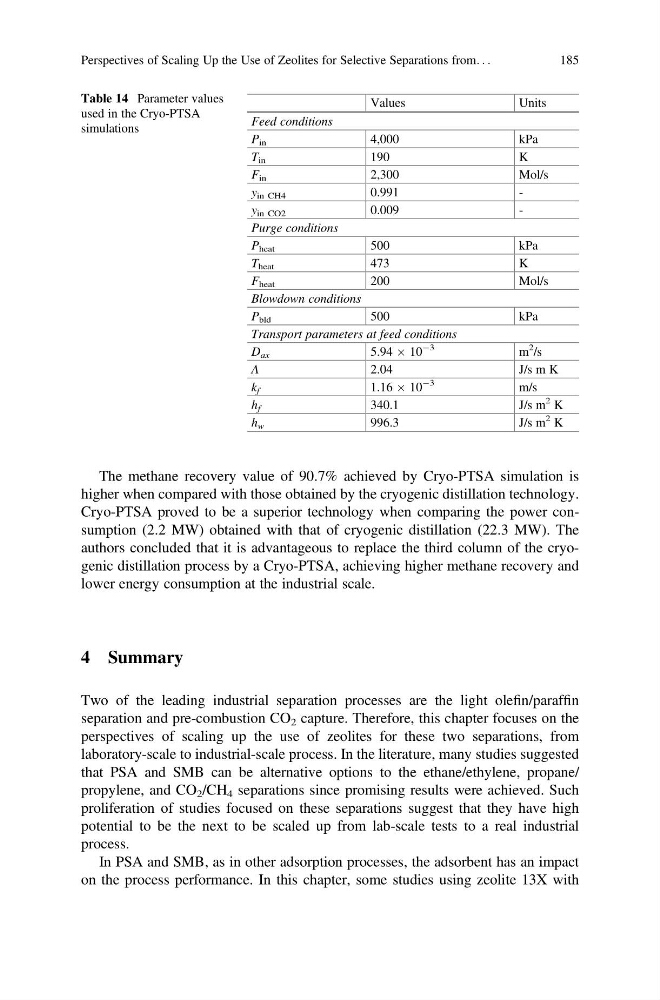
The methane recovery value of 90.7% achieved by Cryo-PTSA simulation is
higher when compared with those obtained by the cryogenic distillation technology.
Cryo-PTSA proved to be a superior technology when comparing the power consumption (2.2 MW) obtained with that of cryogenic distillation (22.3 MW). The
authors concluded that it is advantageous to replace the third column of the cryogenic distillation process by a Cryo-PTSA, achieving higher methane recovery and
lower energy consumption at the industrial scale.
4 Summary
Two of the leading industrial separation processes are the light olefin/paraffin
separation and pre-combustion CO 2 capture. Therefore, this chapter focuses on the
perspectives of scaling up the use of zeolites for these two separations, from
laboratory-scale to industrial-scale process. In the literature, many studies suggested
that PSA and SMB can be alternative options to the ethane/ethylene, propane/
propylene, and CO 2 /CH 4 separations since promising results were achieved. Such
proliferation of studies focused on these separations suggest that they have high
potential to be the next to be scaled up from lab-scale tests to a real industrial
process.
In PSA and SMB, as in other adsorption processes, the adsorbent has an impact
on the process performance. In this chapter, some studies using zeolite 13X with
Table 14 Parameter values
used in the Cryo-PTSA
simulations
Values
Units
Feed conditions
P in
4,000
kPa
T in
190
K
F in
2,300
Mol/s
y in CH4
0.991
-
y in CO2
0.009
-
Purge conditions
P heat
500
kPa
T heat
473
K
F heat
200
Mol/s
Blowdown conditions
P bld
500
kPa
Transport parameters at feed conditions
D ax
5.94 Â 10
À3
m
2
/s
Λ
2.04
J/s m K
k f
1.16 Â 10
À3
m/s
h f
340.1
J/s m
2 K
h w
996.3
J/s m
2 K
Perspectives of Scaling Up the Use of Zeolites for Selective Separations from. . .
185
higher when compared with those obtained by the cryogenic distillation technology.
Cryo-PTSA proved to be a superior technology when comparing the power consumption (2.2 MW) obtained with that of cryogenic distillation (22.3 MW). The
authors concluded that it is advantageous to replace the third column of the cryogenic distillation process by a Cryo-PTSA, achieving higher methane recovery and
lower energy consumption at the industrial scale.
4 Summary
Two of the leading industrial separation processes are the light olefin/paraffin
separation and pre-combustion CO 2 capture. Therefore, this chapter focuses on the
perspectives of scaling up the use of zeolites for these two separations, from
laboratory-scale to industrial-scale process. In the literature, many studies suggested
that PSA and SMB can be alternative options to the ethane/ethylene, propane/
propylene, and CO 2 /CH 4 separations since promising results were achieved. Such
proliferation of studies focused on these separations suggest that they have high
potential to be the next to be scaled up from lab-scale tests to a real industrial
process.
In PSA and SMB, as in other adsorption processes, the adsorbent has an impact
on the process performance. In this chapter, some studies using zeolite 13X with
Table 14 Parameter values
used in the Cryo-PTSA
simulations
Values
Units
Feed conditions
P in
4,000
kPa
T in
190
K
F in
2,300
Mol/s
y in CH4
0.991
-
y in CO2
0.009
-
Purge conditions
P heat
500
kPa
T heat
473
K
F heat
200
Mol/s
Blowdown conditions
P bld
500
kPa
Transport parameters at feed conditions
D ax
5.94 Â 10
À3
m
2
/s
Λ
2.04
J/s m K
k f
1.16 Â 10
À3
m/s
h f
340.1
J/s m
2 K
h w
996.3
J/s m
2 K
Perspectives of Scaling Up the Use of Zeolites for Selective Separations from. . .
185