

(Prod X ¼ 2.9 mol C3H6 Áh
À1
Ákg
À1 ), and desorbent consumption (DC X ¼ 0.8 m
3
STP,
iC4H10 Ákg
À1
C3H6 ) and also in terms of propane purity at the raffinate stream
(Pu R ¼ 98.1%), recovery, (Rec R ¼ 99.7%), productivity (Prod R ¼ 0.7
mol C3H8 Áh
À1 Ákg
À1 ), and desorbent consumption (DC R ¼ 1.3 m
3
STP,
iC4H10 Ákg
À1
C3H8 ). The desorbent consumption in these cases was always high
since there is no desorbent recycle, i.e., during the experiments it is only used as
fresh desorbent, as mentioned above. This is not a critical problem since the
desorbent can be recovered in two downstream separation units, e.g., PSA units
using MIL-100(Fe) as adsorbent [114] or two depropanizer columns. The high
desorbent flow rate and the four columns allow almost complete adsorbent regeneration in section I, and, consequently, the extract purity and propylene recovery were
improved. In section II the molar fraction of propane decreases, and a pure propylene
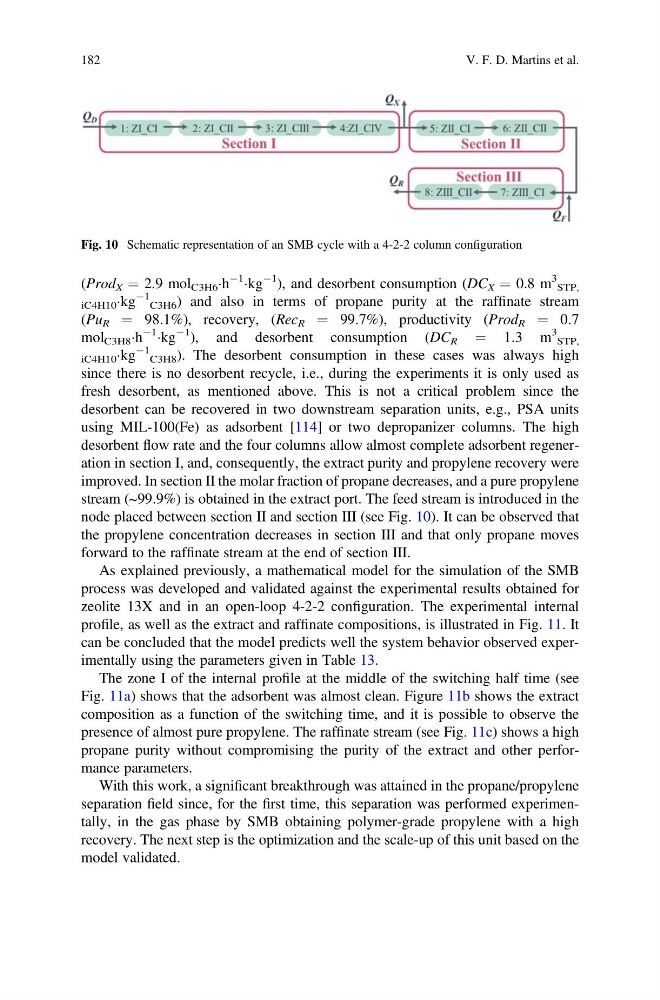
stream (~99.9%) is obtained in the extract port. The feed stream is introduced in the
node placed between section II and section III (see Fig. 10). It can be observed that
the propylene concentration decreases in section III and that only propane moves
forward to the raffinate stream at the end of section III.
As explained previously, a mathematical model for the simulation of the SMB
process was developed and validated against the experimental results obtained for
zeolite 13X and in an open-loop 4-2-2 configuration. The experimental internal
profile, as well as the extract and raffinate compositions, is illustrated in Fig. 11. It
can be concluded that the model predicts well the system behavior observed experimentally using the parameters given in Table 13.
The zone I of the internal profile at the middle of the switching half time (see
Fig. 11a) shows that the adsorbent was almost clean. Figure 11b shows the extract
composition as a function of the switching time, and it is possible to observe the
presence of almost pure propylene. The raffinate stream (see Fig. 11c) shows a high
propane purity without compromising the purity of the extract and other performance parameters.
With this work, a significant breakthrough was attained in the propane/propylene
separation field since, for the first time, this separation was performed experimentally, in the gas phase by SMB obtaining polymer-grade propylene with a high
recovery. The next step is the optimization and the scale-up of this unit based on the
model validated.
Fig. 10 Schematic representation of an SMB cycle with a 4-2-2 column configuration
182
V. F. D. Martins et al.
À1
Ákg
À1 ), and desorbent consumption (DC X ¼ 0.8 m
3
STP,
iC4H10 Ákg
À1
C3H6 ) and also in terms of propane purity at the raffinate stream
(Pu R ¼ 98.1%), recovery, (Rec R ¼ 99.7%), productivity (Prod R ¼ 0.7
mol C3H8 Áh
À1 Ákg
À1 ), and desorbent consumption (DC R ¼ 1.3 m
3
STP,
iC4H10 Ákg
À1
C3H8 ). The desorbent consumption in these cases was always high
since there is no desorbent recycle, i.e., during the experiments it is only used as
fresh desorbent, as mentioned above. This is not a critical problem since the
desorbent can be recovered in two downstream separation units, e.g., PSA units
using MIL-100(Fe) as adsorbent [114] or two depropanizer columns. The high
desorbent flow rate and the four columns allow almost complete adsorbent regeneration in section I, and, consequently, the extract purity and propylene recovery were
improved. In section II the molar fraction of propane decreases, and a pure propylene
stream (~99.9%) is obtained in the extract port. The feed stream is introduced in the
node placed between section II and section III (see Fig. 10). It can be observed that
the propylene concentration decreases in section III and that only propane moves
forward to the raffinate stream at the end of section III.
As explained previously, a mathematical model for the simulation of the SMB
process was developed and validated against the experimental results obtained for
zeolite 13X and in an open-loop 4-2-2 configuration. The experimental internal
profile, as well as the extract and raffinate compositions, is illustrated in Fig. 11. It
can be concluded that the model predicts well the system behavior observed experimentally using the parameters given in Table 13.
The zone I of the internal profile at the middle of the switching half time (see
Fig. 11a) shows that the adsorbent was almost clean. Figure 11b shows the extract
composition as a function of the switching time, and it is possible to observe the
presence of almost pure propylene. The raffinate stream (see Fig. 11c) shows a high
propane purity without compromising the purity of the extract and other performance parameters.
With this work, a significant breakthrough was attained in the propane/propylene
separation field since, for the first time, this separation was performed experimentally, in the gas phase by SMB obtaining polymer-grade propylene with a high
recovery. The next step is the optimization and the scale-up of this unit based on the
model validated.
Fig. 10 Schematic representation of an SMB cycle with a 4-2-2 column configuration
182
V. F. D. Martins et al.