

N
0 -dimethyl-1,4-diazabicyclo[2.2.2]octane mixed-SDA system and to denote it as
PST-29 (PWN) [45].
All known members of this RHO family are accessible to the molecules that can
pass through their 8-ring windows, and so they are potentially useful as small
molecule adsorbents. As such, we and other groups have examined the CO 2 adsorption properties of various alkali cation forms of the first five members of the RHO
family at 298–373 K and 0–1.0 bar [30, 39, 45–47]. Among them, the firstgeneration Na-rho gave the highest CO 2 uptake (4.6 mmol g
À1 ) at 298 K and
1.0 bar. This uptake is lower than the value (5.8 mmol g
À1 ) of the commercial
large-pore zeolite Na-X with Si/Al ¼ 1.3, but is rather higher than the capacities (3.6
and 3.7 mmol g
À1 , respectively) of two widely studied small-pore zeolites Na-A
with Si/Al ¼ 1.0 and K-chabazite with Si/Al ¼ 3.0 [32, 48]. One serious drawback of
Na-rho as an industrial CO 2 adsorbent is its very slow kinetics: this zeolite achieves
equilibrium only after about 2 h, mainly due to the restricted diffusion of CO 2
molecules into its internal void space via d8r units.
As shown in Fig. 5, however, higher generations of the RHO family of embedded
isoreticular zeolites (i.e., Na-PST-29, NaTEA-ECR-18, NaTEA-ZSM-25, and
NaTEA-PST-20) achieve equilibrium within 5 min. In these samples, CO 2 can
diffuse not only via d8r units but also via single 8-ring (s8r) windows that are
located between the t-oto cages and the pau or t-plg cages and as such equilibration
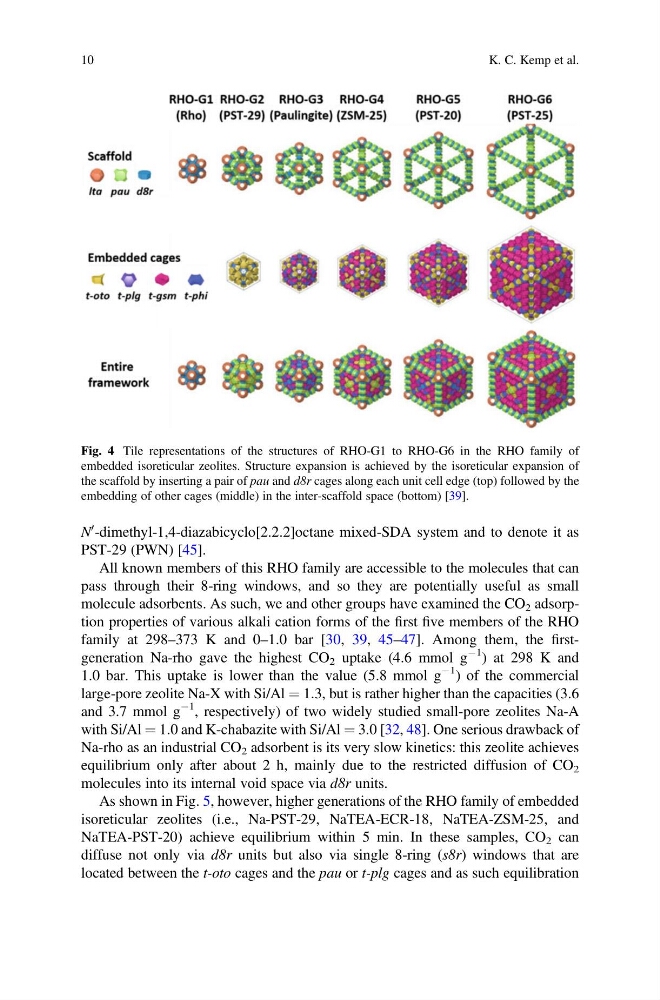
Fig. 4 Tile representations of the structures of RHO-G1 to RHO-G6 in the RHO family of
embedded isoreticular zeolites. Structure expansion is achieved by the isoreticular expansion of
the scaffold by inserting a pair of pau and d8r cages along each unit cell edge (top) followed by the
embedding of other cages (middle) in the inter-scaffold space (bottom) [39].
10
K. C. Kemp et al.
0 -dimethyl-1,4-diazabicyclo[2.2.2]octane mixed-SDA system and to denote it as
PST-29 (PWN) [45].
All known members of this RHO family are accessible to the molecules that can
pass through their 8-ring windows, and so they are potentially useful as small
molecule adsorbents. As such, we and other groups have examined the CO 2 adsorption properties of various alkali cation forms of the first five members of the RHO
family at 298–373 K and 0–1.0 bar [30, 39, 45–47]. Among them, the firstgeneration Na-rho gave the highest CO 2 uptake (4.6 mmol g
À1 ) at 298 K and
1.0 bar. This uptake is lower than the value (5.8 mmol g
À1 ) of the commercial
large-pore zeolite Na-X with Si/Al ¼ 1.3, but is rather higher than the capacities (3.6
and 3.7 mmol g
À1 , respectively) of two widely studied small-pore zeolites Na-A
with Si/Al ¼ 1.0 and K-chabazite with Si/Al ¼ 3.0 [32, 48]. One serious drawback of
Na-rho as an industrial CO 2 adsorbent is its very slow kinetics: this zeolite achieves
equilibrium only after about 2 h, mainly due to the restricted diffusion of CO 2
molecules into its internal void space via d8r units.
As shown in Fig. 5, however, higher generations of the RHO family of embedded
isoreticular zeolites (i.e., Na-PST-29, NaTEA-ECR-18, NaTEA-ZSM-25, and
NaTEA-PST-20) achieve equilibrium within 5 min. In these samples, CO 2 can
diffuse not only via d8r units but also via single 8-ring (s8r) windows that are
located between the t-oto cages and the pau or t-plg cages and as such equilibration
Fig. 4 Tile representations of the structures of RHO-G1 to RHO-G6 in the RHO family of
embedded isoreticular zeolites. Structure expansion is achieved by the isoreticular expansion of
the scaffold by inserting a pair of pau and d8r cages along each unit cell edge (top) followed by the
embedding of other cages (middle) in the inter-scaffold space (bottom) [39].
10
K. C. Kemp et al.