

measurable N 2 adsorption isotherm, probably due to the random framework Al
distribution.
Pham et al. have investigated the effect of Si/Al ratio (6 and 12) and cation type
(H
+ , Li
+
, Na
+
, and K
+
) on the CO 2 and N 2 adsorption properties of SSZ-13 (CHA) by
comparing the adsorption isotherms and heats of adsorption [32]. They found that
SSZ-13 with Si/Al ¼ 6, which translates into a higher cation content, has higher CO 2
and N 2 uptakes, whereas the adsorption uptake follows a trend based on the inherent
properties of the cations. Consequently, Li-SSZ-13 with Li
+ ions of the smallest size
and thus largest polarizability gave the highest CO 2 and N 2 uptakes. In another work,
Hudson et al. examined the CO 2 uptakes (3.98 vs 3.75 mmol g
À1 ) and CO 2 /N 2
selectivities (74 vs 72) on H- and Cu-SSZ-13 zeolites with Si/Al ¼ 6 at 298 K and
1.0 bar [33]. Although the results obtained were not different from each other, they
found that in Cu-SSZ-13 with Cu loadings of 0.5 to 1.5, CO 2 preferentially adsorbs
at 8-ring windows and do not coordinate to the Cu
2+ ion, unlike the previously
reported cases. For example, in a series of alkali ion-exchanged Y zeolites (FAU),
Na-X (FAU), and H- or Na-ZSM-5 (MFI), CO 2 interacts end-on with the cations
[34–36]. Therefore, varying the Cu
2+ content in Cu-SSZ-13 could lead to an
improved CO 2 adsorption capacity and/or selectivity, because water would preferentially bind to Cu
2+ , but not interfere with CO 2 binding in 8-ring windows. Such an
adsorption mechanism, in contrast to other cation-exchanged zeolites, would eliminate the competitive adsorption between the extraframework cations and H 2 O/CO 2
in Cu-SSZ-13, leading to an increase in adsorption capacity and selectivity under wet
conditions.
3.3 KFI-Type Zeolites
Lobo and co-workers have studied the effect of cation type (H
+
, Li
+ , Na
+ , K
+ , Mg
2+ ,
Ca
2+ ) and Si/Al ratio (1.7–4.7) on the CO 2 and N 2 adsorption properties of ZK-5
with KFI topology [37, 38]. They showed that Li-ZK-5 with Si/Al ¼ 4.7 has the
highest CO 2 uptake (5.0 mmol g
À1 at 303 K and 1.0 bar), not only because the Li
+
ion, with the smallest ionic radius among the cations studied, has a stronger
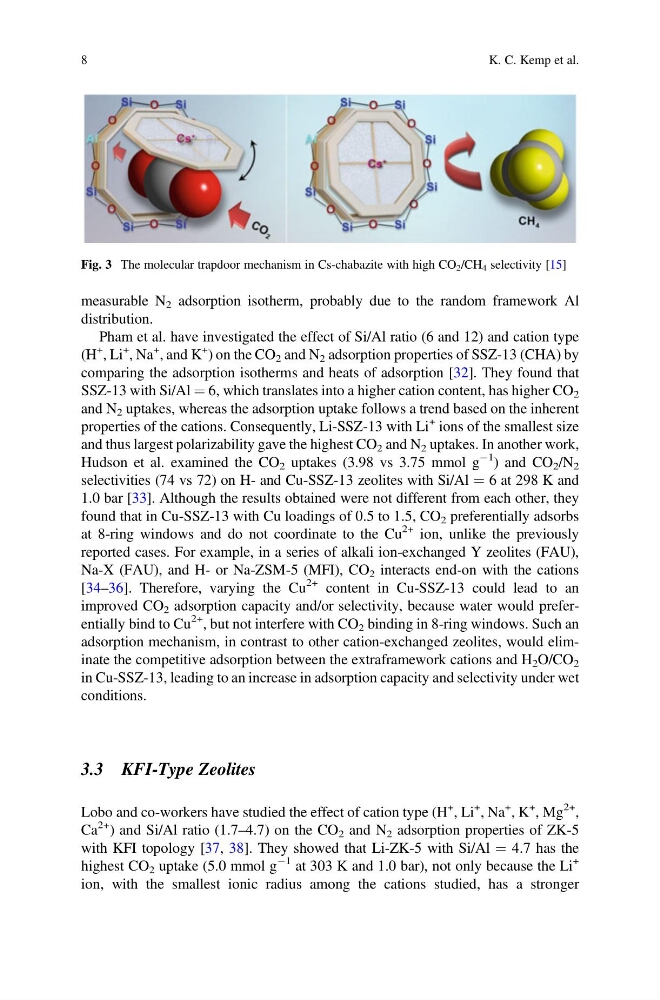
Fig. 3 The molecular trapdoor mechanism in Cs-chabazite with high CO 2 /CH 4 selectivity [15]
8
K. C. Kemp et al.
distribution.
Pham et al. have investigated the effect of Si/Al ratio (6 and 12) and cation type
(H
+ , Li
+
, Na
+
, and K
+
) on the CO 2 and N 2 adsorption properties of SSZ-13 (CHA) by
comparing the adsorption isotherms and heats of adsorption [32]. They found that
SSZ-13 with Si/Al ¼ 6, which translates into a higher cation content, has higher CO 2
and N 2 uptakes, whereas the adsorption uptake follows a trend based on the inherent
properties of the cations. Consequently, Li-SSZ-13 with Li
+ ions of the smallest size
and thus largest polarizability gave the highest CO 2 and N 2 uptakes. In another work,
Hudson et al. examined the CO 2 uptakes (3.98 vs 3.75 mmol g
À1 ) and CO 2 /N 2
selectivities (74 vs 72) on H- and Cu-SSZ-13 zeolites with Si/Al ¼ 6 at 298 K and
1.0 bar [33]. Although the results obtained were not different from each other, they
found that in Cu-SSZ-13 with Cu loadings of 0.5 to 1.5, CO 2 preferentially adsorbs
at 8-ring windows and do not coordinate to the Cu
2+ ion, unlike the previously
reported cases. For example, in a series of alkali ion-exchanged Y zeolites (FAU),
Na-X (FAU), and H- or Na-ZSM-5 (MFI), CO 2 interacts end-on with the cations
[34–36]. Therefore, varying the Cu
2+ content in Cu-SSZ-13 could lead to an
improved CO 2 adsorption capacity and/or selectivity, because water would preferentially bind to Cu
2+ , but not interfere with CO 2 binding in 8-ring windows. Such an
adsorption mechanism, in contrast to other cation-exchanged zeolites, would eliminate the competitive adsorption between the extraframework cations and H 2 O/CO 2
in Cu-SSZ-13, leading to an increase in adsorption capacity and selectivity under wet
conditions.
3.3 KFI-Type Zeolites
Lobo and co-workers have studied the effect of cation type (H
+
, Li
+ , Na
+ , K
+ , Mg
2+ ,
Ca
2+ ) and Si/Al ratio (1.7–4.7) on the CO 2 and N 2 adsorption properties of ZK-5
with KFI topology [37, 38]. They showed that Li-ZK-5 with Si/Al ¼ 4.7 has the
highest CO 2 uptake (5.0 mmol g
À1 at 303 K and 1.0 bar), not only because the Li
+
ion, with the smallest ionic radius among the cations studied, has a stronger
Fig. 3 The molecular trapdoor mechanism in Cs-chabazite with high CO 2 /CH 4 selectivity [15]
8
K. C. Kemp et al.