

co-workers used zeolite 4A extrudates to reach propylene with high purity (99%)
with a high recovery of 85% from a C 3 ’s mixture by VPSA; the proposed cycle
comprised five steps [46]. More recently, they proposed another five-step VPSA
cycle on a commercial zeolite 4A to obtain also polymer-grade propylene with a
recovery of 67% [52]. To enhance the recovery, they proposed a dual VPSA
concept, although the high energy consumption remains an unsolved problem.
Indeed, few studies were performed, targeting the reduction of energy consumption.
Furthermore, propylene with 92% purity and 29% recovery was produced on
another study with a four-bed/eight-step VPSA cycle on zeolite 5A [64]. A low
energy consumption seven-step PVSA cycle was developed, based on zeolite 4A as
adsorbent, to produce high-purity (>99.5 wt %), high-recovery (>99%) propylene,
yet the initial feed mixture was already rich in propylene, i.e., 84.4/15.6 propylene/
propane (wt %) feed mixture [66].
Cavenati and co-workers tested a Skarstrom-type cycle to separate 0.60CH 4 /
0.20CO 2 /0.20N 2 using zeolite 13X in a single-column VSA-PSA unit, and the
CO 2 was removed to levels lower than 2% as required by fuel-grade methane,
with a methane recovery of 80.3%. A five-step cycle was simulated, suggesting
that 90% of methane can be recovered, improving the process [48]. Campo et al.
proposed a VSA cycle for CH 4 upgrading from contaminated natural gas. A fourstep VSA cycle was implemented using an improved zeolite 13X to separate a
stream with a composition of 0.60CH 4 /0.20CO 2 /0.20N 2 . Methane was obtained
with a high purity of 74%, a high recovery of 96%, and a productivity of 2.5
mol CH4 Áh
À1
Ákg
À1 [49]. More recently, Moreira et al. designed and simulated a new
industrial-scale pressure and temperature swing adsorption process at low temperature (Cryo-PTSA) to obtain almost pure methane and maximizing the methane
recovery, using binderless zeolite 13X as adsorbent. A CH 4 recovery of 90.7%
and a product stream with 41.8 ppm of CO 2 in methane were attained, with CH 4
productivity of 100.1 mol kg ads
À1 h
À1 [29].
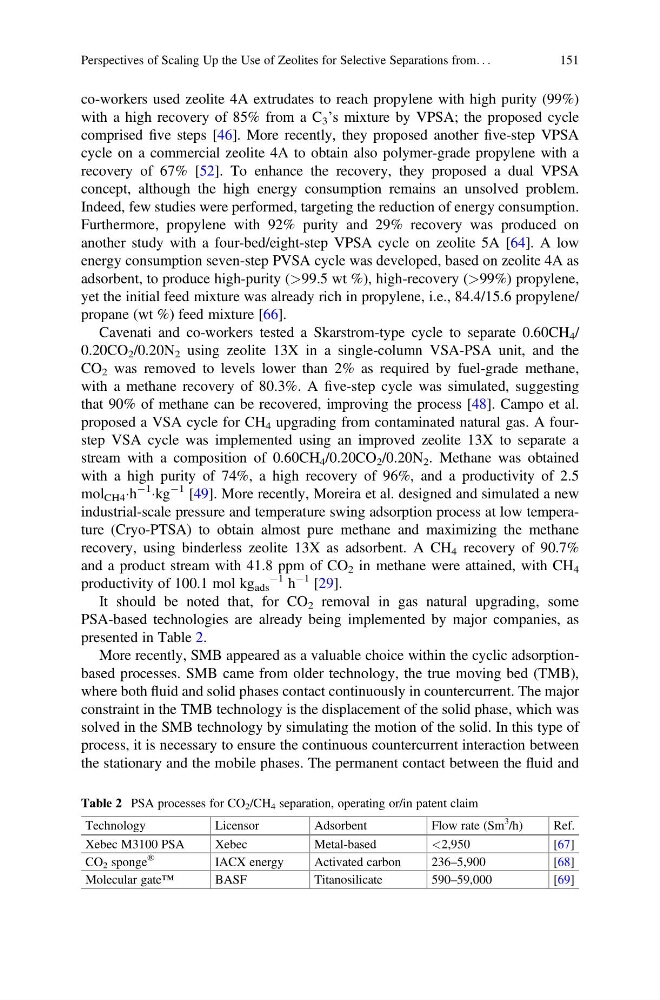
It should be noted that, for CO 2 removal in gas natural upgrading, some
PSA-based technologies are already being implemented by major companies, as
presented in Table 2.
More recently, SMB appeared as a valuable choice within the cyclic adsorptionbased processes. SMB came from older technology, the true moving bed (TMB),
where both fluid and solid phases contact continuously in countercurrent. The major
constraint in the TMB technology is the displacement of the solid phase, which was
solved in the SMB technology by simulating the motion of the solid. In this type of
process, it is necessary to ensure the continuous countercurrent interaction between
the stationary and the mobile phases. The permanent contact between the fluid and
Table 2 PSA processes for CO 2 /CH 4 separation, operating or/in patent claim
Technology
Licensor
Adsorbent
Flow rate (Sm
3
/h)
Ref.
Xebec M3100 PSA
Xebec
Metal-based
<2,950
[67]
CO 2 sponge
®
IACX energy
Activated carbon
236–5,900
[68]
Molecular gate™
BASF
Titanosilicate
590–59,000
[69]
Perspectives of Scaling Up the Use of Zeolites for Selective Separations from. . .
151
with a high recovery of 85% from a C 3 ’s mixture by VPSA; the proposed cycle
comprised five steps [46]. More recently, they proposed another five-step VPSA
cycle on a commercial zeolite 4A to obtain also polymer-grade propylene with a
recovery of 67% [52]. To enhance the recovery, they proposed a dual VPSA
concept, although the high energy consumption remains an unsolved problem.
Indeed, few studies were performed, targeting the reduction of energy consumption.
Furthermore, propylene with 92% purity and 29% recovery was produced on
another study with a four-bed/eight-step VPSA cycle on zeolite 5A [64]. A low
energy consumption seven-step PVSA cycle was developed, based on zeolite 4A as
adsorbent, to produce high-purity (>99.5 wt %), high-recovery (>99%) propylene,
yet the initial feed mixture was already rich in propylene, i.e., 84.4/15.6 propylene/
propane (wt %) feed mixture [66].
Cavenati and co-workers tested a Skarstrom-type cycle to separate 0.60CH 4 /
0.20CO 2 /0.20N 2 using zeolite 13X in a single-column VSA-PSA unit, and the
CO 2 was removed to levels lower than 2% as required by fuel-grade methane,
with a methane recovery of 80.3%. A five-step cycle was simulated, suggesting
that 90% of methane can be recovered, improving the process [48]. Campo et al.
proposed a VSA cycle for CH 4 upgrading from contaminated natural gas. A fourstep VSA cycle was implemented using an improved zeolite 13X to separate a
stream with a composition of 0.60CH 4 /0.20CO 2 /0.20N 2 . Methane was obtained
with a high purity of 74%, a high recovery of 96%, and a productivity of 2.5
mol CH4 Áh
À1
Ákg
À1 [49]. More recently, Moreira et al. designed and simulated a new
industrial-scale pressure and temperature swing adsorption process at low temperature (Cryo-PTSA) to obtain almost pure methane and maximizing the methane
recovery, using binderless zeolite 13X as adsorbent. A CH 4 recovery of 90.7%
and a product stream with 41.8 ppm of CO 2 in methane were attained, with CH 4
productivity of 100.1 mol kg ads
À1 h
À1 [29].
It should be noted that, for CO 2 removal in gas natural upgrading, some
PSA-based technologies are already being implemented by major companies, as
presented in Table 2.
More recently, SMB appeared as a valuable choice within the cyclic adsorptionbased processes. SMB came from older technology, the true moving bed (TMB),
where both fluid and solid phases contact continuously in countercurrent. The major
constraint in the TMB technology is the displacement of the solid phase, which was
solved in the SMB technology by simulating the motion of the solid. In this type of
process, it is necessary to ensure the continuous countercurrent interaction between
the stationary and the mobile phases. The permanent contact between the fluid and
Table 2 PSA processes for CO 2 /CH 4 separation, operating or/in patent claim
Technology
Licensor
Adsorbent
Flow rate (Sm
3
/h)
Ref.
Xebec M3100 PSA
Xebec
Metal-based
<2,950
[67]
CO 2 sponge
®
IACX energy
Activated carbon
236–5,900
[68]
Molecular gate™
BASF
Titanosilicate
590–59,000
[69]
Perspectives of Scaling Up the Use of Zeolites for Selective Separations from. . .
151