

Initially the stream containing the carrier gas and the adsorbate is sent to the
sample. The standard ZLC experiments allow the sample to reach equilibrium, and
after this, the valves are switched, and the pure carrier stream is sent to the sample.
The concentration at the outlet is recorded as a function of time, and a mass transport
model is used to extract the kinetic time constant from the data.
In principle the experiment can be run also in adsorption mode, i.e. starting from
pure carrier and switching to carrier and adsorbate. The reason for which the
desorption experiment is used as standard lies in the fact that most of the kinetic
information is in the final tail of the signal, and in desorption mode, there are two
main advantages compared to the adsorption experiment: the signal-to-noise ratio is
much higher since the baseline is being subtracted and not a large signal; in
desorption mode, the final tail will always be in the linear region of the adsorption
isotherm, and this simplifies the model to be used in the analysis.
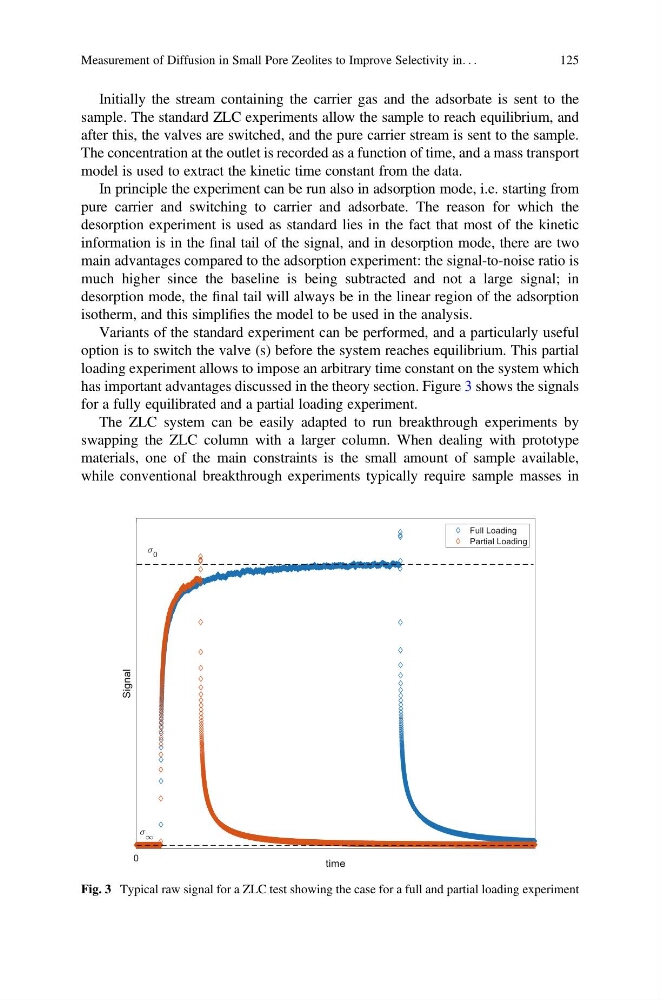
Variants of the standard experiment can be performed, and a particularly useful
option is to switch the valve (s) before the system reaches equilibrium. This partial
loading experiment allows to impose an arbitrary time constant on the system which
has important advantages discussed in the theory section. Figure 3 shows the signals
for a fully equilibrated and a partial loading experiment.
The ZLC system can be easily adapted to run breakthrough experiments by
swapping the ZLC column with a larger column. When dealing with prototype
materials, one of the main constraints is the small amount of sample available,
while conventional breakthrough experiments typically require sample masses in
Fig. 3 Typical raw signal for a ZLC test showing the case for a full and partial loading experiment
Measurement of Diffusion in Small Pore Zeolites to Improve Selectivity in. . .
125
sample. The standard ZLC experiments allow the sample to reach equilibrium, and
after this, the valves are switched, and the pure carrier stream is sent to the sample.
The concentration at the outlet is recorded as a function of time, and a mass transport
model is used to extract the kinetic time constant from the data.
In principle the experiment can be run also in adsorption mode, i.e. starting from
pure carrier and switching to carrier and adsorbate. The reason for which the
desorption experiment is used as standard lies in the fact that most of the kinetic
information is in the final tail of the signal, and in desorption mode, there are two
main advantages compared to the adsorption experiment: the signal-to-noise ratio is
much higher since the baseline is being subtracted and not a large signal; in
desorption mode, the final tail will always be in the linear region of the adsorption
isotherm, and this simplifies the model to be used in the analysis.
Variants of the standard experiment can be performed, and a particularly useful
option is to switch the valve (s) before the system reaches equilibrium. This partial
loading experiment allows to impose an arbitrary time constant on the system which
has important advantages discussed in the theory section. Figure 3 shows the signals
for a fully equilibrated and a partial loading experiment.
The ZLC system can be easily adapted to run breakthrough experiments by
swapping the ZLC column with a larger column. When dealing with prototype
materials, one of the main constraints is the small amount of sample available,
while conventional breakthrough experiments typically require sample masses in
Fig. 3 Typical raw signal for a ZLC test showing the case for a full and partial loading experiment
Measurement of Diffusion in Small Pore Zeolites to Improve Selectivity in. . .
125