

are inevitably present in an adsorptive system. Adsorption is an exothermic process;
therefore one of the main issues is to mitigate or eliminate heat effects during the
process, making it as close as possible to isothermal. Of the different techniques,
chromatographic methods offer the advantage of having gas flowing through the
sample. If the sample mass is minimized, then the actual column casing, typically
metal, acts as a further large thermal mass, thus leading to near isothermal conditions. Columns packed with very small amounts of adsorbent are effectively zero
length columns (ZLCs) [4]. The focus of this contribution will be to review the basic
theory of the ZLC technique and discuss some of the practical aspects of the
experiment and demonstrate its use to measure diffusion of CO 2 in small pore
zeolites.
2 The ZLC Technique: Description of the Experiment
The ZLC experiment is a chromatographic flow experiment where the sample is
exposed to different concentrations of adsorbate. There are different configurations
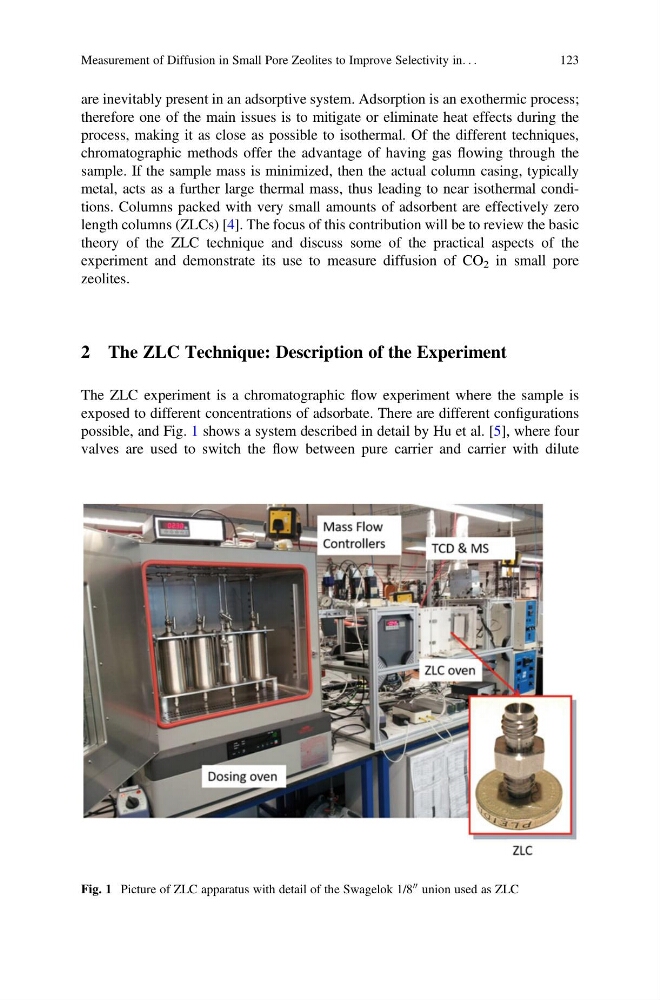
possible, and Fig. 1 shows a system described in detail by Hu et al. [5], where four
valves are used to switch the flow between pure carrier and carrier with dilute
Fig. 1 Picture of ZLC apparatus with detail of the Swagelok 1/8
00 union used as ZLC
Measurement of Diffusion in Small Pore Zeolites to Improve Selectivity in. . .
123
therefore one of the main issues is to mitigate or eliminate heat effects during the
process, making it as close as possible to isothermal. Of the different techniques,
chromatographic methods offer the advantage of having gas flowing through the
sample. If the sample mass is minimized, then the actual column casing, typically
metal, acts as a further large thermal mass, thus leading to near isothermal conditions. Columns packed with very small amounts of adsorbent are effectively zero
length columns (ZLCs) [4]. The focus of this contribution will be to review the basic
theory of the ZLC technique and discuss some of the practical aspects of the
experiment and demonstrate its use to measure diffusion of CO 2 in small pore
zeolites.
2 The ZLC Technique: Description of the Experiment
The ZLC experiment is a chromatographic flow experiment where the sample is
exposed to different concentrations of adsorbate. There are different configurations
possible, and Fig. 1 shows a system described in detail by Hu et al. [5], where four
valves are used to switch the flow between pure carrier and carrier with dilute
Fig. 1 Picture of ZLC apparatus with detail of the Swagelok 1/8
00 union used as ZLC
Measurement of Diffusion in Small Pore Zeolites to Improve Selectivity in. . .
123