

opposite relationship was obtained: the highest self-diffusion coefficients were
obtained for the larger cations Li, K, and Mg.
Via molecular simulations, the effect of molecular clustering of alcohols and
water on their diffusion properties in all-silica LTA was investigated by Krishna and
Van Baten [128]. Due to water-water hydrogen bonding, non-Arrhenius-type behavior was observed for the self-diffusion coefficient as a function of temperature.
Furthermore, in the case of alcohol/water mixtures, both the self-diffusion of the
alcohol and water are lowered due to cluster formation. These results are similar to
those observed by the same authors in other zeolite frameworks, such as ZSM-5 and
silicalite-1 (vide supra).
3.4 Separation of ABE Mixtures on ITQ-29 and CHA
Zeolites
The separation of biobutanol form ABE vapor mixtures was studied by Van der
Perre et al. by means of breakthrough experiments with columns packed with
all-silica zeolites with LTA (ITQ-29) and CHA topologies [59]. The breakthrough
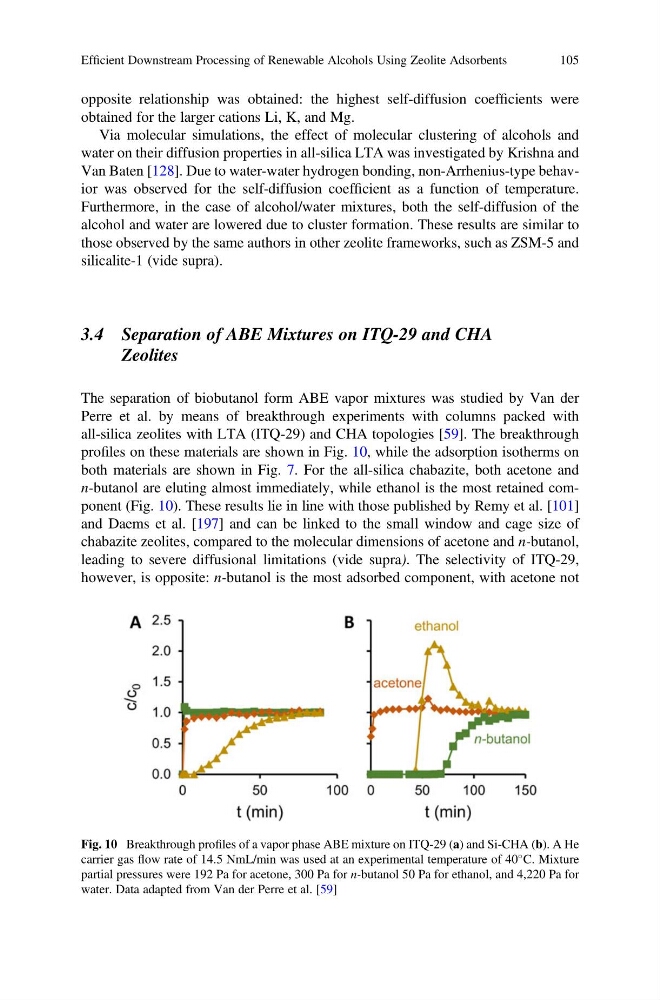
profiles on these materials are shown in Fig. 10, while the adsorption isotherms on
both materials are shown in Fig. 7. For the all-silica chabazite, both acetone and
n-butanol are eluting almost immediately, while ethanol is the most retained component (Fig. 10). These results lie in line with those published by Remy et al. [101]
and Daems et al. [197] and can be linked to the small window and cage size of
chabazite zeolites, compared to the molecular dimensions of acetone and n-butanol,
leading to severe diffusional limitations (vide supra). The selectivity of ITQ-29,
however, is opposite: n-butanol is the most adsorbed component, with acetone not
Fig. 10 Breakthrough profiles of a vapor phase ABE mixture on ITQ-29 (a) and Si-CHA (b). A He
carrier gas flow rate of 14.5 NmL/min was used at an experimental temperature of 40
C. Mixture
partial pressures were 192 Pa for acetone, 300 Pa for n-butanol 50 Pa for ethanol, and 4,220 Pa for
water. Data adapted from Van der Perre et al. [59]
Efficient Downstream Processing of Renewable Alcohols Using Zeolite Adsorbents
105
obtained for the larger cations Li, K, and Mg.
Via molecular simulations, the effect of molecular clustering of alcohols and
water on their diffusion properties in all-silica LTA was investigated by Krishna and
Van Baten [128]. Due to water-water hydrogen bonding, non-Arrhenius-type behavior was observed for the self-diffusion coefficient as a function of temperature.
Furthermore, in the case of alcohol/water mixtures, both the self-diffusion of the
alcohol and water are lowered due to cluster formation. These results are similar to
those observed by the same authors in other zeolite frameworks, such as ZSM-5 and
silicalite-1 (vide supra).
3.4 Separation of ABE Mixtures on ITQ-29 and CHA
Zeolites
The separation of biobutanol form ABE vapor mixtures was studied by Van der
Perre et al. by means of breakthrough experiments with columns packed with
all-silica zeolites with LTA (ITQ-29) and CHA topologies [59]. The breakthrough
profiles on these materials are shown in Fig. 10, while the adsorption isotherms on
both materials are shown in Fig. 7. For the all-silica chabazite, both acetone and
n-butanol are eluting almost immediately, while ethanol is the most retained component (Fig. 10). These results lie in line with those published by Remy et al. [101]
and Daems et al. [197] and can be linked to the small window and cage size of
chabazite zeolites, compared to the molecular dimensions of acetone and n-butanol,
leading to severe diffusional limitations (vide supra). The selectivity of ITQ-29,
however, is opposite: n-butanol is the most adsorbed component, with acetone not
Fig. 10 Breakthrough profiles of a vapor phase ABE mixture on ITQ-29 (a) and Si-CHA (b). A He
carrier gas flow rate of 14.5 NmL/min was used at an experimental temperature of 40
C. Mixture
partial pressures were 192 Pa for acetone, 300 Pa for n-butanol 50 Pa for ethanol, and 4,220 Pa for
water. Data adapted from Van der Perre et al. [59]
Efficient Downstream Processing of Renewable Alcohols Using Zeolite Adsorbents
105