

3 Cage-and-Window-Type Zeolites: LTA and CHA
3.1 Framework Structure
Besides channel-type zeolites, such as ZSM-5, the adsorption of alcohols on cageand-window-type zeolites, such as CHA and LTA zeolites, has gained considerable
interest in recent years [57, 59, 101, 102, 180–185]. The pore geometry of these
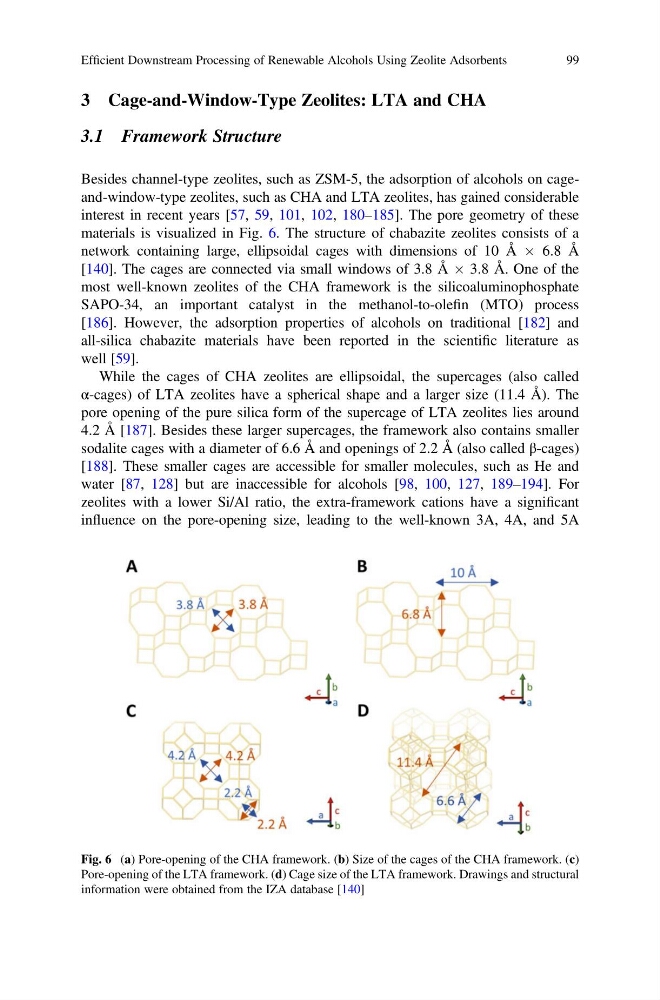
materials is visualized in Fig. 6. The structure of chabazite zeolites consists of a
network containing large, ellipsoidal cages with dimensions of 10 Å Â 6.8 Å
[140]. The cages are connected via small windows of 3.8 Å Â 3.8 Å. One of the
most well-known zeolites of the CHA framework is the silicoaluminophosphate
SAPO-34, an important catalyst in the methanol-to-olefin (MTO) process
[186]. However, the adsorption properties of alcohols on traditional [182] and
all-silica chabazite materials have been reported in the scientific literature as
well [59].
While the cages of CHA zeolites are ellipsoidal, the supercages (also called
α-cages) of LTA zeolites have a spherical shape and a larger size (11.4 Å). The
pore opening of the pure silica form of the supercage of LTA zeolites lies around
4.2 Å [187]. Besides these larger supercages, the framework also contains smaller
sodalite cages with a diameter of 6.6 Å and openings of 2.2 Å (also called β-cages)
[188]. These smaller cages are accessible for smaller molecules, such as He and
water [87, 128] but are inaccessible for alcohols [98, 100, 127, 189–194]. For
zeolites with a lower Si/Al ratio, the extra-framework cations have a significant
influence on the pore-opening size, leading to the well-known 3A, 4A, and 5A
Fig. 6 (a) Pore-opening of the CHA framework. (b) Size of the cages of the CHA framework. (c)
Pore-opening of the LTA framework. (d) Cage size of the LTA framework. Drawings and structural
information were obtained from the IZA database [140]
Efficient Downstream Processing of Renewable Alcohols Using Zeolite Adsorbents
99
3.1 Framework Structure
Besides channel-type zeolites, such as ZSM-5, the adsorption of alcohols on cageand-window-type zeolites, such as CHA and LTA zeolites, has gained considerable
interest in recent years [57, 59, 101, 102, 180–185]. The pore geometry of these
materials is visualized in Fig. 6. The structure of chabazite zeolites consists of a
network containing large, ellipsoidal cages with dimensions of 10 Å Â 6.8 Å
[140]. The cages are connected via small windows of 3.8 Å Â 3.8 Å. One of the
most well-known zeolites of the CHA framework is the silicoaluminophosphate
SAPO-34, an important catalyst in the methanol-to-olefin (MTO) process
[186]. However, the adsorption properties of alcohols on traditional [182] and
all-silica chabazite materials have been reported in the scientific literature as
well [59].
While the cages of CHA zeolites are ellipsoidal, the supercages (also called
α-cages) of LTA zeolites have a spherical shape and a larger size (11.4 Å). The
pore opening of the pure silica form of the supercage of LTA zeolites lies around
4.2 Å [187]. Besides these larger supercages, the framework also contains smaller
sodalite cages with a diameter of 6.6 Å and openings of 2.2 Å (also called β-cages)
[188]. These smaller cages are accessible for smaller molecules, such as He and
water [87, 128] but are inaccessible for alcohols [98, 100, 127, 189–194]. For
zeolites with a lower Si/Al ratio, the extra-framework cations have a significant
influence on the pore-opening size, leading to the well-known 3A, 4A, and 5A
Fig. 6 (a) Pore-opening of the CHA framework. (b) Size of the cages of the CHA framework. (c)
Pore-opening of the LTA framework. (d) Cage size of the LTA framework. Drawings and structural
information were obtained from the IZA database [140]
Efficient Downstream Processing of Renewable Alcohols Using Zeolite Adsorbents
99