

zeolites are less-suited for the adsorptive recovery of isobutanol, compared to
n-butanol.
2.3 The Adsorption of Water: Si/Al Ratio, Cations, Defects,
and Co-adsorption
Water is the main component in a fermentation broth. Therefore, in this section, the
adsorption of water and its effect on the adsorption of alcohols on zeolites are
discussed, including also the role of material properties, such as the alumina content
and extra-framework cations. A detailed experimental study of water adsorption on
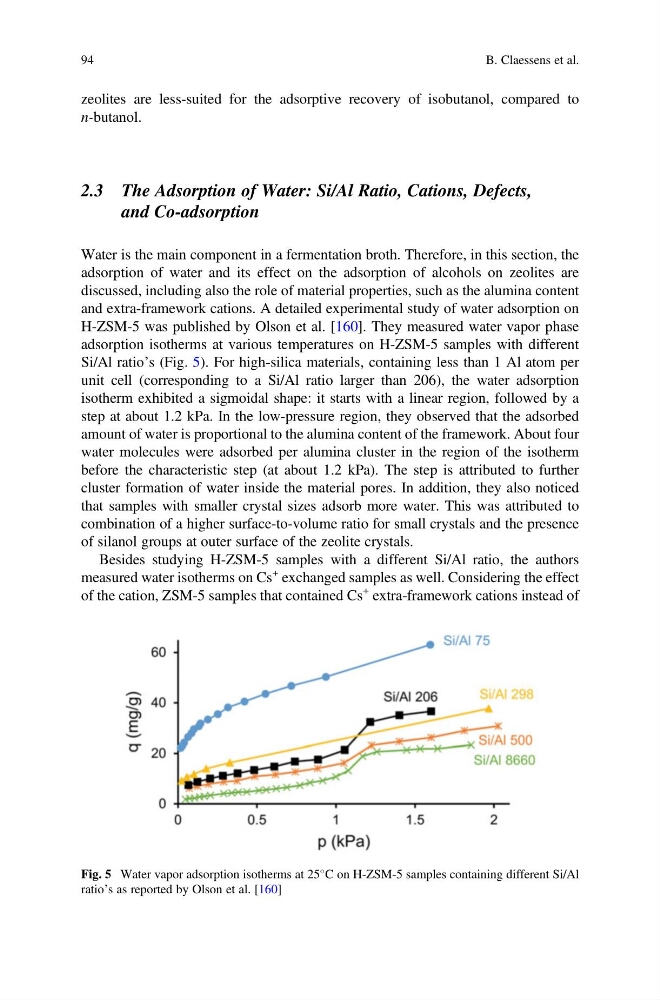
H-ZSM-5 was published by Olson et al. [160]. They measured water vapor phase
adsorption isotherms at various temperatures on H-ZSM-5 samples with different
Si/Al ratio’s (Fig. 5). For high-silica materials, containing less than 1 Al atom per
unit cell (corresponding to a Si/Al ratio larger than 206), the water adsorption
isotherm exhibited a sigmoidal shape: it starts with a linear region, followed by a
step at about 1.2 kPa. In the low-pressure region, they observed that the adsorbed
amount of water is proportional to the alumina content of the framework. About four
water molecules were adsorbed per alumina cluster in the region of the isotherm
before the characteristic step (at about 1.2 kPa). The step is attributed to further
cluster formation of water inside the material pores. In addition, they also noticed
that samples with smaller crystal sizes adsorb more water. This was attributed to
combination of a higher surface-to-volume ratio for small crystals and the presence
of silanol groups at outer surface of the zeolite crystals.
Besides studying H-ZSM-5 samples with a different Si/Al ratio, the authors
measured water isotherms on Cs
+ exchanged samples as well. Considering the effect
of the cation, ZSM-5 samples that contained Cs
+ extra-framework cations instead of
Fig. 5 Water vapor adsorption isotherms at 25
C on H-ZSM-5 samples containing different Si/Al
ratio’s as reported by Olson et al. [160]
94
B. Claessens et al.
n-butanol.
2.3 The Adsorption of Water: Si/Al Ratio, Cations, Defects,
and Co-adsorption
Water is the main component in a fermentation broth. Therefore, in this section, the
adsorption of water and its effect on the adsorption of alcohols on zeolites are
discussed, including also the role of material properties, such as the alumina content
and extra-framework cations. A detailed experimental study of water adsorption on
H-ZSM-5 was published by Olson et al. [160]. They measured water vapor phase
adsorption isotherms at various temperatures on H-ZSM-5 samples with different
Si/Al ratio’s (Fig. 5). For high-silica materials, containing less than 1 Al atom per
unit cell (corresponding to a Si/Al ratio larger than 206), the water adsorption
isotherm exhibited a sigmoidal shape: it starts with a linear region, followed by a
step at about 1.2 kPa. In the low-pressure region, they observed that the adsorbed
amount of water is proportional to the alumina content of the framework. About four
water molecules were adsorbed per alumina cluster in the region of the isotherm
before the characteristic step (at about 1.2 kPa). The step is attributed to further
cluster formation of water inside the material pores. In addition, they also noticed
that samples with smaller crystal sizes adsorb more water. This was attributed to
combination of a higher surface-to-volume ratio for small crystals and the presence
of silanol groups at outer surface of the zeolite crystals.
Besides studying H-ZSM-5 samples with a different Si/Al ratio, the authors
measured water isotherms on Cs
+ exchanged samples as well. Considering the effect
of the cation, ZSM-5 samples that contained Cs
+ extra-framework cations instead of
Fig. 5 Water vapor adsorption isotherms at 25
C on H-ZSM-5 samples containing different Si/Al
ratio’s as reported by Olson et al. [160]
94
B. Claessens et al.