

3 Bio-nanotechnology Application in Wastewater Treatment
45
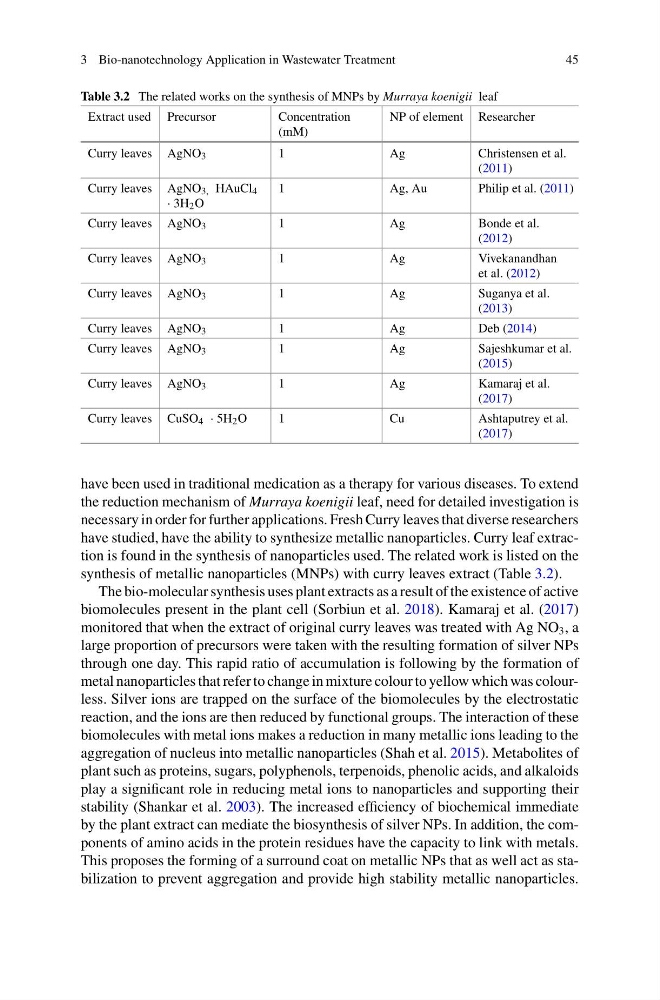
Table 3.2 The related works on the synthesis of MNPs by Murraya koenigii leaf
Extract used Precursor
Concentration
(mM)
NP of element Researcher
Curry leaves AgNO 3
1
Ag
Christensen et al.
(2011)
Curry leaves AgNO 3, HAuCl 4
· 3H 2 O
1
Ag, Au
Philip et al. (2011)
Curry leaves AgNO 3
1
Ag
Bonde et al.
(2012)
Curry leaves AgNO 3
1
Ag
Vivekanandhan
et al. (2012)
Curry leaves AgNO 3
1
Ag
Suganya et al.
(2013)
Curry leaves AgNO 3
1
Ag
Deb (2014)
Curry leaves AgNO 3
1
Ag
Sajeshkumar et al.
(2015)
Curry leaves AgNO 3
1
Ag
Kamaraj et al.
(2017)
Curry leaves CuSO 4 · 5H 2 O
1
Cu
Ashtaputrey et al.
(2017)
have been used in traditional medication as a therapy for various diseases. To extend
the reduction mechanism of Murraya koenigii leaf, need for detailed investigation is
necessary in order for further applications. Fresh Curry leaves that diverse researchers
have studied, have the ability to synthesize metallic nanoparticles. Curry leaf extraction is found in the synthesis of nanoparticles used. The related work is listed on the
synthesis of metallic nanoparticles (MNPs) with curry leaves extract (Table 3.2).
The bio-molecular synthesis uses plant extracts as a result of the existence of active
biomolecules present in the plant cell (Sorbiun et al. 2018). Kamaraj et al. (2017)
monitored that when the extract of original curry leaves was treated with Ag NO 3 , a
large proportion of precursors were taken with the resulting formation of silver NPs
through one day. This rapid ratio of accumulation is following by the formation of
metal nanoparticles that refer to change in mixture colour to yellow which was colourless. Silver ions are trapped on the surface of the biomolecules by the electrostatic
reaction, and the ions are then reduced by functional groups. The interaction of these
biomolecules with metal ions makes a reduction in many metallic ions leading to the
aggregation of nucleus into metallic nanoparticles (Shah et al. 2015). Metabolites of
plant such as proteins, sugars, polyphenols, terpenoids, phenolic acids, and alkaloids
play a significant role in reducing metal ions to nanoparticles and supporting their
stability (Shankar et al. 2003). The increased efficiency of biochemical immediate
by the plant extract can mediate the biosynthesis of silver NPs. In addition, the components of amino acids in the protein residues have the capacity to link with metals.
This proposes the forming of a surround coat on metallic NPs that as well act as stabilization to prevent aggregation and provide high stability metallic nanoparticles.
45
Table 3.2 The related works on the synthesis of MNPs by Murraya koenigii leaf
Extract used Precursor
Concentration
(mM)
NP of element Researcher
Curry leaves AgNO 3
1
Ag
Christensen et al.
(2011)
Curry leaves AgNO 3, HAuCl 4
· 3H 2 O
1
Ag, Au
Philip et al. (2011)
Curry leaves AgNO 3
1
Ag
Bonde et al.
(2012)
Curry leaves AgNO 3
1
Ag
Vivekanandhan
et al. (2012)
Curry leaves AgNO 3
1
Ag
Suganya et al.
(2013)
Curry leaves AgNO 3
1
Ag
Deb (2014)
Curry leaves AgNO 3
1
Ag
Sajeshkumar et al.
(2015)
Curry leaves AgNO 3
1
Ag
Kamaraj et al.
(2017)
Curry leaves CuSO 4 · 5H 2 O
1
Cu
Ashtaputrey et al.
(2017)
have been used in traditional medication as a therapy for various diseases. To extend
the reduction mechanism of Murraya koenigii leaf, need for detailed investigation is
necessary in order for further applications. Fresh Curry leaves that diverse researchers
have studied, have the ability to synthesize metallic nanoparticles. Curry leaf extraction is found in the synthesis of nanoparticles used. The related work is listed on the
synthesis of metallic nanoparticles (MNPs) with curry leaves extract (Table 3.2).
The bio-molecular synthesis uses plant extracts as a result of the existence of active
biomolecules present in the plant cell (Sorbiun et al. 2018). Kamaraj et al. (2017)
monitored that when the extract of original curry leaves was treated with Ag NO 3 , a
large proportion of precursors were taken with the resulting formation of silver NPs
through one day. This rapid ratio of accumulation is following by the formation of
metal nanoparticles that refer to change in mixture colour to yellow which was colourless. Silver ions are trapped on the surface of the biomolecules by the electrostatic
reaction, and the ions are then reduced by functional groups. The interaction of these
biomolecules with metal ions makes a reduction in many metallic ions leading to the
aggregation of nucleus into metallic nanoparticles (Shah et al. 2015). Metabolites of
plant such as proteins, sugars, polyphenols, terpenoids, phenolic acids, and alkaloids
play a significant role in reducing metal ions to nanoparticles and supporting their
stability (Shankar et al. 2003). The increased efficiency of biochemical immediate
by the plant extract can mediate the biosynthesis of silver NPs. In addition, the components of amino acids in the protein residues have the capacity to link with metals.
This proposes the forming of a surround coat on metallic NPs that as well act as stabilization to prevent aggregation and provide high stability metallic nanoparticles.