

168
E. Noman et al.
the term of reusable or recyclable is used to define the solid materials which might be
reused or recycle. Based on this definition the sharps, cotton, and medical devices are
defined as a recyclable materials, while blood, body parts, chemicals, pharmaceuticals, and radioactive materials are wastes. In other meaning, it has to be mentioned
that not all the wastes generated from the hospital are classified as clinical wastes.
According to the Controlled Waste Regulations 1992 (S1588), the clinical wastes
are defined as any waste with human or animal tissue, excretions, blood as well as
body fluids, excretions, swabs, syringes, and needles. These wastes are generated
from the medical, dental, nursing, veterinary pharmaceutical or similar practice,
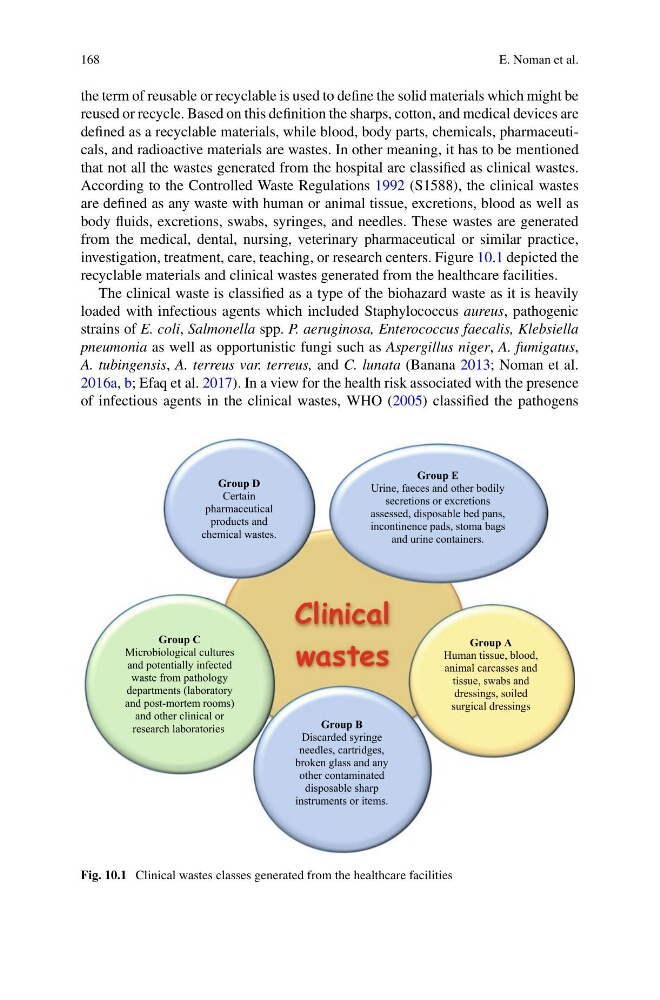
investigation, treatment, care, teaching, or research centers. Figure 10.1 depicted the
recyclable materials and clinical wastes generated from the healthcare facilities.
The clinical waste is classified as a type of the biohazard waste as it is heavily
loaded with infectious agents which included Staphylococcus aureus, pathogenic
strains of E. coli, Salmonella spp. P. aeruginosa, Enterococcus faecalis, Klebsiella
pneumonia as well as opportunistic fungi such as Aspergillus niger, A. fumigatus,
A. tubingensis, A. terreus var. terreus, and C. lunata (Banana 2013; Noman et al.
2016a, b; Efaq et al. 2017). In a view for the health risk associated with the presence
of infectious agents in the clinical wastes, WHO (2005) classified the pathogens
Group C
Microbiological cultures
and potentially infected
waste from pathology
departments (laboratory
and post-mortem rooms)
and other clinical or
research laboratories.
Group A
Human tissue, blood,
animal carcasses and
tissue, swabs and
dressings, soiled
surgical dressings
Group B
Discarded syringe
needles, cartridges,
broken glass and any
other contaminated
disposable sharp
instruments or items.
Group E
Urine, faeces and other bodily
secretions or excretions
assessed, disposable bed pans,
incontinence pads, stoma bags
and urine containers.
Group D
Certain
pharmaceutical
products and
chemical wastes.
Fig. 10.1 Clinical wastes classes generated from the healthcare facilities
E. Noman et al.
the term of reusable or recyclable is used to define the solid materials which might be
reused or recycle. Based on this definition the sharps, cotton, and medical devices are
defined as a recyclable materials, while blood, body parts, chemicals, pharmaceuticals, and radioactive materials are wastes. In other meaning, it has to be mentioned
that not all the wastes generated from the hospital are classified as clinical wastes.
According to the Controlled Waste Regulations 1992 (S1588), the clinical wastes
are defined as any waste with human or animal tissue, excretions, blood as well as
body fluids, excretions, swabs, syringes, and needles. These wastes are generated
from the medical, dental, nursing, veterinary pharmaceutical or similar practice,
investigation, treatment, care, teaching, or research centers. Figure 10.1 depicted the
recyclable materials and clinical wastes generated from the healthcare facilities.
The clinical waste is classified as a type of the biohazard waste as it is heavily
loaded with infectious agents which included Staphylococcus aureus, pathogenic
strains of E. coli, Salmonella spp. P. aeruginosa, Enterococcus faecalis, Klebsiella
pneumonia as well as opportunistic fungi such as Aspergillus niger, A. fumigatus,
A. tubingensis, A. terreus var. terreus, and C. lunata (Banana 2013; Noman et al.
2016a, b; Efaq et al. 2017). In a view for the health risk associated with the presence
of infectious agents in the clinical wastes, WHO (2005) classified the pathogens
Group C
Microbiological cultures
and potentially infected
waste from pathology
departments (laboratory
and post-mortem rooms)
and other clinical or
research laboratories.
Group A
Human tissue, blood,
animal carcasses and
tissue, swabs and
dressings, soiled
surgical dressings
Group B
Discarded syringe
needles, cartridges,
broken glass and any
other contaminated
disposable sharp
instruments or items.
Group E
Urine, faeces and other bodily
secretions or excretions
assessed, disposable bed pans,
incontinence pads, stoma bags
and urine containers.
Group D
Certain
pharmaceutical
products and
chemical wastes.
Fig. 10.1 Clinical wastes classes generated from the healthcare facilities