

9 Struvite Crystallization: An Effective Technology …
145
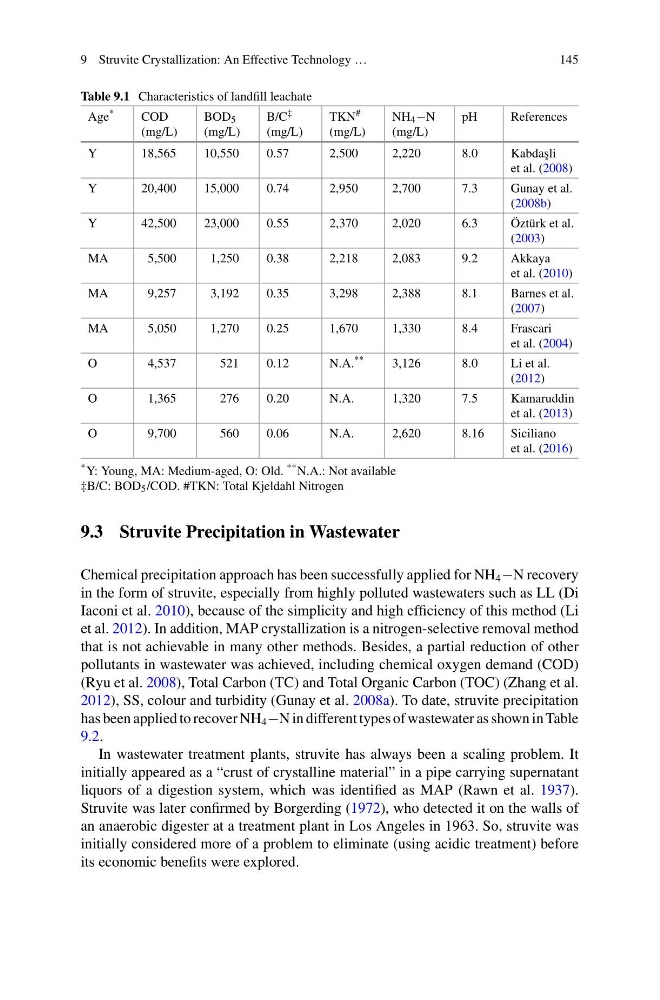
Table 9.1 Characteristics of landfill leachate
Age *
COD
(mg/L)
BOD 5
(mg/L)
B/C ‡
(mg/L)
TKN #
(mg/L)
NH 4 −N
(mg/L)
pH
References
Y
18,565
10,550
0.57
2,500
2,220
8.0
Kabda¸ sli
et al. (2008)
Y
20,400
15,000
0.74
2,950
2,700
7.3
Gunay et al.
(2008b)
Y
42,500
23,000
0.55
2,370
2,020
6.3
Öztürk et al.
(2003)
MA
5,500
1,250
0.38
2,218
2,083
9.2
Akkaya
et al. (2010)
MA
9,257
3,192
0.35
3,298
2,388
8.1
Barnes et al.
(2007)
MA
5,050
1,270
0.25
1,670
1,330
8.4
Frascari
et al. (2004)
O
4,537
521
0.12
N.A. **
3,126
8.0
Li et al.
(2012)
O
1,365
276
0.20
N.A.
1,320
7.5
Kamaruddin
et al. (2013)
O
9,700
560
0.06
N.A.
2,620
8.16
Siciliano
et al. (2016)
* Y: Young, MA: Medium-aged, O: Old. ** N.A.: Not available
‡B/C: BOD 5 /COD. #TKN: Total Kjeldahl Nitrogen
9.3 Struvite Precipitation in Wastewater
Chemical precipitation approach has been successfully applied for NH 4 −N recovery
in the form of struvite, especially from highly polluted wastewaters such as LL (Di
Iaconi et al. 2010), because of the simplicity and high efficiency of this method (Li
et al. 2012). In addition, MAP crystallization is a nitrogen-selective removal method
that is not achievable in many other methods. Besides, a partial reduction of other
pollutants in wastewater was achieved, including chemical oxygen demand (COD)
(Ryu et al. 2008), Total Carbon (TC) and Total Organic Carbon (TOC) (Zhang et al.
2012), SS, colour and turbidity (Gunay et al. 2008a). To date, struvite precipitation
has been applied to recover NH 4 −N in different types of wastewater as shown in Table
9.2.
In wastewater treatment plants, struvite has always been a scaling problem. It
initially appeared as a “crust of crystalline material” in a pipe carrying supernatant
liquors of a digestion system, which was identified as MAP (Rawn et al. 1937).
Struvite was later confirmed by Borgerding (1972), who detected it on the walls of
an anaerobic digester at a treatment plant in Los Angeles in 1963. So, struvite was
initially considered more of a problem to eliminate (using acidic treatment) before
its economic benefits were explored.
145
Table 9.1 Characteristics of landfill leachate
Age *
COD
(mg/L)
BOD 5
(mg/L)
B/C ‡
(mg/L)
TKN #
(mg/L)
NH 4 −N
(mg/L)
pH
References
Y
18,565
10,550
0.57
2,500
2,220
8.0
Kabda¸ sli
et al. (2008)
Y
20,400
15,000
0.74
2,950
2,700
7.3
Gunay et al.
(2008b)
Y
42,500
23,000
0.55
2,370
2,020
6.3
Öztürk et al.
(2003)
MA
5,500
1,250
0.38
2,218
2,083
9.2
Akkaya
et al. (2010)
MA
9,257
3,192
0.35
3,298
2,388
8.1
Barnes et al.
(2007)
MA
5,050
1,270
0.25
1,670
1,330
8.4
Frascari
et al. (2004)
O
4,537
521
0.12
N.A. **
3,126
8.0
Li et al.
(2012)
O
1,365
276
0.20
N.A.
1,320
7.5
Kamaruddin
et al. (2013)
O
9,700
560
0.06
N.A.
2,620
8.16
Siciliano
et al. (2016)
* Y: Young, MA: Medium-aged, O: Old. ** N.A.: Not available
‡B/C: BOD 5 /COD. #TKN: Total Kjeldahl Nitrogen
9.3 Struvite Precipitation in Wastewater
Chemical precipitation approach has been successfully applied for NH 4 −N recovery
in the form of struvite, especially from highly polluted wastewaters such as LL (Di
Iaconi et al. 2010), because of the simplicity and high efficiency of this method (Li
et al. 2012). In addition, MAP crystallization is a nitrogen-selective removal method
that is not achievable in many other methods. Besides, a partial reduction of other
pollutants in wastewater was achieved, including chemical oxygen demand (COD)
(Ryu et al. 2008), Total Carbon (TC) and Total Organic Carbon (TOC) (Zhang et al.
2012), SS, colour and turbidity (Gunay et al. 2008a). To date, struvite precipitation
has been applied to recover NH 4 −N in different types of wastewater as shown in Table
9.2.
In wastewater treatment plants, struvite has always been a scaling problem. It
initially appeared as a “crust of crystalline material” in a pipe carrying supernatant
liquors of a digestion system, which was identified as MAP (Rawn et al. 1937).
Struvite was later confirmed by Borgerding (1972), who detected it on the walls of
an anaerobic digester at a treatment plant in Los Angeles in 1963. So, struvite was
initially considered more of a problem to eliminate (using acidic treatment) before
its economic benefits were explored.