

8 Biofilter Aquaponic System for Nutrients …
131
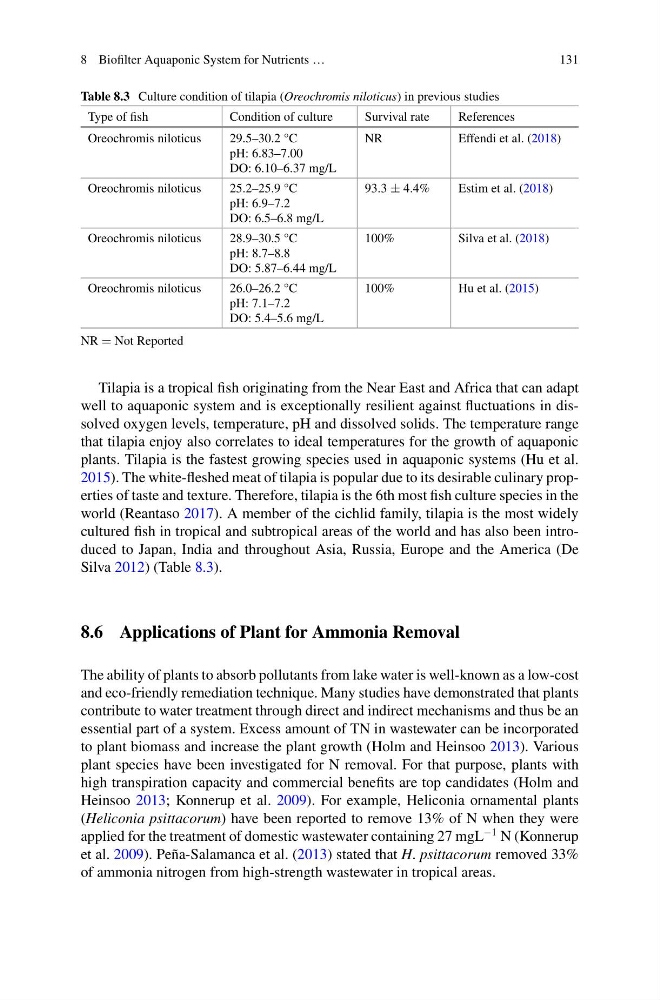
Table 8.3 Culture condition of tilapia (Oreochromis niloticus) in previous studies
Type of fish
Condition of culture
Survival rate
References
Oreochromis niloticus
29.5–30.2 °C
pH: 6.83–7.00
DO: 6.10–6.37 mg/L
NR
Effendi et al. (2018)
Oreochromis niloticus
25.2–25.9 °C
pH: 6.9–7.2
DO: 6.5–6.8 mg/L
93.3 ± 4.4%
Estim et al. (2018)
Oreochromis niloticus
28.9–30.5 °C
pH: 8.7–8.8
DO: 5.87–6.44 mg/L
100%
Silva et al. (2018)
Oreochromis niloticus
26.0–26.2 °C
pH: 7.1–7.2
DO: 5.4–5.6 mg/L
100%
Hu et al. (2015)
NR = Not Reported
Tilapia is a tropical fish originating from the Near East and Africa that can adapt
well to aquaponic system and is exceptionally resilient against fluctuations in dissolved oxygen levels, temperature, pH and dissolved solids. The temperature range
that tilapia enjoy also correlates to ideal temperatures for the growth of aquaponic
plants. Tilapia is the fastest growing species used in aquaponic systems (Hu et al.
2015). The white-fleshed meat of tilapia is popular due to its desirable culinary properties of taste and texture. Therefore, tilapia is the 6th most fish culture species in the
world (Reantaso 2017). A member of the cichlid family, tilapia is the most widely
cultured fish in tropical and subtropical areas of the world and has also been introduced to Japan, India and throughout Asia, Russia, Europe and the America (De
Silva 2012) (Table 8.3).
8.6 Applications of Plant for Ammonia Removal
The ability of plants to absorb pollutants from lake water is well-known as a low-cost
and eco-friendly remediation technique. Many studies have demonstrated that plants
contribute to water treatment through direct and indirect mechanisms and thus be an
essential part of a system. Excess amount of TN in wastewater can be incorporated
to plant biomass and increase the plant growth (Holm and Heinsoo 2013). Various
plant species have been investigated for N removal. For that purpose, plants with
high transpiration capacity and commercial benefits are top candidates (Holm and
Heinsoo 2013; Konnerup et al. 2009). For example, Heliconia ornamental plants
(Heliconia psittacorum) have been reported to remove 13% of N when they were
applied for the treatment of domestic wastewater containing 27 mgL
−1 N (Konnerup
et al. 2009). Peña-Salamanca et al. (2013) stated that H. psittacorum removed 33%
of ammonia nitrogen from high-strength wastewater in tropical areas.
131
Table 8.3 Culture condition of tilapia (Oreochromis niloticus) in previous studies
Type of fish
Condition of culture
Survival rate
References
Oreochromis niloticus
29.5–30.2 °C
pH: 6.83–7.00
DO: 6.10–6.37 mg/L
NR
Effendi et al. (2018)
Oreochromis niloticus
25.2–25.9 °C
pH: 6.9–7.2
DO: 6.5–6.8 mg/L
93.3 ± 4.4%
Estim et al. (2018)
Oreochromis niloticus
28.9–30.5 °C
pH: 8.7–8.8
DO: 5.87–6.44 mg/L
100%
Silva et al. (2018)
Oreochromis niloticus
26.0–26.2 °C
pH: 7.1–7.2
DO: 5.4–5.6 mg/L
100%
Hu et al. (2015)
NR = Not Reported
Tilapia is a tropical fish originating from the Near East and Africa that can adapt
well to aquaponic system and is exceptionally resilient against fluctuations in dissolved oxygen levels, temperature, pH and dissolved solids. The temperature range
that tilapia enjoy also correlates to ideal temperatures for the growth of aquaponic
plants. Tilapia is the fastest growing species used in aquaponic systems (Hu et al.
2015). The white-fleshed meat of tilapia is popular due to its desirable culinary properties of taste and texture. Therefore, tilapia is the 6th most fish culture species in the
world (Reantaso 2017). A member of the cichlid family, tilapia is the most widely
cultured fish in tropical and subtropical areas of the world and has also been introduced to Japan, India and throughout Asia, Russia, Europe and the America (De
Silva 2012) (Table 8.3).
8.6 Applications of Plant for Ammonia Removal
The ability of plants to absorb pollutants from lake water is well-known as a low-cost
and eco-friendly remediation technique. Many studies have demonstrated that plants
contribute to water treatment through direct and indirect mechanisms and thus be an
essential part of a system. Excess amount of TN in wastewater can be incorporated
to plant biomass and increase the plant growth (Holm and Heinsoo 2013). Various
plant species have been investigated for N removal. For that purpose, plants with
high transpiration capacity and commercial benefits are top candidates (Holm and
Heinsoo 2013; Konnerup et al. 2009). For example, Heliconia ornamental plants
(Heliconia psittacorum) have been reported to remove 13% of N when they were
applied for the treatment of domestic wastewater containing 27 mgL
−1 N (Konnerup
et al. 2009). Peña-Salamanca et al. (2013) stated that H. psittacorum removed 33%
of ammonia nitrogen from high-strength wastewater in tropical areas.