

3.5 Carbenic Nitrile Imines
85
While theoretically possible, the presence of a truly carbenic NI within a practical
synthetic manifold has yet to be conclusively proven. This is likely due to the
electronic properties of the NI substituents most commonly used in synthesis
promoting adoption of the linear propargylic resonance form, as opposed to the
more electron-rich allenic and carbenic forms required for 1,1-type cycloadditions
(Sect. 1.2).
3.6 Decomposition
In the absence of an appropriate dipolarophile or alternative reaction partner, and at
sufficient dilutions to inhibit dimerisation, NIs will decompose to yield a number of
simpler constituents. This is normally only applicable to irreversible methods of NI
generation, such as 2,5-tetrazoles or sydnones. Species such as hydrazonyl chlorides
will maintain an equilibrium between the NI and the precursor until the reaction is
quenched.
From a synthetic perspective, the principal product of NI decomposition is the
corresponding carbodiimide isomer. This can be generated thermally, [207] but can
also be accelerated through photolysis of the corresponding NI [242–244]. The exact
nature of this rearrangement was presumed for many years to proceed via a diazirine
intermediate, however no experimental evidence of this species could be obtained
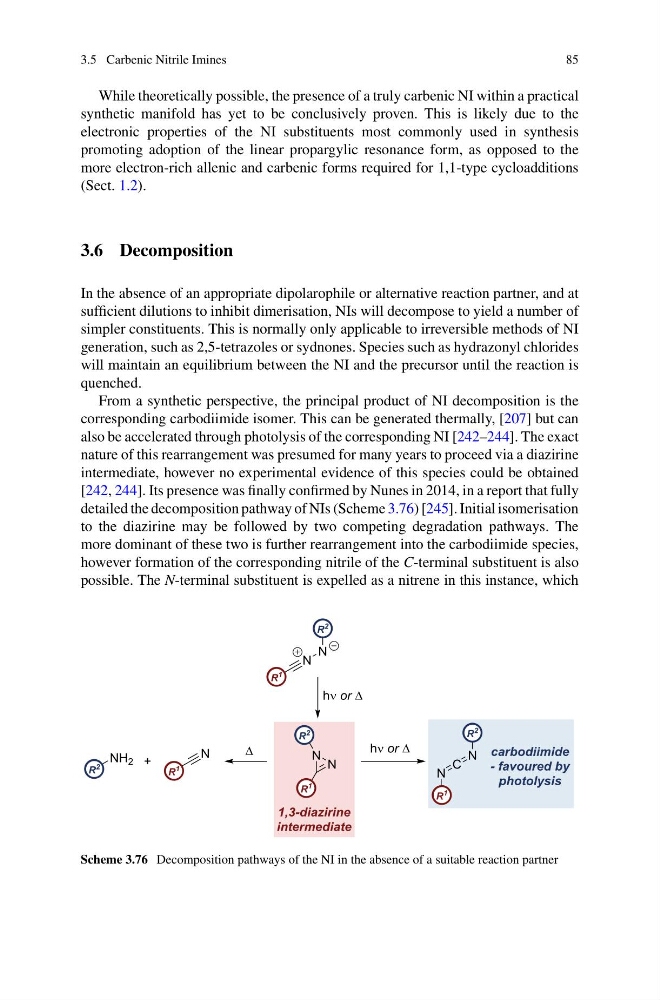
[242, 244]. Its presence was finally confirmed by Nunes in 2014, in a report that fully
detailed the decomposition pathway of NIs (Scheme 3.76) [245]. Initial isomerisation
to the diazirine may be followed by two competing degradation pathways. The
more dominant of these two is further rearrangement into the carbodiimide species,
however formation of the corresponding nitrile of the C-terminal substituent is also
possible. The N-terminal substituent is expelled as a nitrene in this instance, which
N
N
N
N
N
NH 2
C
N
N
+
1,3-diazirine
intermediate
hor
hor
carbodiimide
- favoured by
photolysis
R
1
R
2
R
1
R
1
R
1
R
2
R
2
R
2
Scheme 3.76 Decomposition pathways of the NI in the absence of a suitable reaction partner
85
While theoretically possible, the presence of a truly carbenic NI within a practical
synthetic manifold has yet to be conclusively proven. This is likely due to the
electronic properties of the NI substituents most commonly used in synthesis
promoting adoption of the linear propargylic resonance form, as opposed to the
more electron-rich allenic and carbenic forms required for 1,1-type cycloadditions
(Sect. 1.2).
3.6 Decomposition
In the absence of an appropriate dipolarophile or alternative reaction partner, and at
sufficient dilutions to inhibit dimerisation, NIs will decompose to yield a number of
simpler constituents. This is normally only applicable to irreversible methods of NI
generation, such as 2,5-tetrazoles or sydnones. Species such as hydrazonyl chlorides
will maintain an equilibrium between the NI and the precursor until the reaction is
quenched.
From a synthetic perspective, the principal product of NI decomposition is the
corresponding carbodiimide isomer. This can be generated thermally, [207] but can
also be accelerated through photolysis of the corresponding NI [242–244]. The exact
nature of this rearrangement was presumed for many years to proceed via a diazirine
intermediate, however no experimental evidence of this species could be obtained
[242, 244]. Its presence was finally confirmed by Nunes in 2014, in a report that fully
detailed the decomposition pathway of NIs (Scheme 3.76) [245]. Initial isomerisation
to the diazirine may be followed by two competing degradation pathways. The
more dominant of these two is further rearrangement into the carbodiimide species,
however formation of the corresponding nitrile of the C-terminal substituent is also
possible. The N-terminal substituent is expelled as a nitrene in this instance, which
N
N
N
N
N
NH 2
C
N
N
+
1,3-diazirine
intermediate
hor
hor
carbodiimide
- favoured by
photolysis
R
1
R
2
R
1
R
1
R
1
R
2
R
2
R
2
Scheme 3.76 Decomposition pathways of the NI in the absence of a suitable reaction partner