

38
3 The Reactivity of Nitrile Imines
3.1.1 Regioselectivity
Cycloaddition between an NI and an asymmetrical dipolarophile can in principle
generate both the 4-substituted and 5-substituted pyrazoline/pyrazole adduct, and
classification of the regioisomeric preferences of different dipolarophiles has been
thoroughly investigated throughout the literature.
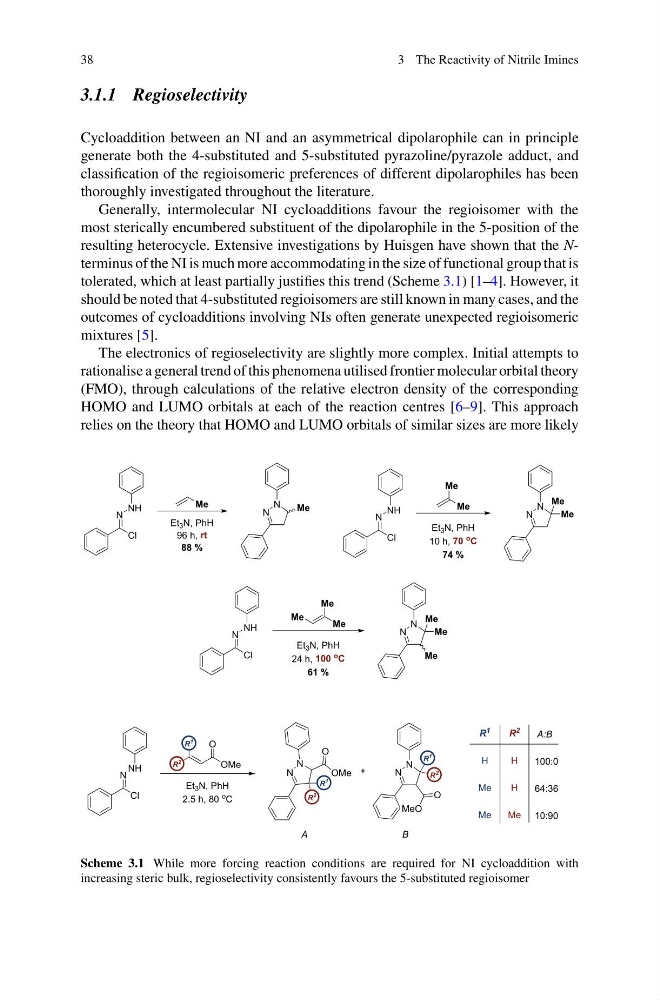
Generally, intermolecular NI cycloadditions favour the regioisomer with the
most sterically encumbered substituent of the dipolarophile in the 5-position of the
resulting heterocycle. Extensive investigations by Huisgen have shown that the Nterminus of the NI is much more accommodating in the size of functional group that is
tolerated, which at least partially justifies this trend (Scheme 3.1) [1–4]. However, it
should be noted that 4-substituted regioisomers are still known in many cases, and the
outcomes of cycloadditions involving NIs often generate unexpected regioisomeric
mixtures [5].
The electronics of regioselectivity are slightly more complex. Initial attempts to
rationalise a general trend of this phenomena utilised frontier molecular orbital theory
(FMO), through calculations of the relative electron density of the corresponding
HOMO and LUMO orbitals at each of the reaction centres [6–9]. This approach
relies on the theory that HOMO and LUMO orbitals of similar sizes are more likely
N
N
Me
Me
Cl
N
NH
Et 3 N, PhH
96 h, rt
88 %
N
N
Me
Me
Cl
N
NH
Et 3 N, PhH
10 h, 70
o C
74 %
Me
Me
N
N
Me
Me
Cl
N
NH
Et 3 N, PhH
24 h, 100
o C
61 %
Me
Me
Me
Me
Cl
N
NH
OMe
O
Et 3 N, PhH
2.5 h, 80
o C
N
N
OMe
O
N
N
MeO
O
+
R
2
H
H
Me
R
1
H
Me
Me
A:B
6
100:0
64:36
10:90
A
B
R 1
R 2
R 1
R 2
R 1
R 2
Scheme 3.1 While more forcing reaction conditions are required for NI cycloaddition with
increasing steric bulk, regioselectivity consistently favours the 5-substituted regioisomer
3 The Reactivity of Nitrile Imines
3.1.1 Regioselectivity
Cycloaddition between an NI and an asymmetrical dipolarophile can in principle
generate both the 4-substituted and 5-substituted pyrazoline/pyrazole adduct, and
classification of the regioisomeric preferences of different dipolarophiles has been
thoroughly investigated throughout the literature.
Generally, intermolecular NI cycloadditions favour the regioisomer with the
most sterically encumbered substituent of the dipolarophile in the 5-position of the
resulting heterocycle. Extensive investigations by Huisgen have shown that the Nterminus of the NI is much more accommodating in the size of functional group that is
tolerated, which at least partially justifies this trend (Scheme 3.1) [1–4]. However, it
should be noted that 4-substituted regioisomers are still known in many cases, and the
outcomes of cycloadditions involving NIs often generate unexpected regioisomeric
mixtures [5].
The electronics of regioselectivity are slightly more complex. Initial attempts to
rationalise a general trend of this phenomena utilised frontier molecular orbital theory
(FMO), through calculations of the relative electron density of the corresponding
HOMO and LUMO orbitals at each of the reaction centres [6–9]. This approach
relies on the theory that HOMO and LUMO orbitals of similar sizes are more likely
N
N
Me
Me
Cl
N
NH
Et 3 N, PhH
96 h, rt
88 %
N
N
Me
Me
Cl
N
NH
Et 3 N, PhH
10 h, 70
o C
74 %
Me
Me
N
N
Me
Me
Cl
N
NH
Et 3 N, PhH
24 h, 100
o C
61 %
Me
Me
Me
Me
Cl
N
NH
OMe
O
Et 3 N, PhH
2.5 h, 80
o C
N
N
OMe
O
N
N
MeO
O
+
R
2
H
H
Me
R
1
H
Me
Me
A:B
6
100:0
64:36
10:90
A
B
R 1
R 2
R 1
R 2
R 1
R 2
Scheme 3.1 While more forcing reaction conditions are required for NI cycloaddition with
increasing steric bulk, regioselectivity consistently favours the 5-substituted regioisomer