

2.6 Other Sources
31
O
N
N
O
R
2
R
1
Fig. 2.1 The structure of 1,3,4-oxadiazolin-5-ones
NI. There are, however, two key differences. Firstly, the substitution pattern of the
NI is already set, and no rearrangements are necessary. Secondly, this process has
been shown to operate thermally, but not photochemically [75, 78]. Indeed, the
only real examples of the application of 1,3,4-oxadiazolin-5-ones as NI sources
originate in flash vacuum pyrolysis work at extremely high temperatures in excess
of 400 °C [36, 79]. As such, this should not be considered a conventional source of
NIs, especially when compared to the other precursors that are more prolific within
the literature.
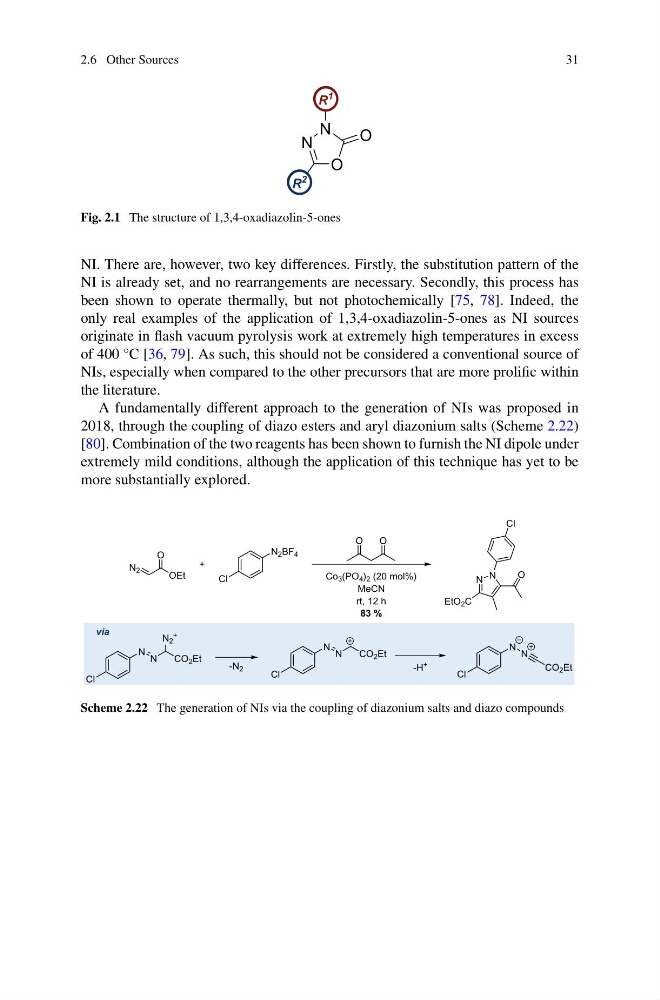
A fundamentally different approach to the generation of NIs was proposed in
2018, through the coupling of diazo esters and aryl diazonium salts (Scheme 2.22)
[80]. Combination of the two reagents has been shown to furnish the NI dipole under
extremely mild conditions, although the application of this technique has yet to be
more substantially explored.
N 2
OEt
O
Cl
N 2 BF 4
O
O
N N
O
EtO 2 C
Cl
Co 3 (PO 4 ) 2 (20 mol%)
MeCN
rt, 12 h
83 %
+
Cl
N N
CO 2 Et
N 2
+
Cl
N N
CO 2 Et
-N 2
-H
+
Cl
N N
CO 2 Et
via
Scheme 2.22 The generation of NIs via the coupling of diazonium salts and diazo compounds
31
O
N
N
O
R
2
R
1
Fig. 2.1 The structure of 1,3,4-oxadiazolin-5-ones
NI. There are, however, two key differences. Firstly, the substitution pattern of the
NI is already set, and no rearrangements are necessary. Secondly, this process has
been shown to operate thermally, but not photochemically [75, 78]. Indeed, the
only real examples of the application of 1,3,4-oxadiazolin-5-ones as NI sources
originate in flash vacuum pyrolysis work at extremely high temperatures in excess
of 400 °C [36, 79]. As such, this should not be considered a conventional source of
NIs, especially when compared to the other precursors that are more prolific within
the literature.
A fundamentally different approach to the generation of NIs was proposed in
2018, through the coupling of diazo esters and aryl diazonium salts (Scheme 2.22)
[80]. Combination of the two reagents has been shown to furnish the NI dipole under
extremely mild conditions, although the application of this technique has yet to be
more substantially explored.
N 2
OEt
O
Cl
N 2 BF 4
O
O
N N
O
EtO 2 C
Cl
Co 3 (PO 4 ) 2 (20 mol%)
MeCN
rt, 12 h
83 %
+
Cl
N N
CO 2 Et
N 2
+
Cl
N N
CO 2 Et
-N 2
-H
+
Cl
N N
CO 2 Et
via
Scheme 2.22 The generation of NIs via the coupling of diazonium salts and diazo compounds