

5.12 Protein Profile
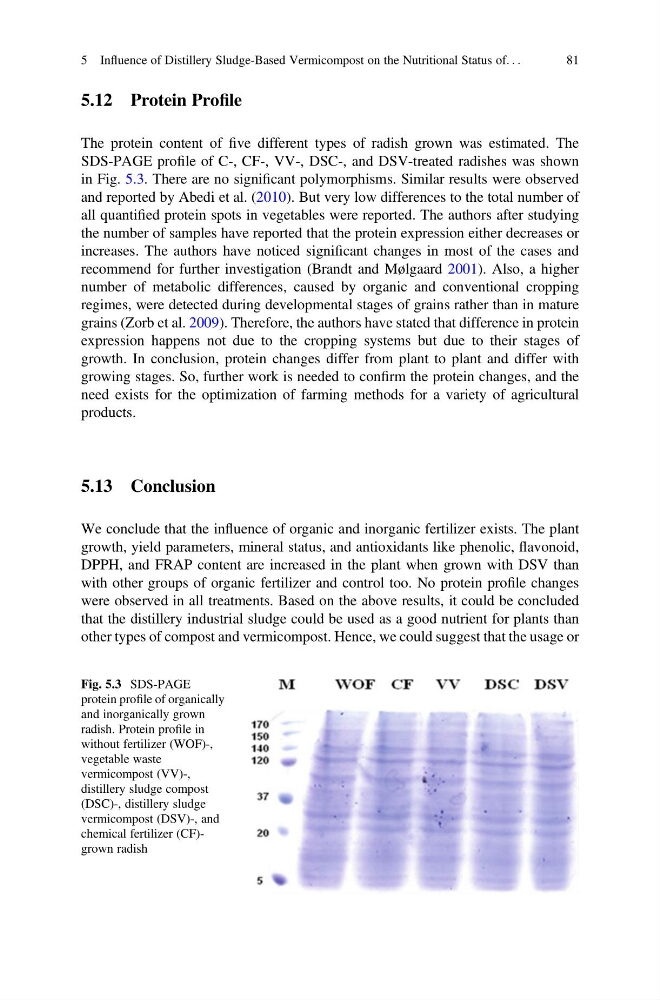
The protein content of five different types of radish grown was estimated. The
SDS-PAGE profile of C-, CF-, VV-, DSC-, and DSV-treated radishes was shown
in Fig. 5.3. There are no significant polymorphisms. Similar results were observed
and reported by Abedi et al. (2010). But very low differences to the total number of
all quantified protein spots in vegetables were reported. The authors after studying
the number of samples have reported that the protein expression either decreases or
increases. The authors have noticed significant changes in most of the cases and
recommend for further investigation (Brandt and Mølgaard 2001). Also, a higher
number of metabolic differences, caused by organic and conventional cropping
regimes, were detected during developmental stages of grains rather than in mature
grains (Zorb et al. 2009). Therefore, the authors have stated that difference in protein
expression happens not due to the cropping systems but due to their stages of
growth. In conclusion, protein changes differ from plant to plant and differ with
growing stages. So, further work is needed to confirm the protein changes, and the
need exists for the optimization of farming methods for a variety of agricultural
products.
5.13 Conclusion
We conclude that the influence of organic and inorganic fertilizer exists. The plant
growth, yield parameters, mineral status, and antioxidants like phenolic, flavonoid,
DPPH, and FRAP content are increased in the plant when grown with DSV than
with other groups of organic fertilizer and control too. No protein profile changes
were observed in all treatments. Based on the above results, it could be concluded
that the distillery industrial sludge could be used as a good nutrient for plants than
other types of compost and vermicompost. Hence, we could suggest that the usage or
Fig. 5.3 SDS-PAGE
protein profile of organically
and inorganically grown
radish. Protein profile in
without fertilizer (WOF)-,
vegetable waste
vermicompost (VV)-,
distillery sludge compost
(DSC)-, distillery sludge
vermicompost (DSV)-, and
chemical fertilizer (CF)grown radish
5 Influence of Distillery Sludge-Based Vermicompost on the Nutritional Status of. . .
81
The protein content of five different types of radish grown was estimated. The
SDS-PAGE profile of C-, CF-, VV-, DSC-, and DSV-treated radishes was shown
in Fig. 5.3. There are no significant polymorphisms. Similar results were observed
and reported by Abedi et al. (2010). But very low differences to the total number of
all quantified protein spots in vegetables were reported. The authors after studying
the number of samples have reported that the protein expression either decreases or
increases. The authors have noticed significant changes in most of the cases and
recommend for further investigation (Brandt and Mølgaard 2001). Also, a higher
number of metabolic differences, caused by organic and conventional cropping
regimes, were detected during developmental stages of grains rather than in mature
grains (Zorb et al. 2009). Therefore, the authors have stated that difference in protein
expression happens not due to the cropping systems but due to their stages of
growth. In conclusion, protein changes differ from plant to plant and differ with
growing stages. So, further work is needed to confirm the protein changes, and the
need exists for the optimization of farming methods for a variety of agricultural
products.
5.13 Conclusion
We conclude that the influence of organic and inorganic fertilizer exists. The plant
growth, yield parameters, mineral status, and antioxidants like phenolic, flavonoid,
DPPH, and FRAP content are increased in the plant when grown with DSV than
with other groups of organic fertilizer and control too. No protein profile changes
were observed in all treatments. Based on the above results, it could be concluded
that the distillery industrial sludge could be used as a good nutrient for plants than
other types of compost and vermicompost. Hence, we could suggest that the usage or
Fig. 5.3 SDS-PAGE
protein profile of organically
and inorganically grown
radish. Protein profile in
without fertilizer (WOF)-,
vegetable waste
vermicompost (VV)-,
distillery sludge compost
(DSC)-, distillery sludge
vermicompost (DSV)-, and
chemical fertilizer (CF)grown radish
5 Influence of Distillery Sludge-Based Vermicompost on the Nutritional Status of. . .
81