

up to an MP concentration of 25 mg a.i./kg. The range of doses considered below
55 mg a.i./kg did not cause death of earthworms till an exposure period of 7 days.
However, the mortality rate of earthworms was observed to start increasing with an
increase in the dose of MP 2% dust a.i. beyond an exposure period of 7 days. Further,
the earthworm mortality was also observed to be very high at higher doses on the
14th day. At a dose of 40 mg a.i./kg, the earthworm mortality was 23% and further
increased to 70% with an increase in the concentration of MP to 70 mg a.i./kg. At a
high concentration, the earthworms were observed to become stiff with the coiling of
their structure. Thus, it can be inferred that MP is extremely toxic to Eisenia fetida.
The median lethal concentration (LC 50 ) of Eisenia fetida for a 14-day exposure to
MP 2% dust a.i. was found to be 36.63 mg a.i./kg.
20.3.2.2 Earthworm Growth Inhibition
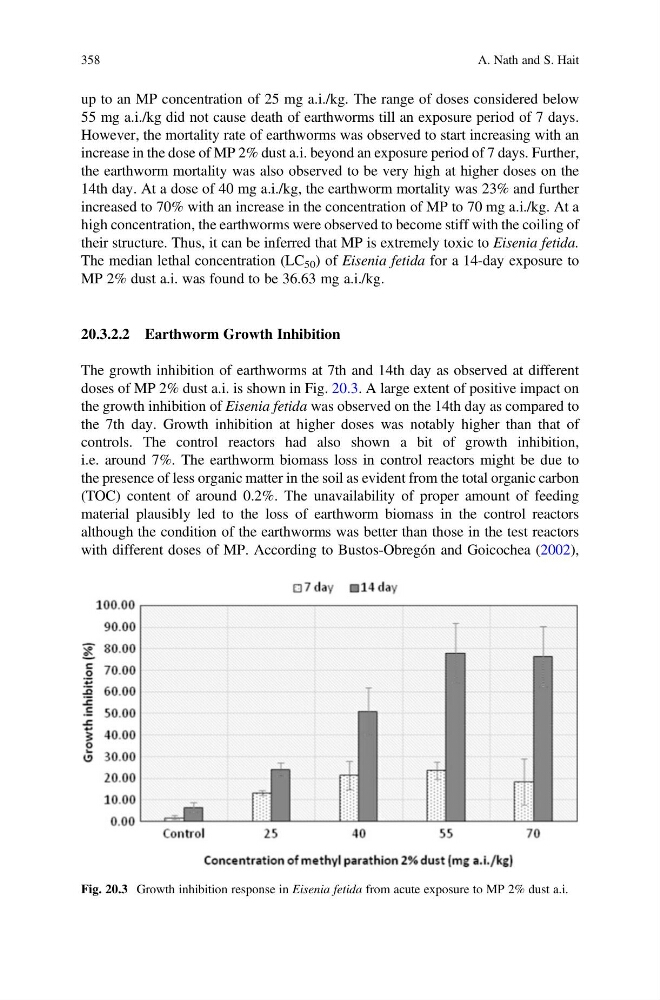
The growth inhibition of earthworms at 7th and 14th day as observed at different
doses of MP 2% dust a.i. is shown in Fig. 20.3. A large extent of positive impact on
the growth inhibition of Eisenia fetida was observed on the 14th day as compared to
the 7th day. Growth inhibition at higher doses was notably higher than that of
controls. The control reactors had also shown a bit of growth inhibition,
i.e. around 7%. The earthworm biomass loss in control reactors might be due to
the presence of less organic matter in the soil as evident from the total organic carbon
(TOC) content of around 0.2%. The unavailability of proper amount of feeding
material plausibly led to the loss of earthworm biomass in the control reactors
although the condition of the earthworms was better than those in the test reactors
with different doses of MP. According to Bustos-Obregón and Goicochea (2002),
Fig. 20.3 Growth inhibition response in Eisenia fetida from acute exposure to MP 2% dust a.i.
358
A. Nath and S. Hait
55 mg a.i./kg did not cause death of earthworms till an exposure period of 7 days.
However, the mortality rate of earthworms was observed to start increasing with an
increase in the dose of MP 2% dust a.i. beyond an exposure period of 7 days. Further,
the earthworm mortality was also observed to be very high at higher doses on the
14th day. At a dose of 40 mg a.i./kg, the earthworm mortality was 23% and further
increased to 70% with an increase in the concentration of MP to 70 mg a.i./kg. At a
high concentration, the earthworms were observed to become stiff with the coiling of
their structure. Thus, it can be inferred that MP is extremely toxic to Eisenia fetida.
The median lethal concentration (LC 50 ) of Eisenia fetida for a 14-day exposure to
MP 2% dust a.i. was found to be 36.63 mg a.i./kg.
20.3.2.2 Earthworm Growth Inhibition
The growth inhibition of earthworms at 7th and 14th day as observed at different
doses of MP 2% dust a.i. is shown in Fig. 20.3. A large extent of positive impact on
the growth inhibition of Eisenia fetida was observed on the 14th day as compared to
the 7th day. Growth inhibition at higher doses was notably higher than that of
controls. The control reactors had also shown a bit of growth inhibition,
i.e. around 7%. The earthworm biomass loss in control reactors might be due to
the presence of less organic matter in the soil as evident from the total organic carbon
(TOC) content of around 0.2%. The unavailability of proper amount of feeding
material plausibly led to the loss of earthworm biomass in the control reactors
although the condition of the earthworms was better than those in the test reactors
with different doses of MP. According to Bustos-Obregón and Goicochea (2002),
Fig. 20.3 Growth inhibition response in Eisenia fetida from acute exposure to MP 2% dust a.i.
358
A. Nath and S. Hait