

GI% ¼
W 0 À W t
ð
Þ
W 0
 100%
where
W 0 : earthworm weight on day 0
W t : earthworm weight after t days
20.2.8 Statistical Analysis
Statistical analyses of the data obtained were performed using the SPSS 26 software.
The significant difference between the treatments was determined by one-way
ANOVA using Tukey’s test as a post-hoc pairwise multiple comparison process
for the contrast of the differences among treatment means. Levene’s test was used to
ensure the homogeneity of variances. The level of probability used for statistical
significance was P < 0.05.
20.3 Results and Discussion
20.3.1 Range Finding Test
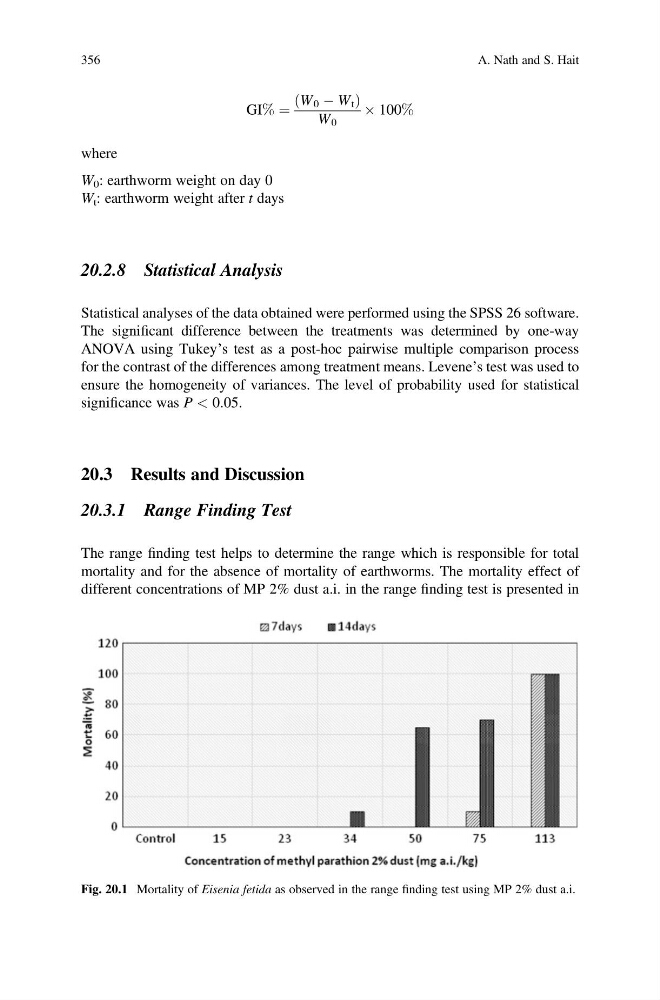
The range finding test helps to determine the range which is responsible for total
mortality and for the absence of mortality of earthworms. The mortality effect of
different concentrations of MP 2% dust a.i. in the range finding test is presented in
Fig. 20.1 Mortality of Eisenia fetida as observed in the range finding test using MP 2% dust a.i.
356
A. Nath and S. Hait
W 0 À W t
ð
Þ
W 0
 100%
where
W 0 : earthworm weight on day 0
W t : earthworm weight after t days
20.2.8 Statistical Analysis
Statistical analyses of the data obtained were performed using the SPSS 26 software.
The significant difference between the treatments was determined by one-way
ANOVA using Tukey’s test as a post-hoc pairwise multiple comparison process
for the contrast of the differences among treatment means. Levene’s test was used to
ensure the homogeneity of variances. The level of probability used for statistical
significance was P < 0.05.
20.3 Results and Discussion
20.3.1 Range Finding Test
The range finding test helps to determine the range which is responsible for total
mortality and for the absence of mortality of earthworms. The mortality effect of
different concentrations of MP 2% dust a.i. in the range finding test is presented in
Fig. 20.1 Mortality of Eisenia fetida as observed in the range finding test using MP 2% dust a.i.
356
A. Nath and S. Hait