

was sieved using a 1.12-mm sieve. Prior to use in the experiment, the soil was
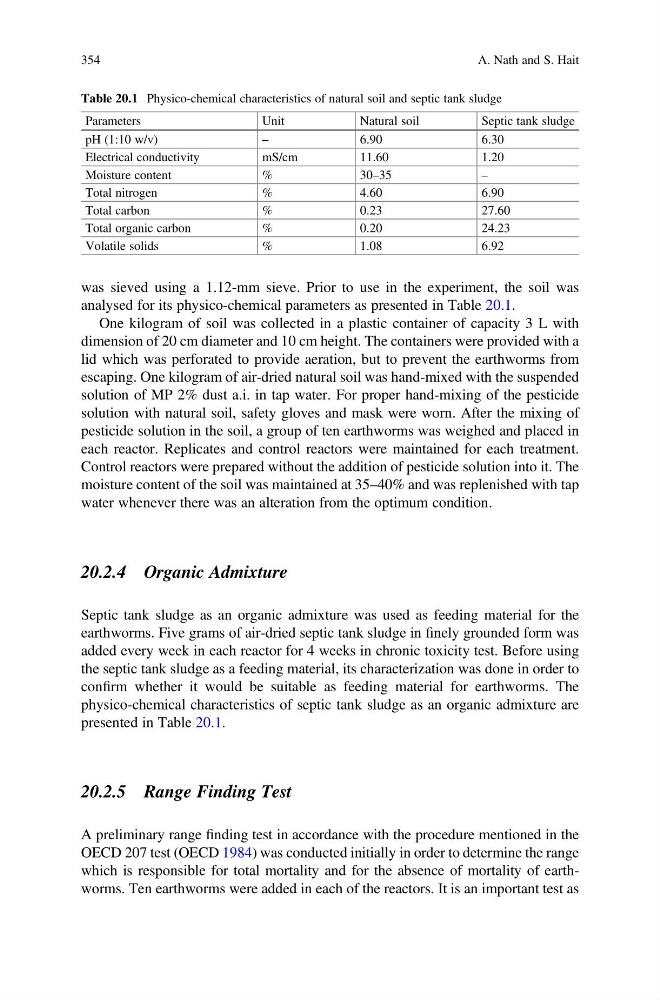
analysed for its physico-chemical parameters as presented in Table 20.1.
One kilogram of soil was collected in a plastic container of capacity 3 L with
dimension of 20 cm diameter and 10 cm height. The containers were provided with a
lid which was perforated to provide aeration, but to prevent the earthworms from
escaping. One kilogram of air-dried natural soil was hand-mixed with the suspended
solution of MP 2% dust a.i. in tap water. For proper hand-mixing of the pesticide
solution with natural soil, safety gloves and mask were worn. After the mixing of
pesticide solution in the soil, a group of ten earthworms was weighed and placed in
each reactor. Replicates and control reactors were maintained for each treatment.
Control reactors were prepared without the addition of pesticide solution into it. The
moisture content of the soil was maintained at 35–40% and was replenished with tap
water whenever there was an alteration from the optimum condition.
20.2.4 Organic Admixture
Septic tank sludge as an organic admixture was used as feeding material for the
earthworms. Five grams of air-dried septic tank sludge in finely grounded form was
added every week in each reactor for 4 weeks in chronic toxicity test. Before using
the septic tank sludge as a feeding material, its characterization was done in order to
confirm whether it would be suitable as feeding material for earthworms. The
physico-chemical characteristics of septic tank sludge as an organic admixture are
presented in Table 20.1.
20.2.5 Range Finding Test
A preliminary range finding test in accordance with the procedure mentioned in the
OECD 207 test (OECD 1984) was conducted initially in order to determine the range
which is responsible for total mortality and for the absence of mortality of earthworms. Ten earthworms were added in each of the reactors. It is an important test as
Table 20.1 Physico-chemical characteristics of natural soil and septic tank sludge
Parameters
Unit
Natural soil
Septic tank sludge
pH (1:10 w/v)
–
6.90
6.30
Electrical conductivity
mS/cm
11.60
1.20
Moisture content
%
30–35
–
Total nitrogen
%
4.60
6.90
Total carbon
%
0.23
27.60
Total organic carbon
%
0.20
24.23
Volatile solids
%
1.08
6.92
354
A. Nath and S. Hait
analysed for its physico-chemical parameters as presented in Table 20.1.
One kilogram of soil was collected in a plastic container of capacity 3 L with
dimension of 20 cm diameter and 10 cm height. The containers were provided with a
lid which was perforated to provide aeration, but to prevent the earthworms from
escaping. One kilogram of air-dried natural soil was hand-mixed with the suspended
solution of MP 2% dust a.i. in tap water. For proper hand-mixing of the pesticide
solution with natural soil, safety gloves and mask were worn. After the mixing of
pesticide solution in the soil, a group of ten earthworms was weighed and placed in
each reactor. Replicates and control reactors were maintained for each treatment.
Control reactors were prepared without the addition of pesticide solution into it. The
moisture content of the soil was maintained at 35–40% and was replenished with tap
water whenever there was an alteration from the optimum condition.
20.2.4 Organic Admixture
Septic tank sludge as an organic admixture was used as feeding material for the
earthworms. Five grams of air-dried septic tank sludge in finely grounded form was
added every week in each reactor for 4 weeks in chronic toxicity test. Before using
the septic tank sludge as a feeding material, its characterization was done in order to
confirm whether it would be suitable as feeding material for earthworms. The
physico-chemical characteristics of septic tank sludge as an organic admixture are
presented in Table 20.1.
20.2.5 Range Finding Test
A preliminary range finding test in accordance with the procedure mentioned in the
OECD 207 test (OECD 1984) was conducted initially in order to determine the range
which is responsible for total mortality and for the absence of mortality of earthworms. Ten earthworms were added in each of the reactors. It is an important test as
Table 20.1 Physico-chemical characteristics of natural soil and septic tank sludge
Parameters
Unit
Natural soil
Septic tank sludge
pH (1:10 w/v)
–
6.90
6.30
Electrical conductivity
mS/cm
11.60
1.20
Moisture content
%
30–35
–
Total nitrogen
%
4.60
6.90
Total carbon
%
0.23
27.60
Total organic carbon
%
0.20
24.23
Volatile solids
%
1.08
6.92
354
A. Nath and S. Hait