

2.3 Vermifiltration
The houses in rural areas are not built in a planned manner and may be in the middle
of large farms; hence, they are not close to one another like in urban areas. Hence, in
rural areas decentralized wastewater treatment systems may be adopted as they are
more suitable. Vermifiltration is one such decentralized technology which is
eco-friendly and most suited for rural areas. Vermifiltration consist of harnessing
the vermiculture ecosystem for utilization of organic wastewaters so as to produce
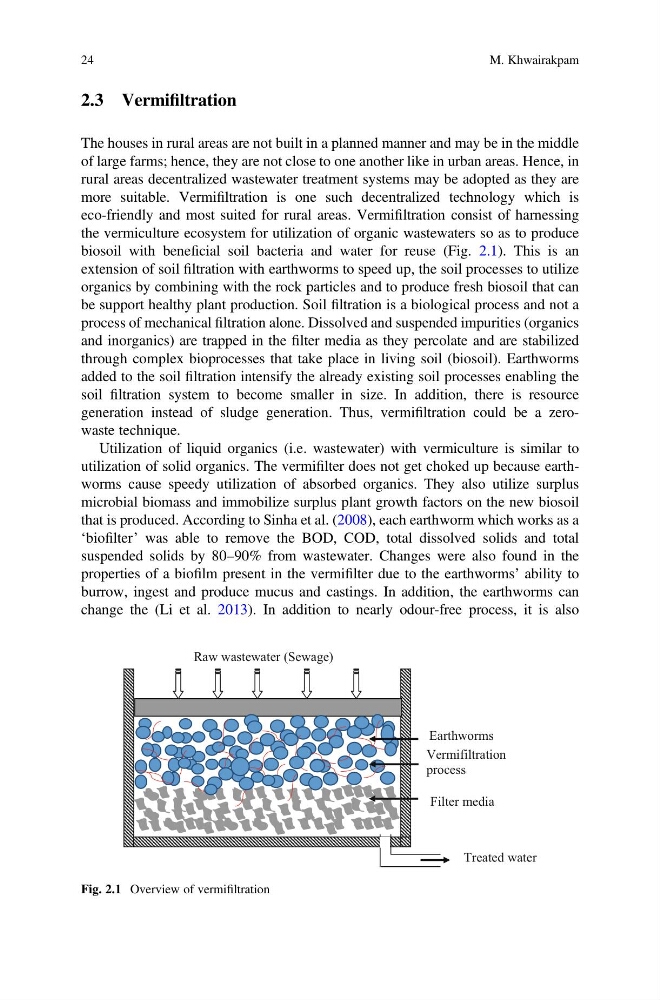
biosoil with beneficial soil bacteria and water for reuse (Fig. 2.1). This is an
extension of soil filtration with earthworms to speed up, the soil processes to utilize
organics by combining with the rock particles and to produce fresh biosoil that can
be support healthy plant production. Soil filtration is a biological process and not a
process of mechanical filtration alone. Dissolved and suspended impurities (organics
and inorganics) are trapped in the filter media as they percolate and are stabilized
through complex bioprocesses that take place in living soil (biosoil). Earthworms
added to the soil filtration intensify the already existing soil processes enabling the
soil filtration system to become smaller in size. In addition, there is resource
generation instead of sludge generation. Thus, vermifiltration could be a zerowaste technique.
Utilization of liquid organics (i.e. wastewater) with vermiculture is similar to
utilization of solid organics. The vermifilter does not get choked up because earthworms cause speedy utilization of absorbed organics. They also utilize surplus
microbial biomass and immobilize surplus plant growth factors on the new biosoil
that is produced. According to Sinha et al. (2008), each earthworm which works as a
‘biofilter’ was able to remove the BOD, COD, total dissolved solids and total
suspended solids by 80–90% from wastewater. Changes were also found in the
properties of a biofilm present in the vermifilter due to the earthworms’ ability to
burrow, ingest and produce mucus and castings. In addition, the earthworms can
change the (Li et al. 2013). In addition to nearly odour-free process, it is also
Treated water
Raw wastewater (Sewage)
Filter media
Vermifiltration
process
Earthworms
Fig. 2.1 Overview of vermifiltration
24
M. Khwairakpam
The houses in rural areas are not built in a planned manner and may be in the middle
of large farms; hence, they are not close to one another like in urban areas. Hence, in
rural areas decentralized wastewater treatment systems may be adopted as they are
more suitable. Vermifiltration is one such decentralized technology which is
eco-friendly and most suited for rural areas. Vermifiltration consist of harnessing
the vermiculture ecosystem for utilization of organic wastewaters so as to produce
biosoil with beneficial soil bacteria and water for reuse (Fig. 2.1). This is an
extension of soil filtration with earthworms to speed up, the soil processes to utilize
organics by combining with the rock particles and to produce fresh biosoil that can
be support healthy plant production. Soil filtration is a biological process and not a
process of mechanical filtration alone. Dissolved and suspended impurities (organics
and inorganics) are trapped in the filter media as they percolate and are stabilized
through complex bioprocesses that take place in living soil (biosoil). Earthworms
added to the soil filtration intensify the already existing soil processes enabling the
soil filtration system to become smaller in size. In addition, there is resource
generation instead of sludge generation. Thus, vermifiltration could be a zerowaste technique.
Utilization of liquid organics (i.e. wastewater) with vermiculture is similar to
utilization of solid organics. The vermifilter does not get choked up because earthworms cause speedy utilization of absorbed organics. They also utilize surplus
microbial biomass and immobilize surplus plant growth factors on the new biosoil
that is produced. According to Sinha et al. (2008), each earthworm which works as a
‘biofilter’ was able to remove the BOD, COD, total dissolved solids and total
suspended solids by 80–90% from wastewater. Changes were also found in the
properties of a biofilm present in the vermifilter due to the earthworms’ ability to
burrow, ingest and produce mucus and castings. In addition, the earthworms can
change the (Li et al. 2013). In addition to nearly odour-free process, it is also
Treated water
Raw wastewater (Sewage)
Filter media
Vermifiltration
process
Earthworms
Fig. 2.1 Overview of vermifiltration
24
M. Khwairakpam