

metals in final materials (Lv et al. 2016; Manakova et al. 2014; Singh and
Kalamdhad 2013; Suthar et al. 2014). According to Lemtiri et al. (2016), the
earthworm E. fetida introduced to heavy metal contaminated soil for 42 days
accumulated large quantities of heavy metals (Zn and Cu) in their body at the end
of the experiment.
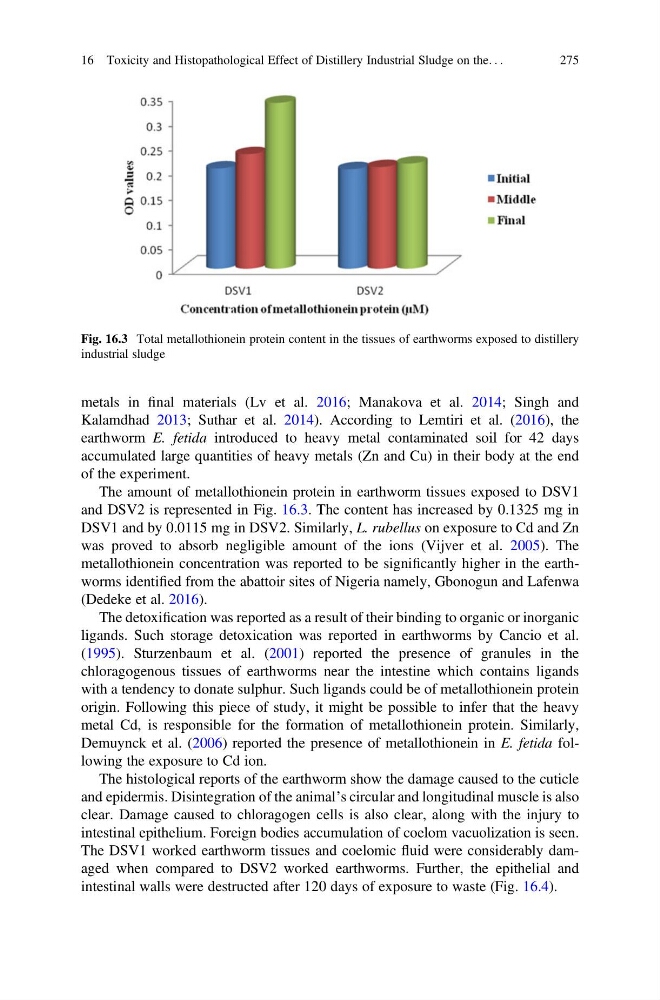
The amount of metallothionein protein in earthworm tissues exposed to DSV1
and DSV2 is represented in Fig. 16.3. The content has increased by 0.1325 mg in
DSV1 and by 0.0115 mg in DSV2. Similarly, L. rubellus on exposure to Cd and Zn
was proved to absorb negligible amount of the ions (Vijver et al. 2005). The
metallothionein concentration was reported to be significantly higher in the earthworms identified from the abattoir sites of Nigeria namely, Gbonogun and Lafenwa
(Dedeke et al. 2016).
The detoxification was reported as a result of their binding to organic or inorganic
ligands. Such storage detoxication was reported in earthworms by Cancio et al.
(1995). Sturzenbaum et al. (2001) reported the presence of granules in the
chloragogenous tissues of earthworms near the intestine which contains ligands
with a tendency to donate sulphur. Such ligands could be of metallothionein protein
origin. Following this piece of study, it might be possible to infer that the heavy
metal Cd, is responsible for the formation of metallothionein protein. Similarly,
Demuynck et al. (2006) reported the presence of metallothionein in E. fetida following the exposure to Cd ion.
The histological reports of the earthworm show the damage caused to the cuticle
and epidermis. Disintegration of the animal’s circular and longitudinal muscle is also
clear. Damage caused to chloragogen cells is also clear, along with the injury to
intestinal epithelium. Foreign bodies accumulation of coelom vacuolization is seen.
The DSV1 worked earthworm tissues and coelomic fluid were considerably damaged when compared to DSV2 worked earthworms. Further, the epithelial and
intestinal walls were destructed after 120 days of exposure to waste (Fig. 16.4).
Fig. 16.3 Total metallothionein protein content in the tissues of earthworms exposed to distillery
industrial sludge
16 Toxicity and Histopathological Effect of Distillery Industrial Sludge on the. . .
275
Kalamdhad 2013; Suthar et al. 2014). According to Lemtiri et al. (2016), the
earthworm E. fetida introduced to heavy metal contaminated soil for 42 days
accumulated large quantities of heavy metals (Zn and Cu) in their body at the end
of the experiment.
The amount of metallothionein protein in earthworm tissues exposed to DSV1
and DSV2 is represented in Fig. 16.3. The content has increased by 0.1325 mg in
DSV1 and by 0.0115 mg in DSV2. Similarly, L. rubellus on exposure to Cd and Zn
was proved to absorb negligible amount of the ions (Vijver et al. 2005). The
metallothionein concentration was reported to be significantly higher in the earthworms identified from the abattoir sites of Nigeria namely, Gbonogun and Lafenwa
(Dedeke et al. 2016).
The detoxification was reported as a result of their binding to organic or inorganic
ligands. Such storage detoxication was reported in earthworms by Cancio et al.
(1995). Sturzenbaum et al. (2001) reported the presence of granules in the
chloragogenous tissues of earthworms near the intestine which contains ligands
with a tendency to donate sulphur. Such ligands could be of metallothionein protein
origin. Following this piece of study, it might be possible to infer that the heavy
metal Cd, is responsible for the formation of metallothionein protein. Similarly,
Demuynck et al. (2006) reported the presence of metallothionein in E. fetida following the exposure to Cd ion.
The histological reports of the earthworm show the damage caused to the cuticle
and epidermis. Disintegration of the animal’s circular and longitudinal muscle is also
clear. Damage caused to chloragogen cells is also clear, along with the injury to
intestinal epithelium. Foreign bodies accumulation of coelom vacuolization is seen.
The DSV1 worked earthworm tissues and coelomic fluid were considerably damaged when compared to DSV2 worked earthworms. Further, the epithelial and
intestinal walls were destructed after 120 days of exposure to waste (Fig. 16.4).
Fig. 16.3 Total metallothionein protein content in the tissues of earthworms exposed to distillery
industrial sludge
16 Toxicity and Histopathological Effect of Distillery Industrial Sludge on the. . .
275