

surface area and enhancing nutrient availability (Giasson et al. 2006; Saxena et al.
2017). AM fungi reported to increase arsenic (As) uptake in Pteris vittata (Al Agely
et al. 2005). Jan and Parray (2016) hypothesized the mechanism AMF action of
binding heavy metals to the fungal cell wall and transporting them to the vacuoles,
chelating heavy metals by phytochelatins present in fungal as well as plant cells, and
transporting metal ions by transporters to the tonoplast of fungi and plants. A study
conducted by Ma et al. (2019) observed enhanced accumulation of Ni in Helianthus
annuus when inoculated with Pseudomonas libanensis TR1 and Claroideoglomus
claroideum BEG210.
14.5 Plant-Microbe Interaction in the Remediation
of Heavy Metals
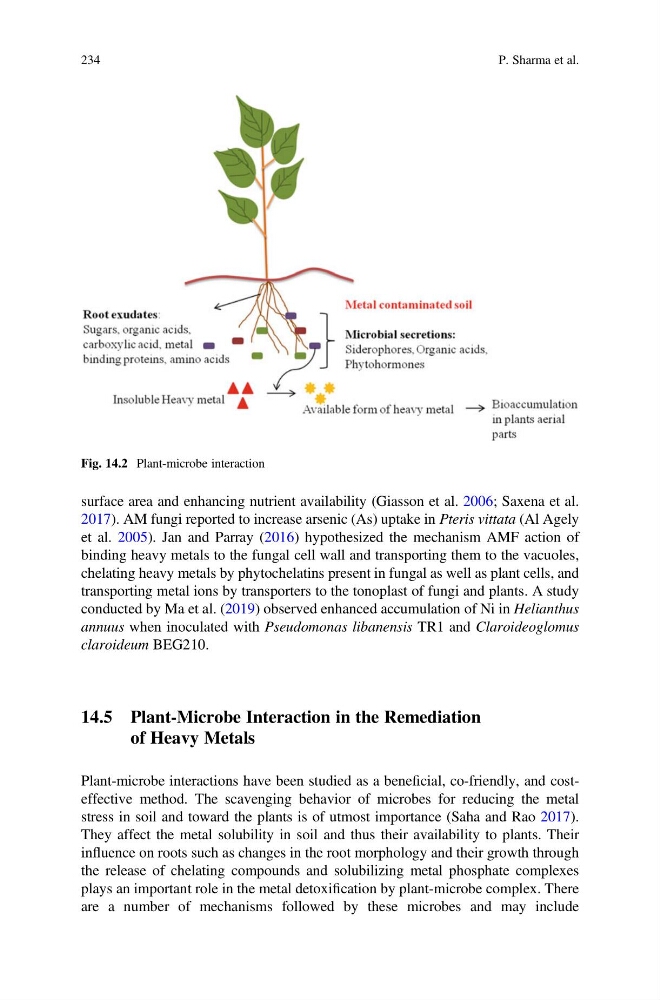
Plant-microbe interactions have been studied as a beneficial, co-friendly, and costeffective method. The scavenging behavior of microbes for reducing the metal
stress in soil and toward the plants is of utmost importance (Saha and Rao 2017).
They affect the metal solubility in soil and thus their availability to plants. Their
influence on roots such as changes in the root morphology and their growth through
the release of chelating compounds and solubilizing metal phosphate complexes
plays an important role in the metal detoxification by plant-microbe complex. There
are a number of mechanisms followed by these microbes and may include
Fig. 14.2 Plant-microbe interaction
234
P. Sharma et al.
2017). AM fungi reported to increase arsenic (As) uptake in Pteris vittata (Al Agely
et al. 2005). Jan and Parray (2016) hypothesized the mechanism AMF action of
binding heavy metals to the fungal cell wall and transporting them to the vacuoles,
chelating heavy metals by phytochelatins present in fungal as well as plant cells, and
transporting metal ions by transporters to the tonoplast of fungi and plants. A study
conducted by Ma et al. (2019) observed enhanced accumulation of Ni in Helianthus
annuus when inoculated with Pseudomonas libanensis TR1 and Claroideoglomus
claroideum BEG210.
14.5 Plant-Microbe Interaction in the Remediation
of Heavy Metals
Plant-microbe interactions have been studied as a beneficial, co-friendly, and costeffective method. The scavenging behavior of microbes for reducing the metal
stress in soil and toward the plants is of utmost importance (Saha and Rao 2017).
They affect the metal solubility in soil and thus their availability to plants. Their
influence on roots such as changes in the root morphology and their growth through
the release of chelating compounds and solubilizing metal phosphate complexes
plays an important role in the metal detoxification by plant-microbe complex. There
are a number of mechanisms followed by these microbes and may include
Fig. 14.2 Plant-microbe interaction
234
P. Sharma et al.