

2002). Sexual maturity as indicated by the appearance of clitellum is attained within
20–28 days. Growth rate of Perionyx excavatus in cow dung is 2.86 mg day
À1 , but
addition of straw to cow dung enhances its growth rate significantly as high as
4.75 mg day
À1 , while it is 4.02 mg day
À1 when bamboo leaf litter acts as an additive
(Chaudhuri and Bhattacharjee 2002). Likewise highest rate of reproduction in
P. excavatus was also noticed in cow dung-straw diet (14.0 juveniles
adult
À1 week
À1 ) which was followed by cow dung-bamboo leaf litter (11.7 juveniles
adult
À1 week
À1 ) and cow dung (2.45 juveniles adult
À1 week
À1 ) (Chaudhuri and
Bhattacharjee 2002).
11.3.1.1 Perionyx ceylanensis Michaelsen
This species was first reported from Sri Lanka but at present abundantly found in
Peninsular India. It has a great similarity with P. excavatus and is usually found in
leaf litter with high moisture and organic matter content. A recent report by Prakash
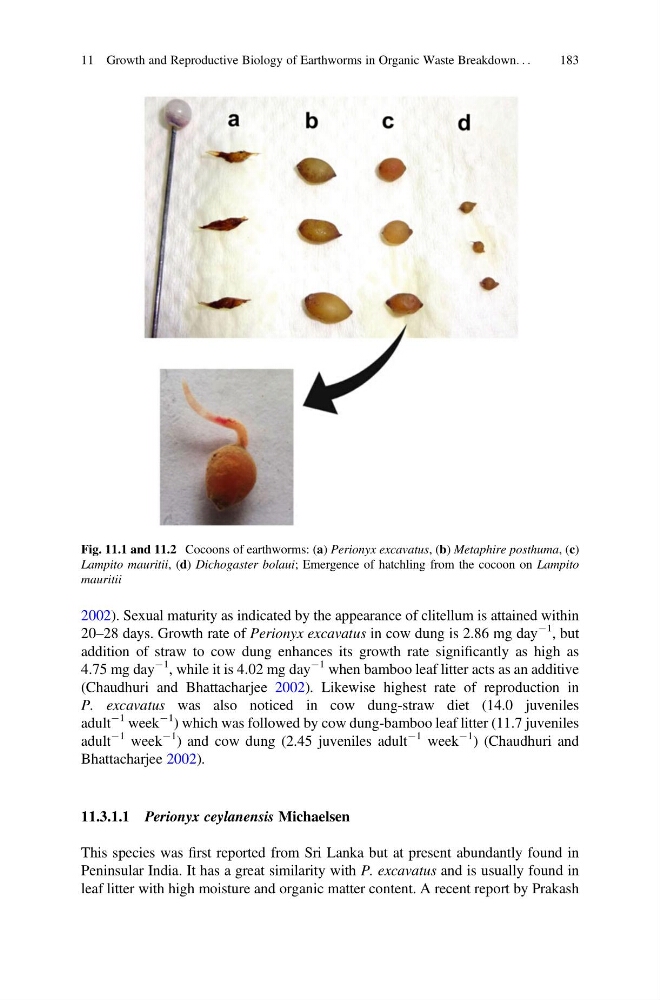
Fig. 11.1 and 11.2 Cocoons of earthworms: (a) Perionyx excavatus, (b) Metaphire posthuma, (c)
Lampito mauritii, (d) Dichogaster bolaui; Emergence of hatchling from the cocoon on Lampito
mauritii
11 Growth and Reproductive Biology of Earthworms in Organic Waste Breakdown. . .
183
20–28 days. Growth rate of Perionyx excavatus in cow dung is 2.86 mg day
À1 , but
addition of straw to cow dung enhances its growth rate significantly as high as
4.75 mg day
À1 , while it is 4.02 mg day
À1 when bamboo leaf litter acts as an additive
(Chaudhuri and Bhattacharjee 2002). Likewise highest rate of reproduction in
P. excavatus was also noticed in cow dung-straw diet (14.0 juveniles
adult
À1 week
À1 ) which was followed by cow dung-bamboo leaf litter (11.7 juveniles
adult
À1 week
À1 ) and cow dung (2.45 juveniles adult
À1 week
À1 ) (Chaudhuri and
Bhattacharjee 2002).
11.3.1.1 Perionyx ceylanensis Michaelsen
This species was first reported from Sri Lanka but at present abundantly found in
Peninsular India. It has a great similarity with P. excavatus and is usually found in
leaf litter with high moisture and organic matter content. A recent report by Prakash
Fig. 11.1 and 11.2 Cocoons of earthworms: (a) Perionyx excavatus, (b) Metaphire posthuma, (c)
Lampito mauritii, (d) Dichogaster bolaui; Emergence of hatchling from the cocoon on Lampito
mauritii
11 Growth and Reproductive Biology of Earthworms in Organic Waste Breakdown. . .
183