

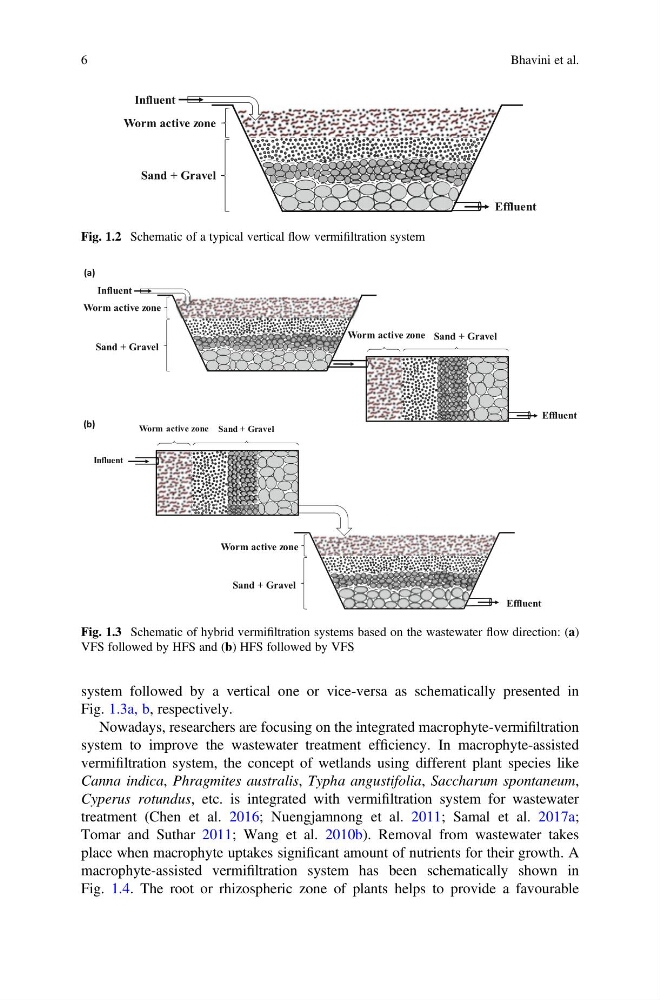
system followed by a vertical one or vice-versa as schematically presented in
Fig. 1.3a, b, respectively.
Nowadays, researchers are focusing on the integrated macrophyte-vermifiltration
system to improve the wastewater treatment efficiency. In macrophyte-assisted
vermifiltration system, the concept of wetlands using different plant species like
Canna indica, Phragmites australis, Typha angustifolia, Saccharum spontaneum,
Cyperus rotundus, etc. is integrated with vermifiltration system for wastewater
treatment (Chen et al. 2016; Nuengjamnong et al. 2011; Samal et al. 2017a;
Tomar and Suthar 2011; Wang et al. 2010b). Removal from wastewater takes
place when macrophyte uptakes significant amount of nutrients for their growth. A
macrophyte-assisted vermifiltration system has been schematically shown in
Fig. 1.4. The root or rhizospheric zone of plants helps to provide a favourable
Influent
Worm active zone
Sand + Gravel
Effluent
Fig. 1.2 Schematic of a typical vertical flow vermifiltration system
(a)
(b)
Influent
Worm active zone
Sand + Gravel
Effluent
Worm active zone Sand + Gravel
Worm active zone
Sand + Gravel
Effluent
Influent
Worm active zone Sand + Gravel
Fig. 1.3 Schematic of hybrid vermifiltration systems based on the wastewater flow direction: (a)
VFS followed by HFS and (b) HFS followed by VFS
6
Bhavini et al.
Fig. 1.3a, b, respectively.
Nowadays, researchers are focusing on the integrated macrophyte-vermifiltration
system to improve the wastewater treatment efficiency. In macrophyte-assisted
vermifiltration system, the concept of wetlands using different plant species like
Canna indica, Phragmites australis, Typha angustifolia, Saccharum spontaneum,
Cyperus rotundus, etc. is integrated with vermifiltration system for wastewater
treatment (Chen et al. 2016; Nuengjamnong et al. 2011; Samal et al. 2017a;
Tomar and Suthar 2011; Wang et al. 2010b). Removal from wastewater takes
place when macrophyte uptakes significant amount of nutrients for their growth. A
macrophyte-assisted vermifiltration system has been schematically shown in
Fig. 1.4. The root or rhizospheric zone of plants helps to provide a favourable
Influent
Worm active zone
Sand + Gravel
Effluent
Fig. 1.2 Schematic of a typical vertical flow vermifiltration system
(a)
(b)
Influent
Worm active zone
Sand + Gravel
Effluent
Worm active zone Sand + Gravel
Worm active zone
Sand + Gravel
Effluent
Influent
Worm active zone Sand + Gravel
Fig. 1.3 Schematic of hybrid vermifiltration systems based on the wastewater flow direction: (a)
VFS followed by HFS and (b) HFS followed by VFS
6
Bhavini et al.