

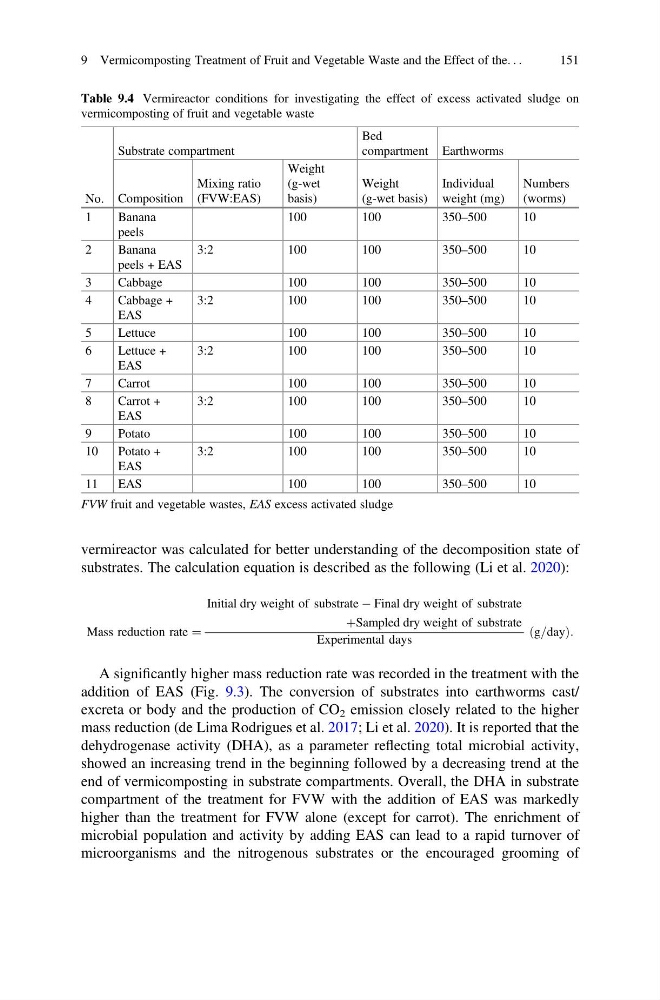
vermireactor was calculated for better understanding of the decomposition state of
substrates. The calculation equation is described as the following (Li et al. 2020):
Mass reduction rate ¼
Initial dry weight of substrate À Final dry weight of substrate
þSampled dry weight of substrate
Experimental days
g=day
ð
Þ:
A significantly higher mass reduction rate was recorded in the treatment with the
addition of EAS (Fig. 9.3). The conversion of substrates into earthworms cast/
excreta or body and the production of CO 2 emission closely related to the higher
mass reduction (de Lima Rodrigues et al. 2017; Li et al. 2020). It is reported that the
dehydrogenase activity (DHA), as a parameter reflecting total microbial activity,
showed an increasing trend in the beginning followed by a decreasing trend at the
end of vermicomposting in substrate compartments. Overall, the DHA in substrate
compartment of the treatment for FVW with the addition of EAS was markedly
higher than the treatment for FVW alone (except for carrot). The enrichment of
microbial population and activity by adding EAS can lead to a rapid turnover of
microorganisms and the nitrogenous substrates or the encouraged grooming of
Table 9.4 Vermireactor conditions for investigating the effect of excess activated sludge on
vermicomposting of fruit and vegetable waste
No.
Substrate compartment
Bed
compartment Earthworms
Composition
Mixing ratio
(FVW:EAS)
Weight
(g-wet
basis)
Weight
(g-wet basis)
Individual
weight (mg)
Numbers
(worms)
1
Banana
peels
100
100
350–500
10
2
Banana
peels + EAS
3:2
100
100
350–500
10
3
Cabbage
100
100
350–500
10
4
Cabbage +
EAS
3:2
100
100
350–500
10
5
Lettuce
100
100
350–500
10
6
Lettuce +
EAS
3:2
100
100
350–500
10
7
Carrot
100
100
350–500
10
8
Carrot +
EAS
3:2
100
100
350–500
10
9
Potato
100
100
350–500
10
10
Potato +
EAS
3:2
100
100
350–500
10
11
EAS
100
100
350–500
10
FVW fruit and vegetable wastes, EAS excess activated sludge
9 Vermicomposting Treatment of Fruit and Vegetable Waste and the Effect of the. . .
151
substrates. The calculation equation is described as the following (Li et al. 2020):
Mass reduction rate ¼
Initial dry weight of substrate À Final dry weight of substrate
þSampled dry weight of substrate
Experimental days
g=day
ð
Þ:
A significantly higher mass reduction rate was recorded in the treatment with the
addition of EAS (Fig. 9.3). The conversion of substrates into earthworms cast/
excreta or body and the production of CO 2 emission closely related to the higher
mass reduction (de Lima Rodrigues et al. 2017; Li et al. 2020). It is reported that the
dehydrogenase activity (DHA), as a parameter reflecting total microbial activity,
showed an increasing trend in the beginning followed by a decreasing trend at the
end of vermicomposting in substrate compartments. Overall, the DHA in substrate
compartment of the treatment for FVW with the addition of EAS was markedly
higher than the treatment for FVW alone (except for carrot). The enrichment of
microbial population and activity by adding EAS can lead to a rapid turnover of
microorganisms and the nitrogenous substrates or the encouraged grooming of
Table 9.4 Vermireactor conditions for investigating the effect of excess activated sludge on
vermicomposting of fruit and vegetable waste
No.
Substrate compartment
Bed
compartment Earthworms
Composition
Mixing ratio
(FVW:EAS)
Weight
(g-wet
basis)
Weight
(g-wet basis)
Individual
weight (mg)
Numbers
(worms)
1
Banana
peels
100
100
350–500
10
2
Banana
peels + EAS
3:2
100
100
350–500
10
3
Cabbage
100
100
350–500
10
4
Cabbage +
EAS
3:2
100
100
350–500
10
5
Lettuce
100
100
350–500
10
6
Lettuce +
EAS
3:2
100
100
350–500
10
7
Carrot
100
100
350–500
10
8
Carrot +
EAS
3:2
100
100
350–500
10
9
Potato
100
100
350–500
10
10
Potato +
EAS
3:2
100
100
350–500
10
11
EAS
100
100
350–500
10
FVW fruit and vegetable wastes, EAS excess activated sludge
9 Vermicomposting Treatment of Fruit and Vegetable Waste and the Effect of the. . .
151