

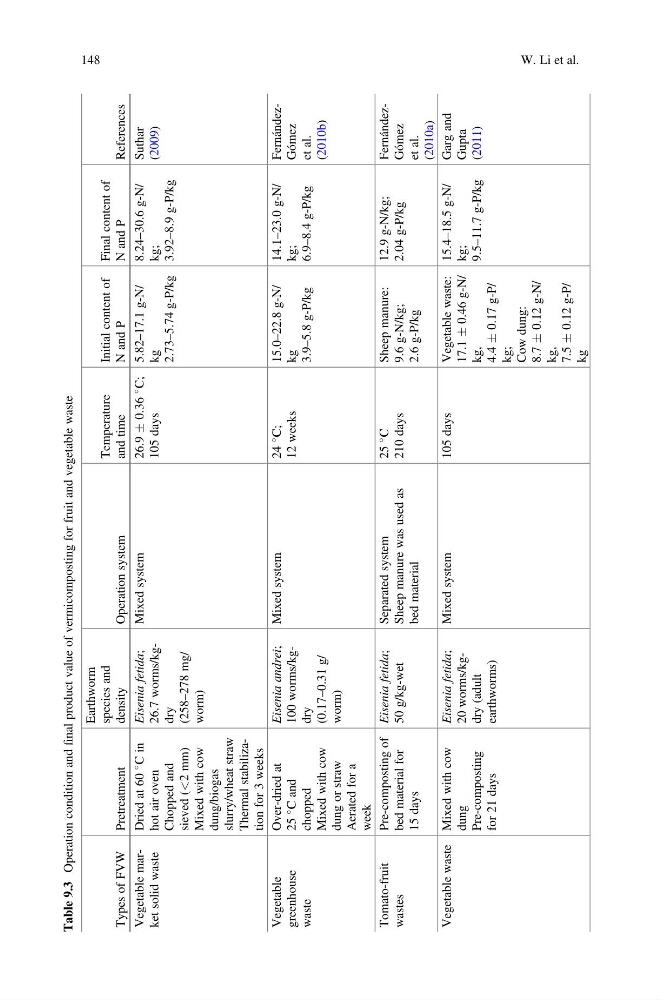
Table 9.3
Operation condition and
final product value of vermicomposting for fruit and vegetable waste
Types of FVW
Pretreatment
Earthworm
species and
density
Operation system
Temperature
and time
Initial content of
N and P
Final content of
N and P
References
Vegetable market solid waste
Dried at 60
C in
hot air oven
Chopped and
sieved (<2 mm)
Mixed with cow
dung/biogas
slurry/wheat straw
Thermal stabilization for 3 weeks
Eisenia fetida;
26.7 worms/kgdry
(258–278 mg/
worm)
Mixed system
26.9
Æ 0.36
C;
105 days
5.82–17.1 g-N/
kg
2.73–5.74 g-P/kg
8.24–30.6 g-N/
kg;
3.92–8.9 g-P/kg
Suthar
(2009)
Vegetable
greenhouse
waste
Over-dried at
25
C and
chopped
Mixed with cow
dung or straw
Aerated for a
week
Eisenia andrei;
100 worms/kgdry
(0.17–0.31 g/
worm)
Mixed system
24
C;
12 weeks
15.0–22.8 g-N/
kg
3.9–5.8 g-P/kg
14.1–23.0 g-N/
kg;
6.9–8.4 g-P/kg
FernándezGómez
et al.
(2010b)
Tomato-fruit
wastes
Pre-composting of
bed material for
15 days
Eisenia fetida;
50 g/kg-wet
Separated system
Sheep manure was used as
bed material
25
C
210 days
Sheep manure:
9.6 g-N/kg;
2.6 g-P/kg
12.9 g-N/kg;
2.04 g-P/kg
FernándezGómez
et al.
(2010a)
Vegetable waste Mixed with cow
dung
Pre-composting
for 21 days
Eisenia fetida;
20 worms/kgdry (adult
earthworms)
Mixed system
105 days
Vegetable waste:
17.1
Æ 0.46 g-N/
kg,
4.4
Æ 0.17 g-P/
kg;
Cow dung:
8.7
Æ 0.12 g-N/
kg,
7.5
Æ 0.12 g-P/
kg
15.4–18.5 g-N/
kg;
9.5–11.7 g-P/kg
Garg and
Gupta
(2011)
148
W. Li et al.
Operation condition and
final product value of vermicomposting for fruit and vegetable waste
Types of FVW
Pretreatment
Earthworm
species and
density
Operation system
Temperature
and time
Initial content of
N and P
Final content of
N and P
References
Vegetable market solid waste
Dried at 60
C in
hot air oven
Chopped and
sieved (<2 mm)
Mixed with cow
dung/biogas
slurry/wheat straw
Thermal stabilization for 3 weeks
Eisenia fetida;
26.7 worms/kgdry
(258–278 mg/
worm)
Mixed system
26.9
Æ 0.36
C;
105 days
5.82–17.1 g-N/
kg
2.73–5.74 g-P/kg
8.24–30.6 g-N/
kg;
3.92–8.9 g-P/kg
Suthar
(2009)
Vegetable
greenhouse
waste
Over-dried at
25
C and
chopped
Mixed with cow
dung or straw
Aerated for a
week
Eisenia andrei;
100 worms/kgdry
(0.17–0.31 g/
worm)
Mixed system
24
C;
12 weeks
15.0–22.8 g-N/
kg
3.9–5.8 g-P/kg
14.1–23.0 g-N/
kg;
6.9–8.4 g-P/kg
FernándezGómez
et al.
(2010b)
Tomato-fruit
wastes
Pre-composting of
bed material for
15 days
Eisenia fetida;
50 g/kg-wet
Separated system
Sheep manure was used as
bed material
25
C
210 days
Sheep manure:
9.6 g-N/kg;
2.6 g-P/kg
12.9 g-N/kg;
2.04 g-P/kg
FernándezGómez
et al.
(2010a)
Vegetable waste Mixed with cow
dung
Pre-composting
for 21 days
Eisenia fetida;
20 worms/kgdry (adult
earthworms)
Mixed system
105 days
Vegetable waste:
17.1
Æ 0.46 g-N/
kg,
4.4
Æ 0.17 g-P/
kg;
Cow dung:
8.7
Æ 0.12 g-N/
kg,
7.5
Æ 0.12 g-P/
kg
15.4–18.5 g-N/
kg;
9.5–11.7 g-P/kg
Garg and
Gupta
(2011)
148
W. Li et al.