

the decomposition process because microorganisms are released again into the
vermicompost matrix as part of the earthworm casts (Aira and Domínguez 2011).
Later on, natural ageing processes known as cast-associated processes take place
during vermicomposting with implications on nutrient availability and, consequently, on the structure of the microbial community (Aira et al. 2010).
Furthermore, we found that the initial differences among bacterial communities in
terms of β-diversity were markedly reduced, mainly at phylogenetic level, once
transformed into vermicomposts (Fig. 8.4b). All of the four vermicomposts grouped
closely together in the negative side of the first axis (Fig. 8.4b). These similarities at
phylogenetic level also held true for the microbiome of fresh casts of E. andrei
feeding on different types of animal manure as reported by Aira et al. (2015). The
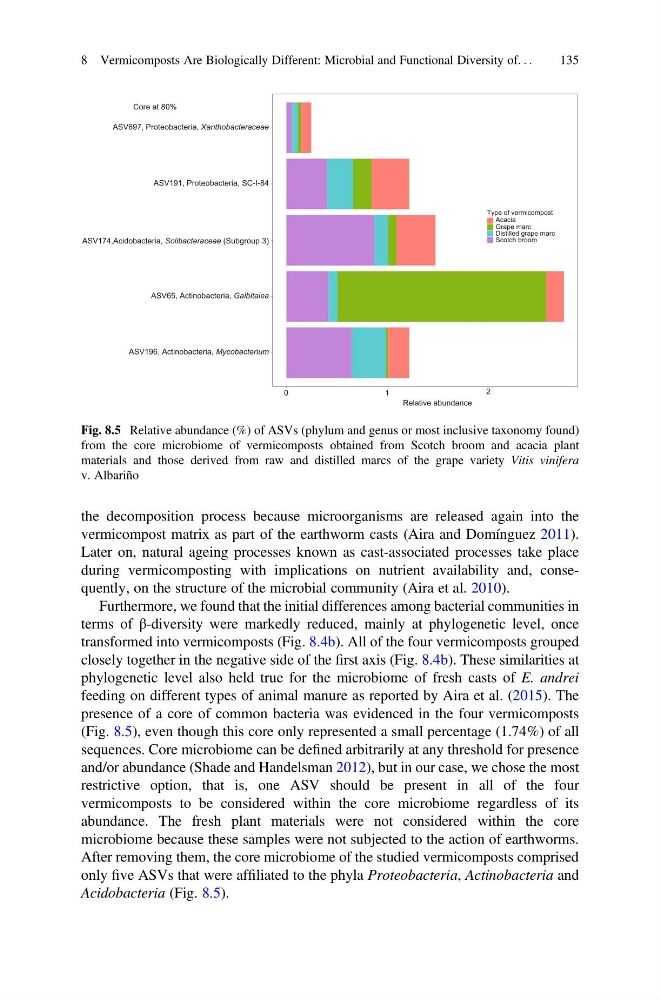
presence of a core of common bacteria was evidenced in the four vermicomposts
(Fig. 8.5), even though this core only represented a small percentage (1.74%) of all
sequences. Core microbiome can be defined arbitrarily at any threshold for presence
and/or abundance (Shade and Handelsman 2012), but in our case, we chose the most
restrictive option, that is, one ASV should be present in all of the four
vermicomposts to be considered within the core microbiome regardless of its
abundance. The fresh plant materials were not considered within the core
microbiome because these samples were not subjected to the action of earthworms.
After removing them, the core microbiome of the studied vermicomposts comprised
only five ASVs that were affiliated to the phyla Proteobacteria, Actinobacteria and
Acidobacteria (Fig. 8.5).
ASV196, Actinobacteria, Mycobacterium
ASV65, Actinobacteria, Galbitalea
ASV174,Acidobacteria, Solibacteraceae (Subgroup 3)
ASV191, Proteobacteria, SC-I-84
ASV697, Proteobacteria, Xanthobacteraceae
2
Acacia
Grape marc
Distilled grape marc
Scotch broom
Core at 80%
Relative abundance
Type of vermicompost
1
0
Fig. 8.5 Relative abundance (%) of ASVs (phylum and genus or most inclusive taxonomy found)
from the core microbiome of vermicomposts obtained from Scotch broom and acacia plant
materials and those derived from raw and distilled marcs of the grape variety Vitis vinifera
v. Albariño
8 Vermicomposts Are Biologically Different: Microbial and Functional Diversity of. . .
135
vermicompost matrix as part of the earthworm casts (Aira and Domínguez 2011).
Later on, natural ageing processes known as cast-associated processes take place
during vermicomposting with implications on nutrient availability and, consequently, on the structure of the microbial community (Aira et al. 2010).
Furthermore, we found that the initial differences among bacterial communities in
terms of β-diversity were markedly reduced, mainly at phylogenetic level, once
transformed into vermicomposts (Fig. 8.4b). All of the four vermicomposts grouped
closely together in the negative side of the first axis (Fig. 8.4b). These similarities at
phylogenetic level also held true for the microbiome of fresh casts of E. andrei
feeding on different types of animal manure as reported by Aira et al. (2015). The
presence of a core of common bacteria was evidenced in the four vermicomposts
(Fig. 8.5), even though this core only represented a small percentage (1.74%) of all
sequences. Core microbiome can be defined arbitrarily at any threshold for presence
and/or abundance (Shade and Handelsman 2012), but in our case, we chose the most
restrictive option, that is, one ASV should be present in all of the four
vermicomposts to be considered within the core microbiome regardless of its
abundance. The fresh plant materials were not considered within the core
microbiome because these samples were not subjected to the action of earthworms.
After removing them, the core microbiome of the studied vermicomposts comprised
only five ASVs that were affiliated to the phyla Proteobacteria, Actinobacteria and
Acidobacteria (Fig. 8.5).
ASV196, Actinobacteria, Mycobacterium
ASV65, Actinobacteria, Galbitalea
ASV174,Acidobacteria, Solibacteraceae (Subgroup 3)
ASV191, Proteobacteria, SC-I-84
ASV697, Proteobacteria, Xanthobacteraceae
2
Acacia
Grape marc
Distilled grape marc
Scotch broom
Core at 80%
Relative abundance
Type of vermicompost
1
0
Fig. 8.5 Relative abundance (%) of ASVs (phylum and genus or most inclusive taxonomy found)
from the core microbiome of vermicomposts obtained from Scotch broom and acacia plant
materials and those derived from raw and distilled marcs of the grape variety Vitis vinifera
v. Albariño
8 Vermicomposts Are Biologically Different: Microbial and Functional Diversity of. . .
135