

vermifilters in treating brewery wastewater. The COD removals were observed to be
up to 95%. In contrast to vertical flow vermifilters, horizontal flow vermifilters
exhibit a greater potential in removing total nitrogen (TN) from the influent
(8–20%). Because of its removing efficiencies, it can be suggested that the use of
vermifilter can be extended to other wastewaters also. The application of
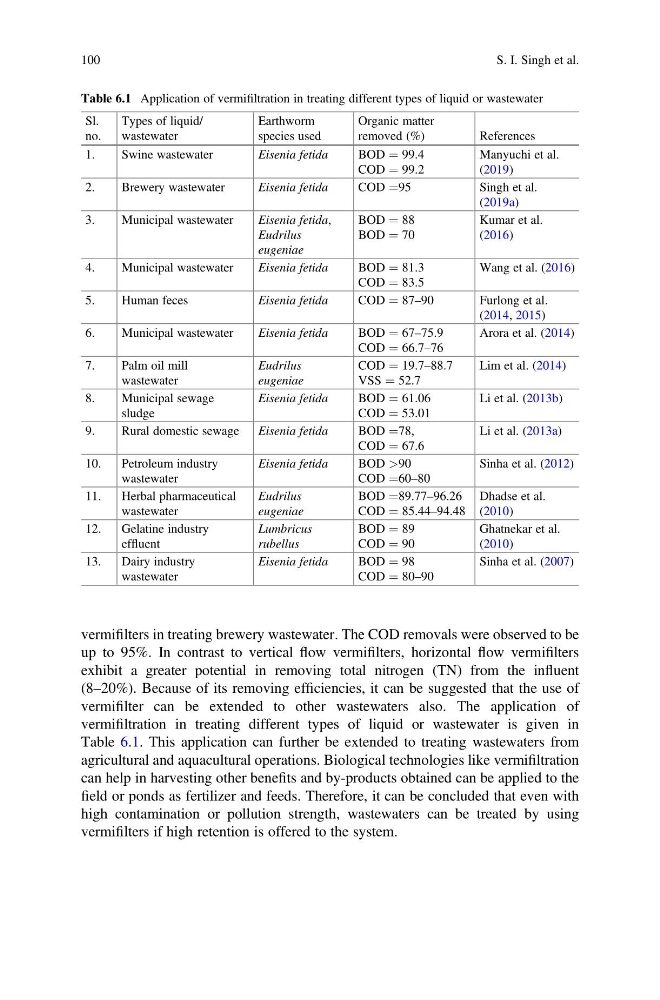
vermifiltration in treating different types of liquid or wastewater is given in
Table 6.1. This application can further be extended to treating wastewaters from
agricultural and aquacultural operations. Biological technologies like vermifiltration
can help in harvesting other benefits and by-products obtained can be applied to the
field or ponds as fertilizer and feeds. Therefore, it can be concluded that even with
high contamination or pollution strength, wastewaters can be treated by using
vermifilters if high retention is offered to the system.
Table 6.1 Application of vermifiltration in treating different types of liquid or wastewater
Sl.
no.
Types of liquid/
wastewater
Earthworm
species used
Organic matter
removed (%)
References
1.
Swine wastewater
Eisenia fetida
BOD ¼ 99.4
COD ¼ 99.2
Manyuchi et al.
(2019)
2.
Brewery wastewater
Eisenia fetida
COD ¼95
Singh et al.
(2019a)
3.
Municipal wastewater
Eisenia fetida,
Eudrilus
eugeniae
BOD ¼ 88
BOD ¼ 70
Kumar et al.
(2016)
4.
Municipal wastewater
Eisenia fetida
BOD ¼ 81.3
COD ¼ 83.5
Wang et al. (2016)
5.
Human feces
Eisenia fetida
COD ¼ 87–90
Furlong et al.
(2014, 2015)
6.
Municipal wastewater
Eisenia fetida
BOD ¼ 67–75.9
COD ¼ 66.7–76
Arora et al. (2014)
7.
Palm oil mill
wastewater
Eudrilus
eugeniae
COD ¼ 19.7–88.7
VSS ¼ 52.7
Lim et al. (2014)
8.
Municipal sewage
sludge
Eisenia fetida
BOD ¼ 61.06
COD ¼ 53.01
Li et al. (2013b)
9.
Rural domestic sewage Eisenia fetida
BOD ¼78,
COD ¼ 67.6
Li et al. (2013a)
10.
Petroleum industry
wastewater
Eisenia fetida
BOD >90
COD ¼60–80
Sinha et al. (2012)
11.
Herbal pharmaceutical
wastewater
Eudrilus
eugeniae
BOD ¼89.77–96.26
COD ¼ 85.44–94.48
Dhadse et al.
(2010)
12.
Gelatine industry
effluent
Lumbricus
rubellus
BOD ¼ 89
COD ¼ 90
Ghatnekar et al.
(2010)
13.
Dairy industry
wastewater
Eisenia fetida
BOD ¼ 98
COD ¼ 80–90
Sinha et al. (2007)
100
S. I. Singh et al.
up to 95%. In contrast to vertical flow vermifilters, horizontal flow vermifilters
exhibit a greater potential in removing total nitrogen (TN) from the influent
(8–20%). Because of its removing efficiencies, it can be suggested that the use of
vermifilter can be extended to other wastewaters also. The application of
vermifiltration in treating different types of liquid or wastewater is given in
Table 6.1. This application can further be extended to treating wastewaters from
agricultural and aquacultural operations. Biological technologies like vermifiltration
can help in harvesting other benefits and by-products obtained can be applied to the
field or ponds as fertilizer and feeds. Therefore, it can be concluded that even with
high contamination or pollution strength, wastewaters can be treated by using
vermifilters if high retention is offered to the system.
Table 6.1 Application of vermifiltration in treating different types of liquid or wastewater
Sl.
no.
Types of liquid/
wastewater
Earthworm
species used
Organic matter
removed (%)
References
1.
Swine wastewater
Eisenia fetida
BOD ¼ 99.4
COD ¼ 99.2
Manyuchi et al.
(2019)
2.
Brewery wastewater
Eisenia fetida
COD ¼95
Singh et al.
(2019a)
3.
Municipal wastewater
Eisenia fetida,
Eudrilus
eugeniae
BOD ¼ 88
BOD ¼ 70
Kumar et al.
(2016)
4.
Municipal wastewater
Eisenia fetida
BOD ¼ 81.3
COD ¼ 83.5
Wang et al. (2016)
5.
Human feces
Eisenia fetida
COD ¼ 87–90
Furlong et al.
(2014, 2015)
6.
Municipal wastewater
Eisenia fetida
BOD ¼ 67–75.9
COD ¼ 66.7–76
Arora et al. (2014)
7.
Palm oil mill
wastewater
Eudrilus
eugeniae
COD ¼ 19.7–88.7
VSS ¼ 52.7
Lim et al. (2014)
8.
Municipal sewage
sludge
Eisenia fetida
BOD ¼ 61.06
COD ¼ 53.01
Li et al. (2013b)
9.
Rural domestic sewage Eisenia fetida
BOD ¼78,
COD ¼ 67.6
Li et al. (2013a)
10.
Petroleum industry
wastewater
Eisenia fetida
BOD >90
COD ¼60–80
Sinha et al. (2012)
11.
Herbal pharmaceutical
wastewater
Eudrilus
eugeniae
BOD ¼89.77–96.26
COD ¼ 85.44–94.48
Dhadse et al.
(2010)
12.
Gelatine industry
effluent
Lumbricus
rubellus
BOD ¼ 89
COD ¼ 90
Ghatnekar et al.
(2010)
13.
Dairy industry
wastewater
Eisenia fetida
BOD ¼ 98
COD ¼ 80–90
Sinha et al. (2007)
100
S. I. Singh et al.