

88
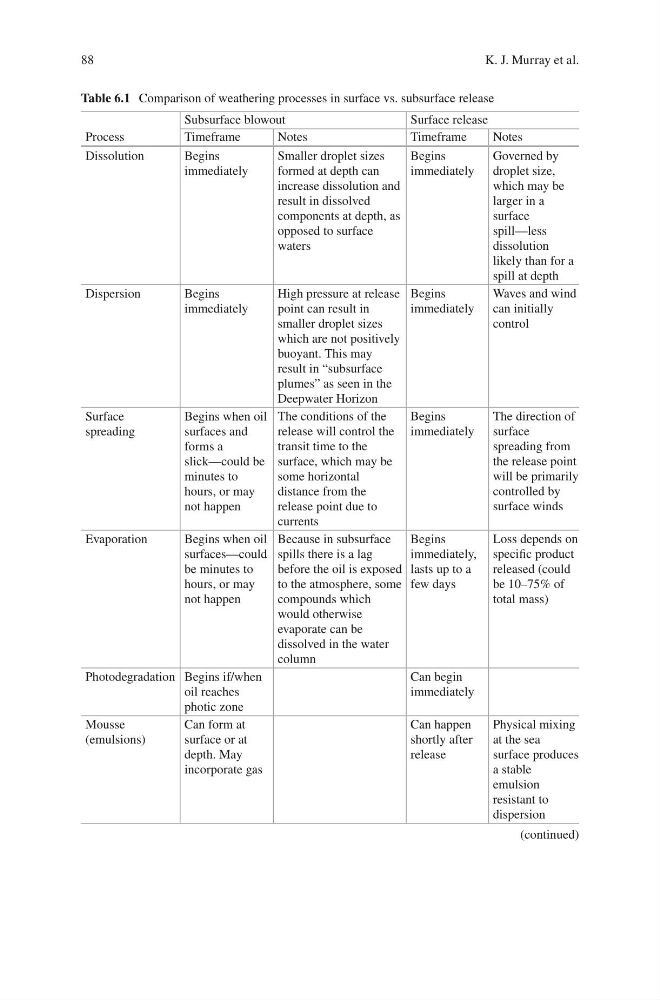
Table 6.1 Comparison of weathering processes in surface vs. subsurface release
Process
Subsurface blowout
Surface release
Timeframe
Notes
Timeframe
Notes
Dissolution
Begins
immediately
Smaller droplet sizes
formed at depth can
increase dissolution and
result in dissolved
components at depth, as
opposed to surface
waters
Begins
immediately
Governed by
droplet size,
which may be
larger in a
surface
spill—less
dissolution
likely than for a
spill at depth
Dispersion
Begins
immediately
High pressure at release
point can result in
smaller droplet sizes
which are not positively
buoyant. This may
result in “subsurface
plumes” as seen in the
Deepwater Horizon
Begins
immediately
Waves and wind
can initially
control
Surface
spreading
Begins when oil
surfaces and
forms a
slick—could be
minutes to
hours, or may
not happen
The conditions of the
release will control the
transit time to the
surface, which may be
some horizontal
distance from the
release point due to
currents
Begins
immediately
The direction of
surface
spreading from
the release point
will be primarily
controlled by
surface winds
Evaporation
Begins when oil
surfaces—could
be minutes to
hours, or may
not happen
Because in subsurface
spills there is a lag
before the oil is exposed
to the atmosphere, some
compounds which
would otherwise
evaporate can be
dissolved in the water
column
Begins
immediately,
lasts up to a
few days
Loss depends on
specific product
released (could
be 10–75% of
total mass)
Photodegradation Begins if/when
oil reaches
photic zone
Can begin
immediately
Mousse
(emulsions)
Can form at
surface or at
depth. May
incorporate gas
Can happen
shortly after
release
Physical mixing
at the sea
surface produces
a stable
emulsion
resistant to
dispersion
(continued)
K. J. Murray et al.
Table 6.1 Comparison of weathering processes in surface vs. subsurface release
Process
Subsurface blowout
Surface release
Timeframe
Notes
Timeframe
Notes
Dissolution
Begins
immediately
Smaller droplet sizes
formed at depth can
increase dissolution and
result in dissolved
components at depth, as
opposed to surface
waters
Begins
immediately
Governed by
droplet size,
which may be
larger in a
surface
spill—less
dissolution
likely than for a
spill at depth
Dispersion
Begins
immediately
High pressure at release
point can result in
smaller droplet sizes
which are not positively
buoyant. This may
result in “subsurface
plumes” as seen in the
Deepwater Horizon
Begins
immediately
Waves and wind
can initially
control
Surface
spreading
Begins when oil
surfaces and
forms a
slick—could be
minutes to
hours, or may
not happen
The conditions of the
release will control the
transit time to the
surface, which may be
some horizontal
distance from the
release point due to
currents
Begins
immediately
The direction of
surface
spreading from
the release point
will be primarily
controlled by
surface winds
Evaporation
Begins when oil
surfaces—could
be minutes to
hours, or may
not happen
Because in subsurface
spills there is a lag
before the oil is exposed
to the atmosphere, some
compounds which
would otherwise
evaporate can be
dissolved in the water
column
Begins
immediately,
lasts up to a
few days
Loss depends on
specific product
released (could
be 10–75% of
total mass)
Photodegradation Begins if/when
oil reaches
photic zone
Can begin
immediately
Mousse
(emulsions)
Can form at
surface or at
depth. May
incorporate gas
Can happen
shortly after
release
Physical mixing
at the sea
surface produces
a stable
emulsion
resistant to
dispersion
(continued)
K. J. Murray et al.