

38
ϴϭϬ
ϴϮϬ
ϴϯϬ
ϴϰϬ
ϴϱϬ
ϴϲϬ
ϴϳϬ
Ϭ
ϱ
ϭϬ
ϭϱ
ϮϬ
Ϯϱ
ĞŶƐŝƚLJŬŐͬŵ ϯ
WDWĂ
>^͕ϮϬΣ
>^н,ϰ͕ϮϬΣ
>^͕ϮϬΣͲƉƌĞĚŝĐƚĞĚ
>^н,ϰ͕ϮϬΣͲƉƌĞĚŝĐƚĞĚ
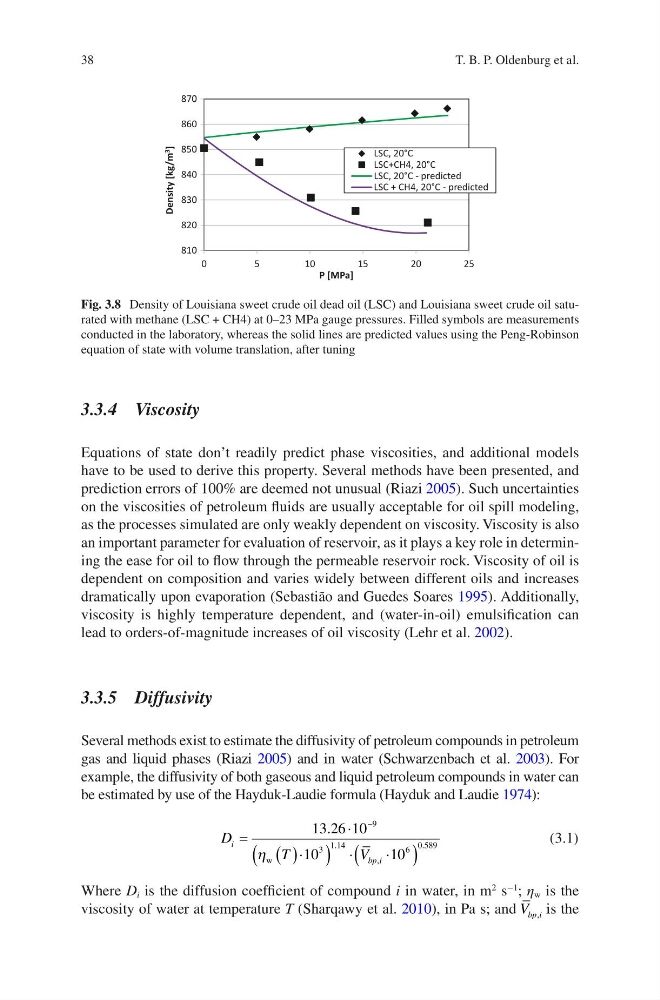
Fig. 3.8 Density of Louisiana sweet crude oil dead oil (LSC) and Louisiana sweet crude oil saturated with methane (LSC + CH4) at 0–23 MPa gauge pressures. Filled symbols are measurements
conducted in the laboratory, whereas the solid lines are predicted values using the Peng-Robinson
equation of state with volume translation, after tuning
3.3.4 Viscosity
Equations of state don’t readily predict phase viscosities, and additional models
have to be used to derive this property. Several methods have been presented, and
prediction errors of 100% are deemed not unusual (Riazi 2005). Such uncertainties
on the viscosities of petroleum fluids are usually acceptable for oil spill modeling,
as the processes simulated are only weakly dependent on viscosity. Viscosity is also
an important parameter for evaluation of reservoir, as it plays a key role in determining the ease for oil to flow through the permeable reservoir rock. Viscosity of oil is
dependent on composition and varies widely between different oils and increases
dramatically upon evaporation (Sebastião and Guedes Soares 1995). Additionally,
viscosity is highly temperature dependent, and (water-in-oil) emulsification can
lead to orders-of-magnitude increases of oil viscosity (Lehr et al. 2002).
3.3.5 Diffusivity
Several methods exist to estimate the diffusivity of petroleum compounds in petroleum
gas and liquid phases (Riazi 2005) and in water (Schwarzenbach et al. 2003). For
example, the diffusivity of both gaseous and liquid petroleum compounds in water can
be estimated by use of the Hayduk-Laudie formula (Hayduk and Laudie 1974):
D
T
V
i
bp i
=
⋅
( )⋅
(
) ⋅ ⋅
(
)
−
13 26 10
10
10
9
3
1 14
6
0 589
.
.
,
.
η w
(3.1)
Where D i is the diffusion coefficient of compound i in water, in m
2
s
−1
; η w is the
viscosity of water at temperature T (Sharqawy et al. 2010), in Pa s; and V bp i
, is the
T. B. P. Oldenburg et al.
ϴϭϬ
ϴϮϬ
ϴϯϬ
ϴϰϬ
ϴϱϬ
ϴϲϬ
ϴϳϬ
Ϭ
ϱ
ϭϬ
ϭϱ
ϮϬ
Ϯϱ
ĞŶƐŝƚLJŬŐͬŵ ϯ
WDWĂ
>^͕ϮϬΣ
>^н,ϰ͕ϮϬΣ
>^͕ϮϬΣͲƉƌĞĚŝĐƚĞĚ
>^н,ϰ͕ϮϬΣͲƉƌĞĚŝĐƚĞĚ
Fig. 3.8 Density of Louisiana sweet crude oil dead oil (LSC) and Louisiana sweet crude oil saturated with methane (LSC + CH4) at 0–23 MPa gauge pressures. Filled symbols are measurements
conducted in the laboratory, whereas the solid lines are predicted values using the Peng-Robinson
equation of state with volume translation, after tuning
3.3.4 Viscosity
Equations of state don’t readily predict phase viscosities, and additional models
have to be used to derive this property. Several methods have been presented, and
prediction errors of 100% are deemed not unusual (Riazi 2005). Such uncertainties
on the viscosities of petroleum fluids are usually acceptable for oil spill modeling,
as the processes simulated are only weakly dependent on viscosity. Viscosity is also
an important parameter for evaluation of reservoir, as it plays a key role in determining the ease for oil to flow through the permeable reservoir rock. Viscosity of oil is
dependent on composition and varies widely between different oils and increases
dramatically upon evaporation (Sebastião and Guedes Soares 1995). Additionally,
viscosity is highly temperature dependent, and (water-in-oil) emulsification can
lead to orders-of-magnitude increases of oil viscosity (Lehr et al. 2002).
3.3.5 Diffusivity
Several methods exist to estimate the diffusivity of petroleum compounds in petroleum
gas and liquid phases (Riazi 2005) and in water (Schwarzenbach et al. 2003). For
example, the diffusivity of both gaseous and liquid petroleum compounds in water can
be estimated by use of the Hayduk-Laudie formula (Hayduk and Laudie 1974):
D
T
V
i
bp i
=
⋅
( )⋅
(
) ⋅ ⋅
(
)
−
13 26 10
10
10
9
3
1 14
6
0 589
.
.
,
.
η w
(3.1)
Where D i is the diffusion coefficient of compound i in water, in m
2
s
−1
; η w is the
viscosity of water at temperature T (Sharqawy et al. 2010), in Pa s; and V bp i
, is the
T. B. P. Oldenburg et al.