

420
landing trend in catch levels after 1993 is attributable to overexploitation. Recently,
the fishery has shown a slight landing increase; however, the fishery resource is
considered to be in a fully to overexploited condition (DOF 2018).
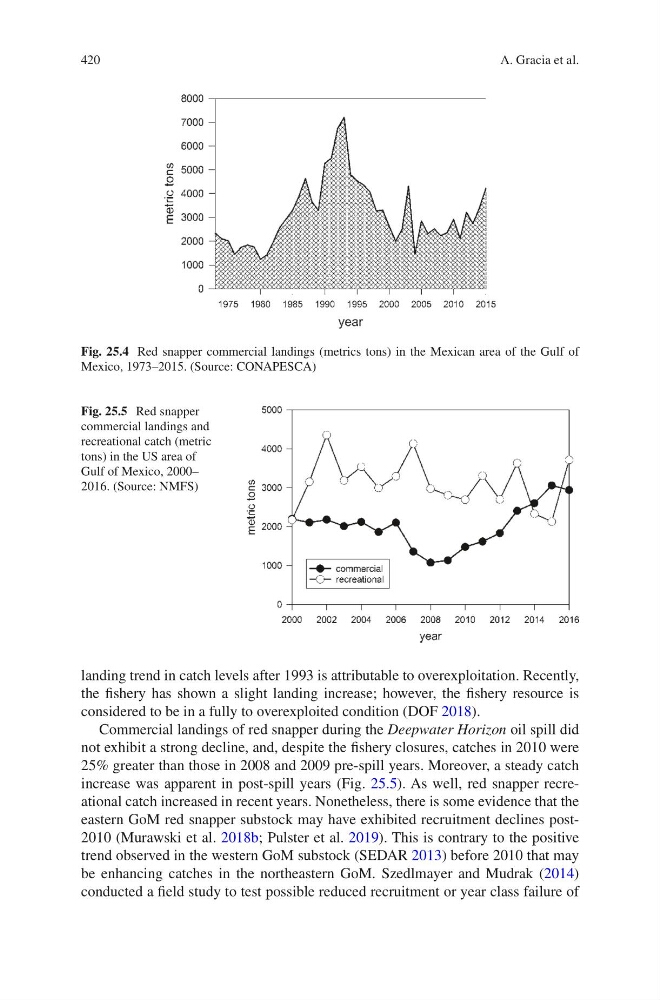
Commercial landings of red snapper during the Deepwater Horizon oil spill did
not exhibit a strong decline, and, despite the fishery closures, catches in 2010 were
25% greater than those in 2008 and 2009 pre-spill years. Moreover, a steady catch
increase was apparent in post-spill years (Fig. 25.5). As well, red snapper recreational catch increased in recent years. Nonetheless, there is some evidence that the
eastern GoM red snapper substock may have exhibited recruitment declines post2010 (Murawski et al. 2018b; Pulster et al. 2019). This is contrary to the positive
trend observed in the western GoM substock (SEDAR 2013) before 2010 that may
be enhancing catches in the northeastern GoM. Szedlmayer and Mudrak (2014)
conducted a field study to test possible reduced recruitment or year class failure of
Fig. 25.4 Red snapper commercial landings (metrics tons) in the Mexican area of the Gulf of
Mexico, 1973–2015. (Source: CONAPESCA)
Fig. 25.5 Red snapper
commercial landings and
recreational catch (metric
tons) in the US area of
Gulf of Mexico, 2000–
2016. (Source: NMFS)
A. Gracia et al.
landing trend in catch levels after 1993 is attributable to overexploitation. Recently,
the fishery has shown a slight landing increase; however, the fishery resource is
considered to be in a fully to overexploited condition (DOF 2018).
Commercial landings of red snapper during the Deepwater Horizon oil spill did
not exhibit a strong decline, and, despite the fishery closures, catches in 2010 were
25% greater than those in 2008 and 2009 pre-spill years. Moreover, a steady catch
increase was apparent in post-spill years (Fig. 25.5). As well, red snapper recreational catch increased in recent years. Nonetheless, there is some evidence that the
eastern GoM red snapper substock may have exhibited recruitment declines post2010 (Murawski et al. 2018b; Pulster et al. 2019). This is contrary to the positive
trend observed in the western GoM substock (SEDAR 2013) before 2010 that may
be enhancing catches in the northeastern GoM. Szedlmayer and Mudrak (2014)
conducted a field study to test possible reduced recruitment or year class failure of
Fig. 25.4 Red snapper commercial landings (metrics tons) in the Mexican area of the Gulf of
Mexico, 1973–2015. (Source: CONAPESCA)
Fig. 25.5 Red snapper
commercial landings and
recreational catch (metric
tons) in the US area of
Gulf of Mexico, 2000–
2016. (Source: NMFS)
A. Gracia et al.