

391
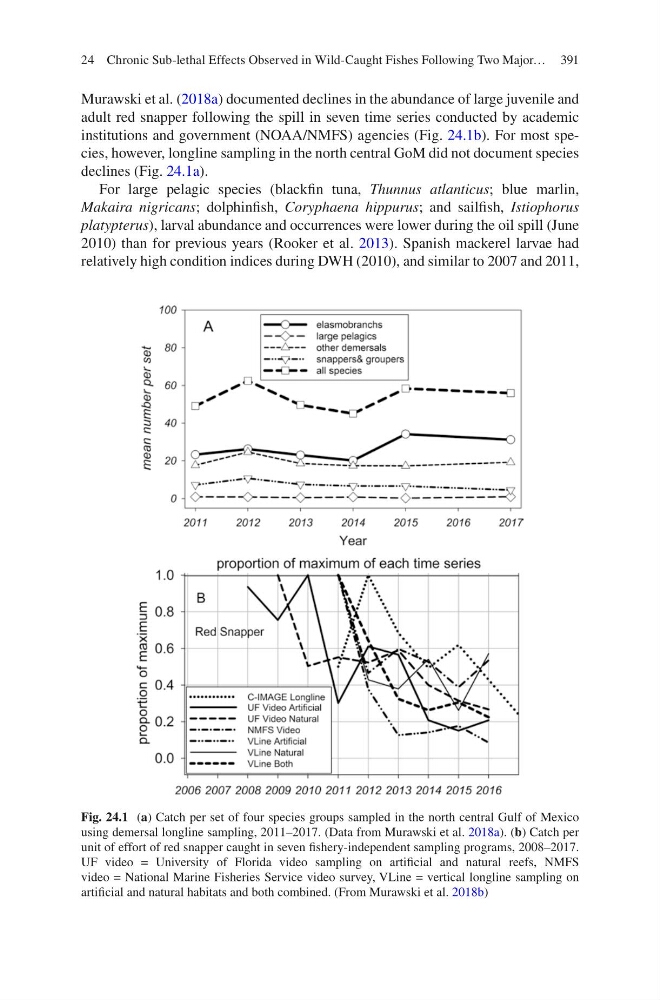
Murawski et al. (2018a) documented declines in the abundance of large juvenile and
adult red snapper following the spill in seven time series conducted by academic
institutions and government (NOAA/NMFS) agencies (Fig. 24.1b). For most species, however, longline sampling in the north central GoM did not document species
declines (Fig. 24.1a).
For large pelagic species (blackfin tuna, Thunnus atlanticus; blue marlin,
Makaira nigricans; dolphinfish, Coryphaena hippurus; and sailfish, Istiophorus
platypterus), larval abundance and occurrences were lower during the oil spill (June
2010) than for previous years (Rooker et al. 2013). Spanish mackerel larvae had
relatively high condition indices during DWH (2010), and similar to 2007 and 2011,
Fig. 24.1 (a) Catch per set of four species groups sampled in the north central Gulf of Mexico
using demersal longline sampling, 2011–2017. (Data from Murawski et al. 2018a). (b) Catch per
unit of effort of red snapper caught in seven fishery-independent sampling programs, 2008–2017.
UF video = University of Florida video sampling on artificial and natural reefs, NMFS
video = National Marine Fisheries Service video survey, VLine = vertical longline sampling on
artificial and natural habitats and both combined. (From Murawski et al. 2018b)
24 Chronic Sub-lethal Effects Observed in Wild-Caught Fishes Following Two Major…
Murawski et al. (2018a) documented declines in the abundance of large juvenile and
adult red snapper following the spill in seven time series conducted by academic
institutions and government (NOAA/NMFS) agencies (Fig. 24.1b). For most species, however, longline sampling in the north central GoM did not document species
declines (Fig. 24.1a).
For large pelagic species (blackfin tuna, Thunnus atlanticus; blue marlin,
Makaira nigricans; dolphinfish, Coryphaena hippurus; and sailfish, Istiophorus
platypterus), larval abundance and occurrences were lower during the oil spill (June
2010) than for previous years (Rooker et al. 2013). Spanish mackerel larvae had
relatively high condition indices during DWH (2010), and similar to 2007 and 2011,
Fig. 24.1 (a) Catch per set of four species groups sampled in the north central Gulf of Mexico
using demersal longline sampling, 2011–2017. (Data from Murawski et al. 2018a). (b) Catch per
unit of effort of red snapper caught in seven fishery-independent sampling programs, 2008–2017.
UF video = University of Florida video sampling on artificial and natural reefs, NMFS
video = National Marine Fisheries Service video survey, VLine = vertical longline sampling on
artificial and natural habitats and both combined. (From Murawski et al. 2018b)
24 Chronic Sub-lethal Effects Observed in Wild-Caught Fishes Following Two Major…