

376
23.2 The Deepwater Horizon Oil Spill
23.2.1 Introduction to the Deepwater Horizon
The Deepwater Horizon (DWH) event released 3.19 million barrels of oil into the
northern GoM from April 20 to July 12, 2010 (US District Court 2015). Following
the DWH event, a phenomenon known as marine oil snow sedimentation and flocculent accumulation (MOSSFA) produced an order of magnitude increase in oiledflocculent flux and sedimentation throughout a large portion of the northern GoM
(Passow et al. 2012; Ziervogel et al. 2012; Brooks et al. 2015; Romero et al. 2015;
Daly et al. 2016; Schwing et al. 2017a; Romero et al. 2017; Quigg et al. 2020).
Increased oiled-flocculent flux following DWH produced a threefold increase in
polycyclic aromatic hydrocarbon (PAH) concentrations (Romero et al. 2015) and
enhanced reducing conditions (Hastings et al. 2016). Both the increase in PAH concentrations and in redox conditions impacted the surface 4–12 mm of sediment
(Brooks et al. 2015).
23.2.2 Impact
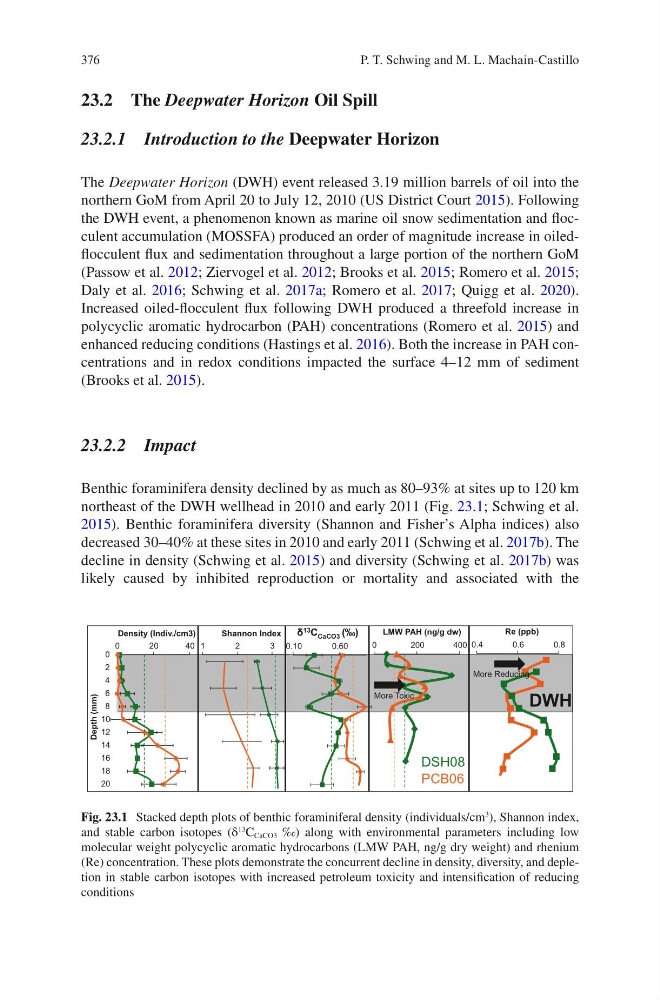
Benthic foraminifera density declined by as much as 80–93% at sites up to 120 km
northeast of the DWH wellhead in 2010 and early 2011 (Fig. 23.1; Schwing et al.
2015). Benthic foraminifera diversity (Shannon and Fisher’s Alpha indices) also
decreased 30–40% at these sites in 2010 and early 2011 (Schwing et al. 2017b). The
decline in density (Schwing et al. 2015) and diversity (Schwing et al. 2017b) was
likely caused by inhibited reproduction or mortality and associated with the
0
2 00
400
LMW PAH (ng/g dw)
0.4
0 .6
0.8
Re (ppb)
DSH08
PCB06
0.10
0.60
δ 13 C CaCO3 (‰)
0
2
4
6
8
10
12
14
16
18
20
0
2 0
4 0
Depth (mm)
1
2
3
Shannon Index
Density (Indiv./cm3)
More Toxic
DWH
More Reducing
Fig. 23.1 Stacked depth plots of benthic foraminiferal density (individuals/cm
3
), Shannon index,
and stable carbon isotopes (δ
13 C CaCO3 ‰) along with environmental parameters including low
molecular weight polycyclic aromatic hydrocarbons (LMW PAH, ng/g dry weight) and rhenium
(Re) concentration. These plots demonstrate the concurrent decline in density, diversity, and depletion in stable carbon isotopes with increased petroleum toxicity and intensification of reducing
conditions
P. T. Schwing and M. L. Machain-Castillo
23.2 The Deepwater Horizon Oil Spill
23.2.1 Introduction to the Deepwater Horizon
The Deepwater Horizon (DWH) event released 3.19 million barrels of oil into the
northern GoM from April 20 to July 12, 2010 (US District Court 2015). Following
the DWH event, a phenomenon known as marine oil snow sedimentation and flocculent accumulation (MOSSFA) produced an order of magnitude increase in oiledflocculent flux and sedimentation throughout a large portion of the northern GoM
(Passow et al. 2012; Ziervogel et al. 2012; Brooks et al. 2015; Romero et al. 2015;
Daly et al. 2016; Schwing et al. 2017a; Romero et al. 2017; Quigg et al. 2020).
Increased oiled-flocculent flux following DWH produced a threefold increase in
polycyclic aromatic hydrocarbon (PAH) concentrations (Romero et al. 2015) and
enhanced reducing conditions (Hastings et al. 2016). Both the increase in PAH concentrations and in redox conditions impacted the surface 4–12 mm of sediment
(Brooks et al. 2015).
23.2.2 Impact
Benthic foraminifera density declined by as much as 80–93% at sites up to 120 km
northeast of the DWH wellhead in 2010 and early 2011 (Fig. 23.1; Schwing et al.
2015). Benthic foraminifera diversity (Shannon and Fisher’s Alpha indices) also
decreased 30–40% at these sites in 2010 and early 2011 (Schwing et al. 2017b). The
decline in density (Schwing et al. 2015) and diversity (Schwing et al. 2017b) was
likely caused by inhibited reproduction or mortality and associated with the
0
2 00
400
LMW PAH (ng/g dw)
0.4
0 .6
0.8
Re (ppb)
DSH08
PCB06
0.10
0.60
δ 13 C CaCO3 (‰)
0
2
4
6
8
10
12
14
16
18
20
0
2 0
4 0
Depth (mm)
1
2
3
Shannon Index
Density (Indiv./cm3)
More Toxic
DWH
More Reducing
Fig. 23.1 Stacked depth plots of benthic foraminiferal density (individuals/cm
3
), Shannon index,
and stable carbon isotopes (δ
13 C CaCO3 ‰) along with environmental parameters including low
molecular weight polycyclic aromatic hydrocarbons (LMW PAH, ng/g dry weight) and rhenium
(Re) concentration. These plots demonstrate the concurrent decline in density, diversity, and depletion in stable carbon isotopes with increased petroleum toxicity and intensification of reducing
conditions
P. T. Schwing and M. L. Machain-Castillo