

335
20.3.3 Decadal-Scale Weathering Processes and Analogies
with the Weathering of Post-DWH Coastal Oil Residues
As demonstrated in various shallow systems (e.g., sandy beaches), time-series studies
of weathered oil residues collected in the nGoM, the fate of the MW oil, released
after the DWH blowout, most likely included pronounced photooxidation of the oil,
in the days and weeks following the spill (Radović et al. 2014; Ward et al. 2018),
followed by coupling to biotic oil transformations, on longer timescales, ~months to
years (Aeppli et al. 2014), with abiotically oxidized metabolites possibly being
good substrates for subsequent microbial degradation and/or prone to water washing (Harriman et al. 2017; Liu and Kujawinski 2015).
Based on the initial results from our study of coastal oil residues collected in
the sGoM, we can potentially hypothesize how oil weathering might proceed in a
multi- decadal timeframe. It seems that in low-energy environments, such as the
42.0
40.0
38.0
36.0
34.0
32.0
30.0
28.0
26.0
24.0
22.0
20.0
18.0
16.0
14.0
12.0
10.0
Percent of Total lons
8.0
6.0
4.0
2.0
0.0
APPI-P Ragnarok
Class
HC
HC
N
NO
NS
NOS
NS 2
NS 3
N
NS 2
O
O
O2
O2
O3
O3
O4
O4
OS
OS
O2S
O2S
OS3
O2S2
S
S
NS
O3S
OS2
S2
S2
S3
S4
Isla Arenas Punta Delgado Montepio Ixtoc
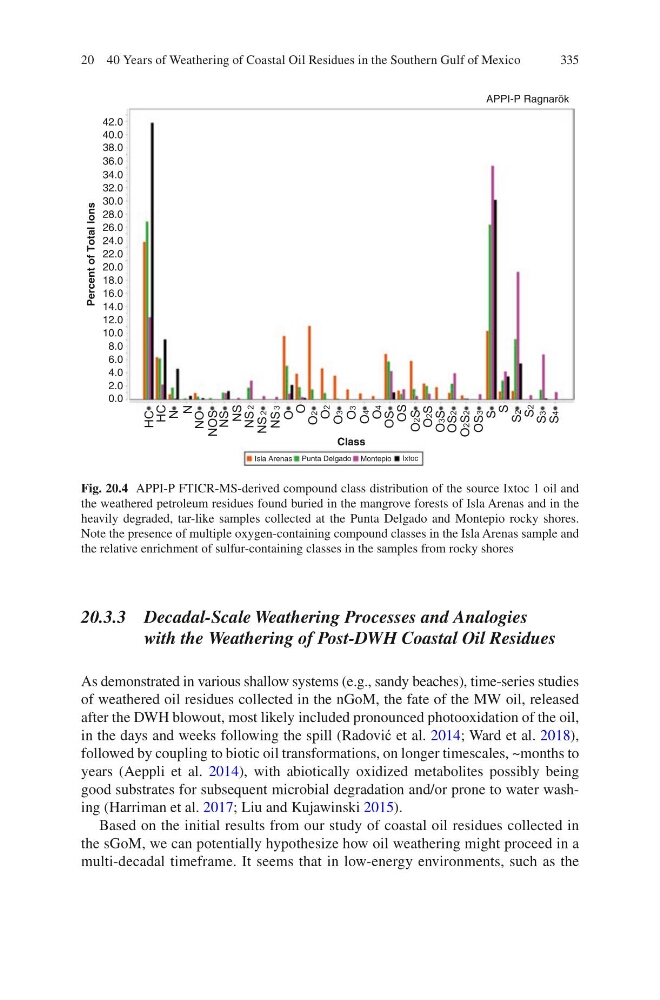
Fig. 20.4 APPI-P FTICR-MS-derived compound class distribution of the source Ixtoc 1 oil and
the weathered petroleum residues found buried in the mangrove forests of Isla Arenas and in the
heavily degraded, tar-like samples collected at the Punta Delgado and Montepio rocky shores.
Note the presence of multiple oxygen-containing compound classes in the Isla Arenas sample and
the relative enrichment of sulfur-containing classes in the samples from rocky shores
20 40 Years of Weathering of Coastal Oil Residues in the Southern Gulf of Mexico
20.3.3 Decadal-Scale Weathering Processes and Analogies
with the Weathering of Post-DWH Coastal Oil Residues
As demonstrated in various shallow systems (e.g., sandy beaches), time-series studies
of weathered oil residues collected in the nGoM, the fate of the MW oil, released
after the DWH blowout, most likely included pronounced photooxidation of the oil,
in the days and weeks following the spill (Radović et al. 2014; Ward et al. 2018),
followed by coupling to biotic oil transformations, on longer timescales, ~months to
years (Aeppli et al. 2014), with abiotically oxidized metabolites possibly being
good substrates for subsequent microbial degradation and/or prone to water washing (Harriman et al. 2017; Liu and Kujawinski 2015).
Based on the initial results from our study of coastal oil residues collected in
the sGoM, we can potentially hypothesize how oil weathering might proceed in a
multi- decadal timeframe. It seems that in low-energy environments, such as the
42.0
40.0
38.0
36.0
34.0
32.0
30.0
28.0
26.0
24.0
22.0
20.0
18.0
16.0
14.0
12.0
10.0
Percent of Total lons
8.0
6.0
4.0
2.0
0.0
APPI-P Ragnarok
Class
HC
HC
N
NO
NS
NOS
NS 2
NS 3
N
NS 2
O
O
O2
O2
O3
O3
O4
O4
OS
OS
O2S
O2S
OS3
O2S2
S
S
NS
O3S
OS2
S2
S2
S3
S4
Isla Arenas Punta Delgado Montepio Ixtoc
Fig. 20.4 APPI-P FTICR-MS-derived compound class distribution of the source Ixtoc 1 oil and
the weathered petroleum residues found buried in the mangrove forests of Isla Arenas and in the
heavily degraded, tar-like samples collected at the Punta Delgado and Montepio rocky shores.
Note the presence of multiple oxygen-containing compound classes in the Isla Arenas sample and
the relative enrichment of sulfur-containing classes in the samples from rocky shores
20 40 Years of Weathering of Coastal Oil Residues in the Southern Gulf of Mexico