

333
screening of very complex samples, such as petroleum (Rodgers and Marshall 2007).
Its advantage, in comparison to more conventional gas chromatography- based
methods used in oil spill research, is the capability to ionize and detect high molecular weight, nonvolatile, and heteroatom (nitrogen, sulfur, and oxygen, plus trace
metals)-containing chemical species. Data processing of complex mixtures of
diverse organic species (e.g., crude oil), using ultrahigh-resolution mass spectra,
yields a long list of molecular formula assignments and intensities related to mass
spectral peaks found in the spectra. In order to be able to efficiently interpret and
compare such “big” datasets, compositional sorting and other visualization strategies are needed, which could reveal the compositional characteristics of the investigated sample set. Typical petroleum geochemistry-related investigations use
sequential data layers based on the heteroatom content, DBE, and carbon number
(C#) to create plots. For more details on FTICR-MS and its applications in oil spill
science, see Radović et al. (2019).
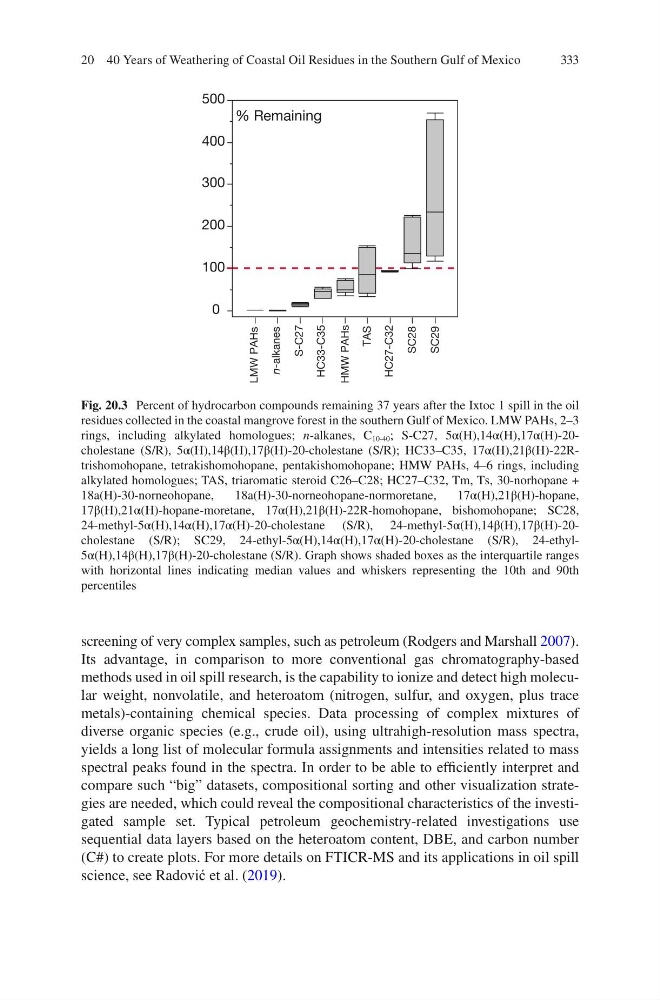
Fig. 20.3 Percent of hydrocarbon compounds remaining 37 years after the Ixtoc 1 spill in the oil
residues collected in the coastal mangrove forest in the southern Gulf of Mexico. LMW PAHs, 2–3
rings, including alkylated homologues; n-alkanes, C 10-40 ; S-C27, 5α(H),14α(H),17α(H)-20cholestane (S/R), 5α(H),14β(H),17β(H)-20-cholestane (S/R); HC33–C35, 17α(H),21β(H)-22Rtrishomohopane, tetrakishomohopane, pentakishomohopane; HMW PAHs, 4–6 rings, including
alkylated homologues; TAS, triaromatic steroid C26–C28; HC27–C32, Tm, Ts, 30-norhopane +
18a(H)-30-norneohopane,
18a(H)-30-norneohopane-normoretane,
17α(H),21β(H)-hopane,
17β(H),21α(H)-hopane-moretane, 17α(H),21β(H)-22R-homohopane, bishomohopane; SC28,
24-methyl-5α(H),14α(H),17α(H)-20-cholestane (S/R), 24-methyl-5α(H),14β(H),17β(H)-20cholestane (S/R); SC29, 24-ethyl-5α(H),14α(H),17α(H)-20-cholestane (S/R), 24-ethyl5α(H),14β(H),17β(H)-20-cholestane (S/R). Graph shows shaded boxes as the interquartile ranges
with horizontal lines indicating median values and whiskers representing the 10th and 90th
percentiles
20 40 Years of Weathering of Coastal Oil Residues in the Southern Gulf of Mexico
screening of very complex samples, such as petroleum (Rodgers and Marshall 2007).
Its advantage, in comparison to more conventional gas chromatography- based
methods used in oil spill research, is the capability to ionize and detect high molecular weight, nonvolatile, and heteroatom (nitrogen, sulfur, and oxygen, plus trace
metals)-containing chemical species. Data processing of complex mixtures of
diverse organic species (e.g., crude oil), using ultrahigh-resolution mass spectra,
yields a long list of molecular formula assignments and intensities related to mass
spectral peaks found in the spectra. In order to be able to efficiently interpret and
compare such “big” datasets, compositional sorting and other visualization strategies are needed, which could reveal the compositional characteristics of the investigated sample set. Typical petroleum geochemistry-related investigations use
sequential data layers based on the heteroatom content, DBE, and carbon number
(C#) to create plots. For more details on FTICR-MS and its applications in oil spill
science, see Radović et al. (2019).
Fig. 20.3 Percent of hydrocarbon compounds remaining 37 years after the Ixtoc 1 spill in the oil
residues collected in the coastal mangrove forest in the southern Gulf of Mexico. LMW PAHs, 2–3
rings, including alkylated homologues; n-alkanes, C 10-40 ; S-C27, 5α(H),14α(H),17α(H)-20cholestane (S/R), 5α(H),14β(H),17β(H)-20-cholestane (S/R); HC33–C35, 17α(H),21β(H)-22Rtrishomohopane, tetrakishomohopane, pentakishomohopane; HMW PAHs, 4–6 rings, including
alkylated homologues; TAS, triaromatic steroid C26–C28; HC27–C32, Tm, Ts, 30-norhopane +
18a(H)-30-norneohopane,
18a(H)-30-norneohopane-normoretane,
17α(H),21β(H)-hopane,
17β(H),21α(H)-hopane-moretane, 17α(H),21β(H)-22R-homohopane, bishomohopane; SC28,
24-methyl-5α(H),14α(H),17α(H)-20-cholestane (S/R), 24-methyl-5α(H),14β(H),17β(H)-20cholestane (S/R); SC29, 24-ethyl-5α(H),14α(H),17α(H)-20-cholestane (S/R), 24-ethyl5α(H),14β(H),17β(H)-20-cholestane (S/R). Graph shows shaded boxes as the interquartile ranges
with horizontal lines indicating median values and whiskers representing the 10th and 90th
percentiles
20 40 Years of Weathering of Coastal Oil Residues in the Southern Gulf of Mexico