

329
20.1 Introduction
The southern Gulf of Mexico (sGoM) was the scene of the second largest accidental
marine oil spill in history, overshadowed only by the 2010 Deepwater Horizon
(DWH) disaster which happened in the northern part of the Gulf (nGoM). On June
3, 1979, a blowout on the Ixtoc 1 exploratory platform in the Bay of Campeche (lat,
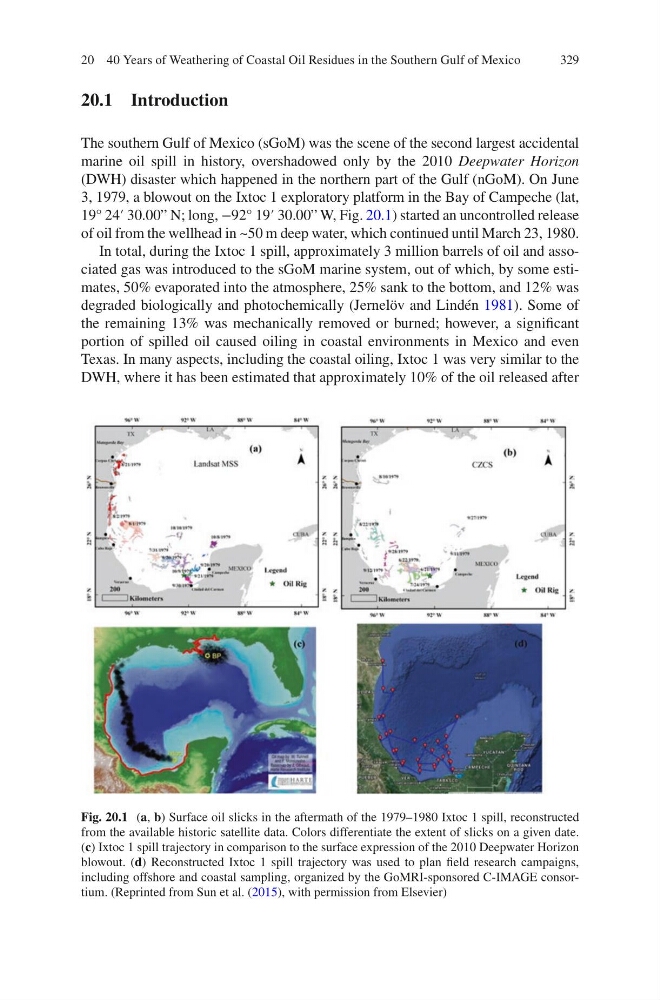
19° 24′ 30.00” N; long, −92° 19′ 30.00” W, Fig. 20.1) started an uncontrolled release
of oil from the wellhead in ~50 m deep water, which continued until March 23, 1980.
In total, during the Ixtoc 1 spill, approximately 3 million barrels of oil and associated gas was introduced to the sGoM marine system, out of which, by some estimates, 50% evaporated into the atmosphere, 25% sank to the bottom, and 12% was
degraded biologically and photochemically (Jernelöv and Lindén 1981). Some of
the remaining 13% was mechanically removed or burned; however, a significant
portion of spilled oil caused oiling in coastal environments in Mexico and even
Texas. In many aspects, including the coastal oiling, Ixtoc 1 was very similar to the
DWH, where it has been estimated that approximately 10% of the oil released after
Fig. 20.1 (a, b) Surface oil slicks in the aftermath of the 1979–1980 Ixtoc 1 spill, reconstructed
from the available historic satellite data. Colors differentiate the extent of slicks on a given date.
(c) Ixtoc 1 spill trajectory in comparison to the surface expression of the 2010 Deepwater Horizon
blowout. (d) Reconstructed Ixtoc 1 spill trajectory was used to plan field research campaigns,
including offshore and coastal sampling, organized by the GoMRI-sponsored C-IMAGE consortium. (Reprinted from Sun et al. (2015), with permission from Elsevier)
20 40 Years of Weathering of Coastal Oil Residues in the Southern Gulf of Mexico
20.1 Introduction
The southern Gulf of Mexico (sGoM) was the scene of the second largest accidental
marine oil spill in history, overshadowed only by the 2010 Deepwater Horizon
(DWH) disaster which happened in the northern part of the Gulf (nGoM). On June
3, 1979, a blowout on the Ixtoc 1 exploratory platform in the Bay of Campeche (lat,
19° 24′ 30.00” N; long, −92° 19′ 30.00” W, Fig. 20.1) started an uncontrolled release
of oil from the wellhead in ~50 m deep water, which continued until March 23, 1980.
In total, during the Ixtoc 1 spill, approximately 3 million barrels of oil and associated gas was introduced to the sGoM marine system, out of which, by some estimates, 50% evaporated into the atmosphere, 25% sank to the bottom, and 12% was
degraded biologically and photochemically (Jernelöv and Lindén 1981). Some of
the remaining 13% was mechanically removed or burned; however, a significant
portion of spilled oil caused oiling in coastal environments in Mexico and even
Texas. In many aspects, including the coastal oiling, Ixtoc 1 was very similar to the
DWH, where it has been estimated that approximately 10% of the oil released after
Fig. 20.1 (a, b) Surface oil slicks in the aftermath of the 1979–1980 Ixtoc 1 spill, reconstructed
from the available historic satellite data. Colors differentiate the extent of slicks on a given date.
(c) Ixtoc 1 spill trajectory in comparison to the surface expression of the 2010 Deepwater Horizon
blowout. (d) Reconstructed Ixtoc 1 spill trajectory was used to plan field research campaigns,
including offshore and coastal sampling, organized by the GoMRI-sponsored C-IMAGE consortium. (Reprinted from Sun et al. (2015), with permission from Elsevier)
20 40 Years of Weathering of Coastal Oil Residues in the Southern Gulf of Mexico