

21
behavior of buoyant smoke from a smokestack in the atmosphere. As it ascends,
seawater is mixed into the plume, while any horizontal ocean currents may also
cause it to bend. Generally, ocean water is density stratified, with colder, saltier
water near the bottom and warmer water of lower salinity being higher in the water
column. Oceanographers and meteorologists define water or air stability related to
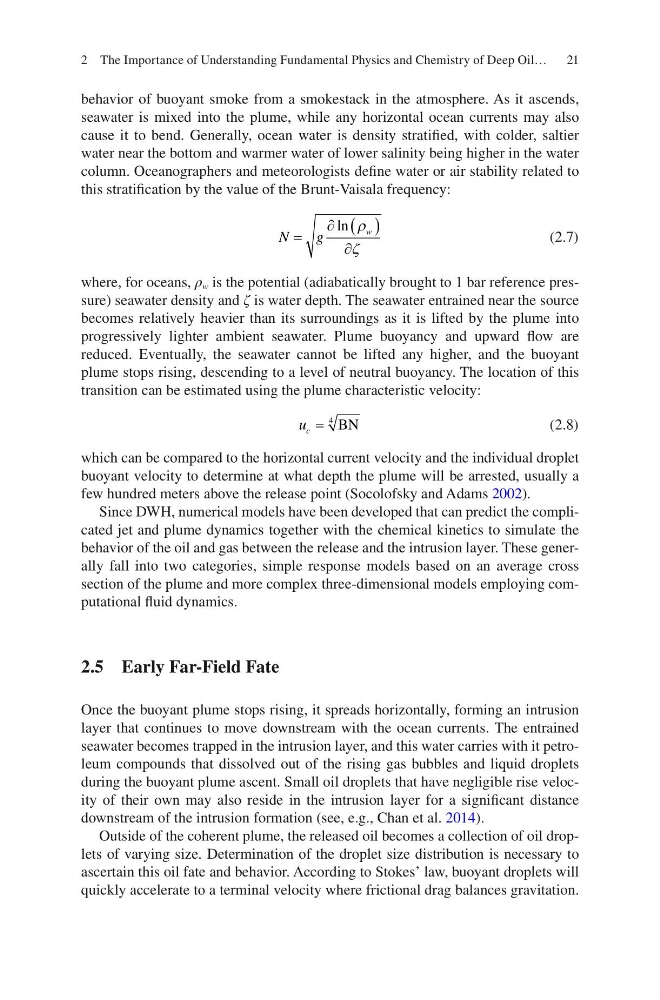
this stratification by the value of the Brunt-Vaisala frequency:
N
g
w
=
∂ ( )
∂
ln ρ
ζ
(2.7)
where, for oceans, ρ w is the potential (adiabatically brought to 1 bar reference pressure) seawater density and ζ is water depth. The seawater entrained near the source
becomes relatively heavier than its surroundings as it is lifted by the plume into
progressively lighter ambient seawater. Plume buoyancy and upward flow are
reduced. Eventually, the seawater cannot be lifted any higher, and the buoyant
plume stops rising, descending to a level of neutral buoyancy. The location of this
transition can be estimated using the plume characteristic velocity:
u c = BN
4
(2.8)
which can be compared to the horizontal current velocity and the individual droplet
buoyant velocity to determine at what depth the plume will be arrested, usually a
few hundred meters above the release point (Socolofsky and Adams 2002).
Since DWH, numerical models have been developed that can predict the complicated jet and plume dynamics together with the chemical kinetics to simulate the
behavior of the oil and gas between the release and the intrusion layer. These generally fall into two categories, simple response models based on an average cross
section of the plume and more complex three-dimensional models employing computational fluid dynamics.
2.5 Early Far-Field Fate
Once the buoyant plume stops rising, it spreads horizontally, forming an intrusion
layer that continues to move downstream with the ocean currents. The entrained
seawater becomes trapped in the intrusion layer, and this water carries with it petroleum compounds that dissolved out of the rising gas bubbles and liquid droplets
during the buoyant plume ascent. Small oil droplets that have negligible rise velocity of their own may also reside in the intrusion layer for a significant distance
downstream of the intrusion formation (see, e.g., Chan et al. 2014).
Outside of the coherent plume, the released oil becomes a collection of oil droplets of varying size. Determination of the droplet size distribution is necessary to
ascertain this oil fate and behavior. According to Stokes’ law, buoyant droplets will
quickly accelerate to a terminal velocity where frictional drag balances gravitation.
2 The Importance of Understanding Fundamental Physics and Chemistry of Deep Oil…
behavior of buoyant smoke from a smokestack in the atmosphere. As it ascends,
seawater is mixed into the plume, while any horizontal ocean currents may also
cause it to bend. Generally, ocean water is density stratified, with colder, saltier
water near the bottom and warmer water of lower salinity being higher in the water
column. Oceanographers and meteorologists define water or air stability related to
this stratification by the value of the Brunt-Vaisala frequency:
N
g
w
=
∂ ( )
∂
ln ρ
ζ
(2.7)
where, for oceans, ρ w is the potential (adiabatically brought to 1 bar reference pressure) seawater density and ζ is water depth. The seawater entrained near the source
becomes relatively heavier than its surroundings as it is lifted by the plume into
progressively lighter ambient seawater. Plume buoyancy and upward flow are
reduced. Eventually, the seawater cannot be lifted any higher, and the buoyant
plume stops rising, descending to a level of neutral buoyancy. The location of this
transition can be estimated using the plume characteristic velocity:
u c = BN
4
(2.8)
which can be compared to the horizontal current velocity and the individual droplet
buoyant velocity to determine at what depth the plume will be arrested, usually a
few hundred meters above the release point (Socolofsky and Adams 2002).
Since DWH, numerical models have been developed that can predict the complicated jet and plume dynamics together with the chemical kinetics to simulate the
behavior of the oil and gas between the release and the intrusion layer. These generally fall into two categories, simple response models based on an average cross
section of the plume and more complex three-dimensional models employing computational fluid dynamics.
2.5 Early Far-Field Fate
Once the buoyant plume stops rising, it spreads horizontally, forming an intrusion
layer that continues to move downstream with the ocean currents. The entrained
seawater becomes trapped in the intrusion layer, and this water carries with it petroleum compounds that dissolved out of the rising gas bubbles and liquid droplets
during the buoyant plume ascent. Small oil droplets that have negligible rise velocity of their own may also reside in the intrusion layer for a significant distance
downstream of the intrusion formation (see, e.g., Chan et al. 2014).
Outside of the coherent plume, the released oil becomes a collection of oil droplets of varying size. Determination of the droplet size distribution is necessary to
ascertain this oil fate and behavior. According to Stokes’ law, buoyant droplets will
quickly accelerate to a terminal velocity where frictional drag balances gravitation.
2 The Importance of Understanding Fundamental Physics and Chemistry of Deep Oil…