

319
use in electrical transformers and capacitors and paper processing (Robertson and
Hansen 2001), PCBs are classified as persistent organic pollutants. They have been
detected in sediments around the world. PCB use began to taper in the 1960s, their
production was banned by the United States in 1979, and their manufacture was banned
globally in 2001 (UNEP 2001). These once ubiquitous compounds thus have the potential to mark a sharp time window in undisturbed marine sediments, serving as a useful
tool for recent chronostratigraphy (e.g., Turetsky et al. 2004). At IXW-250 (Fig. 19.1),
the southern GoM site with strongest biomarker evidence for Ixtoc 1 input (Sect.
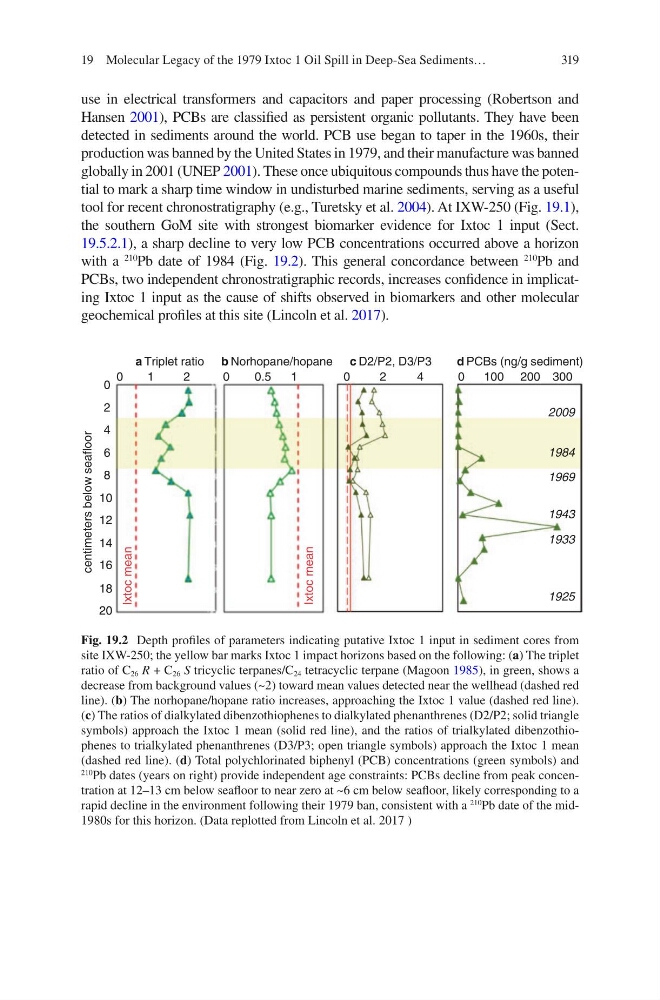
19.5.2.1), a sharp decline to very low PCB concentrations occurred above a horizon
with a
210
Pb date of 1984 (Fig. 19.2). This general concordance between
210
Pb and
PCBs, two independent chronostratigraphic records, increases confidence in implicating Ixtoc 1 input as the cause of shifts observed in biomarkers and other molecular
geochemical profiles at this site (Lincoln et al. 2017).
a Triplet ratio b Norhopane/hopane c D2/P2, D3/P3
d PCBs (ng/g sediment)
0
100 200 300
0
0
2
4
6
8
10
12
14
16
18
20
1
2
0
0.5
1
0
2
4
2009
1984
1943
1969
1933
1925
centimeters below seafloor
Ixtoc mean
Ixtoc mean
Fig. 19.2 Depth profiles of parameters indicating putative Ixtoc 1 input in sediment cores from
site IXW-250; the yellow bar marks Ixtoc 1 impact horizons based on the following: (a) The triplet
ratio of C 26 R + C 26 S tricyclic terpanes/C 24 tetracyclic terpane (Magoon 1985), in green, shows a
decrease from background values (~2) toward mean values detected near the wellhead (dashed red
line). (b) The norhopane/hopane ratio increases, approaching the Ixtoc 1 value (dashed red line).
(c) The ratios of dialkylated dibenzothiophenes to dialkylated phenanthrenes (D2/P2; solid triangle
symbols) approach the Ixtoc 1 mean (solid red line), and the ratios of trialkylated dibenzothiophenes to trialkylated phenanthrenes (D3/P3; open triangle symbols) approach the Ixtoc 1 mean
(dashed red line). (d) Total polychlorinated biphenyl (PCB) concentrations (green symbols) and
210
Pb dates (years on right) provide independent age constraints: PCBs decline from peak concentration at 12–13 cm below seafloor to near zero at ~6 cm below seafloor, likely corresponding to a
rapid decline in the environment following their 1979 ban, consistent with a
210
Pb date of the mid1980s for this horizon. (Data replotted from Lincoln et al. 2017 )
19 Molecular Legacy of the 1979 Ixtoc 1 Oil Spill in Deep-Sea Sediments…
use in electrical transformers and capacitors and paper processing (Robertson and
Hansen 2001), PCBs are classified as persistent organic pollutants. They have been
detected in sediments around the world. PCB use began to taper in the 1960s, their
production was banned by the United States in 1979, and their manufacture was banned
globally in 2001 (UNEP 2001). These once ubiquitous compounds thus have the potential to mark a sharp time window in undisturbed marine sediments, serving as a useful
tool for recent chronostratigraphy (e.g., Turetsky et al. 2004). At IXW-250 (Fig. 19.1),
the southern GoM site with strongest biomarker evidence for Ixtoc 1 input (Sect.
19.5.2.1), a sharp decline to very low PCB concentrations occurred above a horizon
with a
210
Pb date of 1984 (Fig. 19.2). This general concordance between
210
Pb and
PCBs, two independent chronostratigraphic records, increases confidence in implicating Ixtoc 1 input as the cause of shifts observed in biomarkers and other molecular
geochemical profiles at this site (Lincoln et al. 2017).
a Triplet ratio b Norhopane/hopane c D2/P2, D3/P3
d PCBs (ng/g sediment)
0
100 200 300
0
0
2
4
6
8
10
12
14
16
18
20
1
2
0
0.5
1
0
2
4
2009
1984
1943
1969
1933
1925
centimeters below seafloor
Ixtoc mean
Ixtoc mean
Fig. 19.2 Depth profiles of parameters indicating putative Ixtoc 1 input in sediment cores from
site IXW-250; the yellow bar marks Ixtoc 1 impact horizons based on the following: (a) The triplet
ratio of C 26 R + C 26 S tricyclic terpanes/C 24 tetracyclic terpane (Magoon 1985), in green, shows a
decrease from background values (~2) toward mean values detected near the wellhead (dashed red
line). (b) The norhopane/hopane ratio increases, approaching the Ixtoc 1 value (dashed red line).
(c) The ratios of dialkylated dibenzothiophenes to dialkylated phenanthrenes (D2/P2; solid triangle
symbols) approach the Ixtoc 1 mean (solid red line), and the ratios of trialkylated dibenzothiophenes to trialkylated phenanthrenes (D3/P3; open triangle symbols) approach the Ixtoc 1 mean
(dashed red line). (d) Total polychlorinated biphenyl (PCB) concentrations (green symbols) and
210
Pb dates (years on right) provide independent age constraints: PCBs decline from peak concentration at 12–13 cm below seafloor to near zero at ~6 cm below seafloor, likely corresponding to a
rapid decline in the environment following their 1979 ban, consistent with a
210
Pb date of the mid1980s for this horizon. (Data replotted from Lincoln et al. 2017 )
19 Molecular Legacy of the 1979 Ixtoc 1 Oil Spill in Deep-Sea Sediments…