

293
after the DWH oil spill showed to record the MOSSFA event, likely due to changes
in sediment accumulation rates (Schwing et al. 2018). From 2010 to 2012, the
δ
13
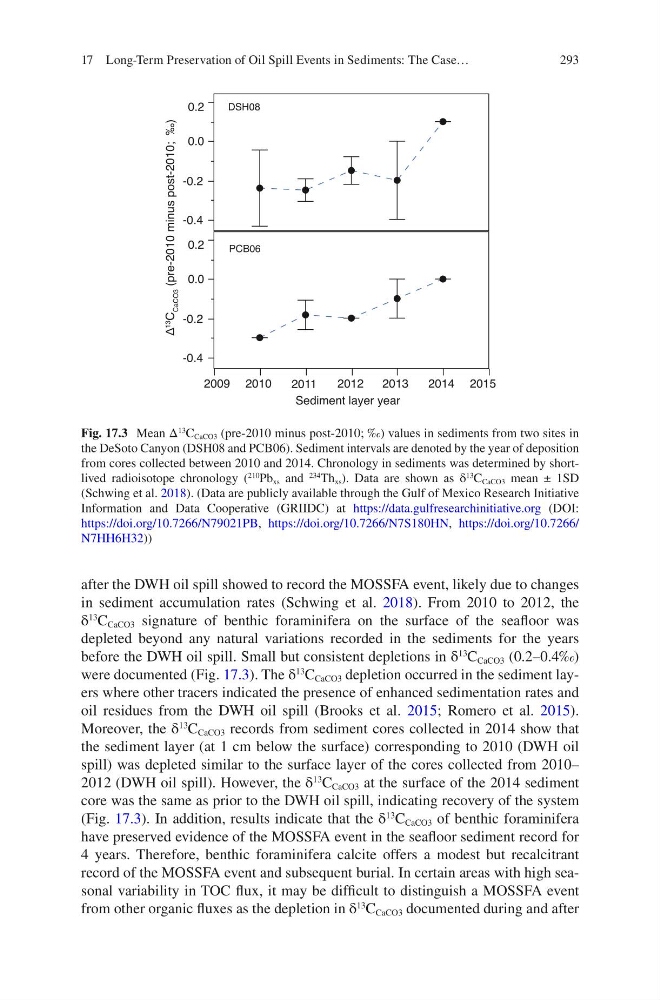
C CaCO3 signature of benthic foraminifera on the surface of the seafloor was
depleted beyond any natural variations recorded in the sediments for the years
before the DWH oil spill. Small but consistent depletions in δ
13
C CaCO3 (0.2–0.4‰)
were documented (Fig. 17.3). The δ
13
C CaCO3 depletion occurred in the sediment layers where other tracers indicated the presence of enhanced sedimentation rates and
oil residues from the DWH oil spill (Brooks et al. 2015; Romero et al. 2015).
Moreover, the δ
13
C CaCO3 records from sediment cores collected in 2014 show that
the sediment layer (at 1 cm below the surface) corresponding to 2010 (DWH oil
spill) was depleted similar to the surface layer of the cores collected from 2010–
2012 (DWH oil spill). However, the δ
13
C CaCO3 at the surface of the 2014 sediment
core was the same as prior to the DWH oil spill, indicating recovery of the system
(Fig. 17.3). In addition, results indicate that the δ
13
C CaCO3 of benthic foraminifera
have preserved evidence of the MOSSFA event in the seafloor sediment record for
4 years. Therefore, benthic foraminifera calcite offers a modest but recalcitrant
record of the MOSSFA event and subsequent burial. In certain areas with high seasonal variability in TOC flux, it may be difficult to distinguish a MOSSFA event
from other organic fluxes as the depletion in δ
13
C CaCO3 documented during and after
̎
&
&D&2
SUHPLQXVSRVWڬ
6HGLPHQWOD\HU\HDU
'6+
3&%
Fig. 17.3 Mean Δ
13 C CaCO3 (pre-2010 minus post-2010; ‰) values in sediments from two sites in
the DeSoto Canyon (DSH08 and PCB06). Sediment intervals are denoted by the year of deposition
from cores collected between 2010 and 2014. Chronology in sediments was determined by shortlived radioisotope chronology (
210
Pb xs and
234 Th xs ). Data are shown as δ
13 C CaCO3 mean ± 1SD
(Schwing et al. 2018). (Data are publicly available through the Gulf of Mexico Research Initiative
Information and Data Cooperative (GRIIDC) at https://data.gulfresearchinitiative.org (DOI:
https://doi.org/10.7266/N79021PB, https://doi.org/10.7266/N7S180HN, https://doi.org/10.7266/
N7HH6H32))
17 Long-Term Preservation of Oil Spill Events in Sediments: The Case…
after the DWH oil spill showed to record the MOSSFA event, likely due to changes
in sediment accumulation rates (Schwing et al. 2018). From 2010 to 2012, the
δ
13
C CaCO3 signature of benthic foraminifera on the surface of the seafloor was
depleted beyond any natural variations recorded in the sediments for the years
before the DWH oil spill. Small but consistent depletions in δ
13
C CaCO3 (0.2–0.4‰)
were documented (Fig. 17.3). The δ
13
C CaCO3 depletion occurred in the sediment layers where other tracers indicated the presence of enhanced sedimentation rates and
oil residues from the DWH oil spill (Brooks et al. 2015; Romero et al. 2015).
Moreover, the δ
13
C CaCO3 records from sediment cores collected in 2014 show that
the sediment layer (at 1 cm below the surface) corresponding to 2010 (DWH oil
spill) was depleted similar to the surface layer of the cores collected from 2010–
2012 (DWH oil spill). However, the δ
13
C CaCO3 at the surface of the 2014 sediment
core was the same as prior to the DWH oil spill, indicating recovery of the system
(Fig. 17.3). In addition, results indicate that the δ
13
C CaCO3 of benthic foraminifera
have preserved evidence of the MOSSFA event in the seafloor sediment record for
4 years. Therefore, benthic foraminifera calcite offers a modest but recalcitrant
record of the MOSSFA event and subsequent burial. In certain areas with high seasonal variability in TOC flux, it may be difficult to distinguish a MOSSFA event
from other organic fluxes as the depletion in δ
13
C CaCO3 documented during and after
̎
&
&D&2
SUHPLQXVSRVWڬ
6HGLPHQWOD\HU\HDU
'6+
3&%
Fig. 17.3 Mean Δ
13 C CaCO3 (pre-2010 minus post-2010; ‰) values in sediments from two sites in
the DeSoto Canyon (DSH08 and PCB06). Sediment intervals are denoted by the year of deposition
from cores collected between 2010 and 2014. Chronology in sediments was determined by shortlived radioisotope chronology (
210
Pb xs and
234 Th xs ). Data are shown as δ
13 C CaCO3 mean ± 1SD
(Schwing et al. 2018). (Data are publicly available through the Gulf of Mexico Research Initiative
Information and Data Cooperative (GRIIDC) at https://data.gulfresearchinitiative.org (DOI:
https://doi.org/10.7266/N79021PB, https://doi.org/10.7266/N7S180HN, https://doi.org/10.7266/
N7HH6H32))
17 Long-Term Preservation of Oil Spill Events in Sediments: The Case…