

291
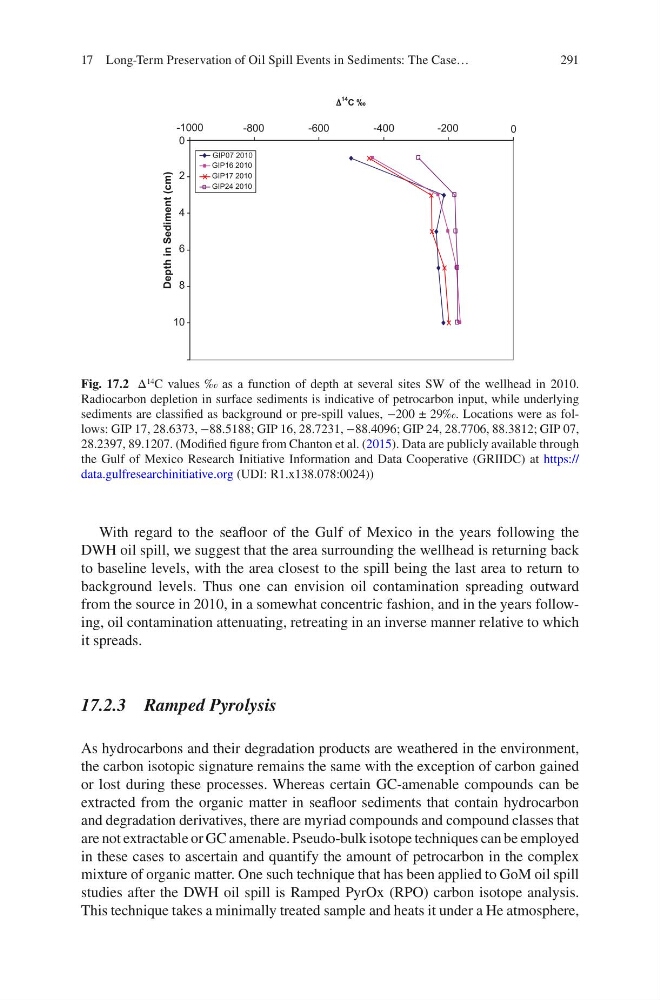
With regard to the seafloor of the Gulf of Mexico in the years following the
DWH oil spill, we suggest that the area surrounding the wellhead is returning back
to baseline levels, with the area closest to the spill being the last area to return to
background levels. Thus one can envision oil contamination spreading outward
from the source in 2010, in a somewhat concentric fashion, and in the years following, oil contamination attenuating, retreating in an inverse manner relative to which
it spreads.
17.2.3 Ramped Pyrolysis
As hydrocarbons and their degradation products are weathered in the environment,
the carbon isotopic signature remains the same with the exception of carbon gained
or lost during these processes. Whereas certain GC-amenable compounds can be
extracted from the organic matter in seafloor sediments that contain hydrocarbon
and degradation derivatives, there are myriad compounds and compound classes that
are not extractable or GC amenable. Pseudo-bulk isotope techniques can be employed
in these cases to ascertain and quantify the amount of petrocarbon in the complex
mixture of organic matter. One such technique that has been applied to GoM oil spill
studies after the DWH oil spill is Ramped PyrOx (RPO) carbon isotope analysis.
This technique takes a minimally treated sample and heats it under a He atmosphere,
'HSWKLQ6HGLPHQWFP
&Å
*,3
*,3
*,3
*,3
Fig. 17.2 Δ
14
C values ‰ as a function of depth at several sites SW of the wellhead in 2010.
Radiocarbon depletion in surface sediments is indicative of petrocarbon input, while underlying
sediments are classified as background or pre-spill values, −200 ± 29‰. Locations were as follows: GIP 17, 28.6373, −88.5188; GIP 16, 28.7231, −88.4096; GIP 24, 28.7706, 88.3812; GIP 07,
28.2397, 89.1207. (Modified figure from Chanton et al. (2015). Data are publicly available through
the Gulf of Mexico Research Initiative Information and Data Cooperative (GRIIDC) at https://
data.gulfresearchinitiative.org (UDI: R1.x138.078:0024))
17 Long-Term Preservation of Oil Spill Events in Sediments: The Case…
With regard to the seafloor of the Gulf of Mexico in the years following the
DWH oil spill, we suggest that the area surrounding the wellhead is returning back
to baseline levels, with the area closest to the spill being the last area to return to
background levels. Thus one can envision oil contamination spreading outward
from the source in 2010, in a somewhat concentric fashion, and in the years following, oil contamination attenuating, retreating in an inverse manner relative to which
it spreads.
17.2.3 Ramped Pyrolysis
As hydrocarbons and their degradation products are weathered in the environment,
the carbon isotopic signature remains the same with the exception of carbon gained
or lost during these processes. Whereas certain GC-amenable compounds can be
extracted from the organic matter in seafloor sediments that contain hydrocarbon
and degradation derivatives, there are myriad compounds and compound classes that
are not extractable or GC amenable. Pseudo-bulk isotope techniques can be employed
in these cases to ascertain and quantify the amount of petrocarbon in the complex
mixture of organic matter. One such technique that has been applied to GoM oil spill
studies after the DWH oil spill is Ramped PyrOx (RPO) carbon isotope analysis.
This technique takes a minimally treated sample and heats it under a He atmosphere,
'HSWKLQ6HGLPHQWFP
&Å
*,3
*,3
*,3
*,3
Fig. 17.2 Δ
14
C values ‰ as a function of depth at several sites SW of the wellhead in 2010.
Radiocarbon depletion in surface sediments is indicative of petrocarbon input, while underlying
sediments are classified as background or pre-spill values, −200 ± 29‰. Locations were as follows: GIP 17, 28.6373, −88.5188; GIP 16, 28.7231, −88.4096; GIP 24, 28.7706, 88.3812; GIP 07,
28.2397, 89.1207. (Modified figure from Chanton et al. (2015). Data are publicly available through
the Gulf of Mexico Research Initiative Information and Data Cooperative (GRIIDC) at https://
data.gulfresearchinitiative.org (UDI: R1.x138.078:0024))
17 Long-Term Preservation of Oil Spill Events in Sediments: The Case…