

18
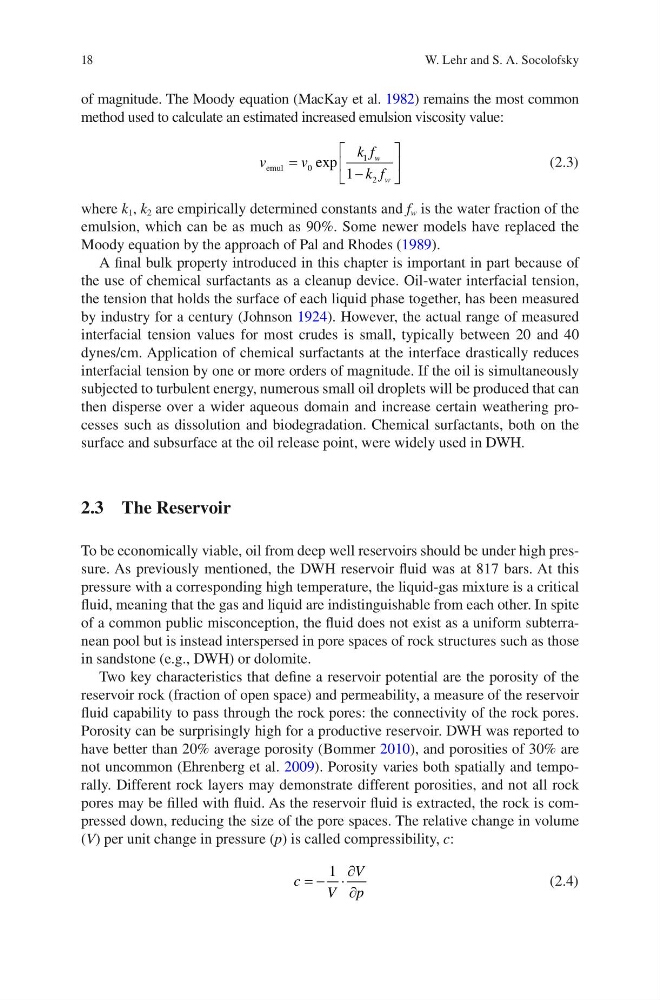
of magnitude. The Moody equation (MacKay et al. 1982) remains the most common
method used to calculate an estimated increased emulsion viscosity value:
v
v
k f
k f
w
w
emul =
−
0
1
2
1
exp
(2.3)
where k 1 , k 2 are empirically determined constants and f w is the water fraction of the
emulsion, which can be as much as 90%. Some newer models have replaced the
Moody equation by the approach of Pal and Rhodes (1989).
A final bulk property introduced in this chapter is important in part because of
the use of chemical surfactants as a cleanup device. Oil-water interfacial tension,
the tension that holds the surface of each liquid phase together, has been measured
by industry for a century (Johnson 1924). However, the actual range of measured
interfacial tension values for most crudes is small, typically between 20 and 40
dynes/cm. Application of chemical surfactants at the interface drastically reduces
interfacial tension by one or more orders of magnitude. If the oil is simultaneously
subjected to turbulent energy, numerous small oil droplets will be produced that can
then disperse over a wider aqueous domain and increase certain weathering processes such as dissolution and biodegradation. Chemical surfactants, both on the
surface and subsurface at the oil release point, were widely used in DWH.
2.3 The Reservoir
To be economically viable, oil from deep well reservoirs should be under high pressure. As previously mentioned, the DWH reservoir fluid was at 817 bars. At this
pressure with a corresponding high temperature, the liquid-gas mixture is a critical
fluid, meaning that the gas and liquid are indistinguishable from each other. In spite
of a common public misconception, the fluid does not exist as a uniform subterranean pool but is instead interspersed in pore spaces of rock structures such as those
in sandstone (e.g., DWH) or dolomite.
Two key characteristics that define a reservoir potential are the porosity of the
reservoir rock (fraction of open space) and permeability, a measure of the reservoir
fluid capability to pass through the rock pores: the connectivity of the rock pores.
Porosity can be surprisingly high for a productive reservoir. DWH was reported to
have better than 20% average porosity (Bommer 2010), and porosities of 30% are
not uncommon (Ehrenberg et al. 2009). Porosity varies both spatially and temporally. Different rock layers may demonstrate different porosities, and not all rock
pores may be filled with fluid. As the reservoir fluid is extracted, the rock is compressed down, reducing the size of the pore spaces. The relative change in volume
(V) per unit change in pressure (p) is called compressibility, c:
c
V
V
p
= − ⋅
∂
∂
1
(2.4)
W. Lehr and S. A. Socolofsky
of magnitude. The Moody equation (MacKay et al. 1982) remains the most common
method used to calculate an estimated increased emulsion viscosity value:
v
v
k f
k f
w
w
emul =
−
0
1
2
1
exp
(2.3)
where k 1 , k 2 are empirically determined constants and f w is the water fraction of the
emulsion, which can be as much as 90%. Some newer models have replaced the
Moody equation by the approach of Pal and Rhodes (1989).
A final bulk property introduced in this chapter is important in part because of
the use of chemical surfactants as a cleanup device. Oil-water interfacial tension,
the tension that holds the surface of each liquid phase together, has been measured
by industry for a century (Johnson 1924). However, the actual range of measured
interfacial tension values for most crudes is small, typically between 20 and 40
dynes/cm. Application of chemical surfactants at the interface drastically reduces
interfacial tension by one or more orders of magnitude. If the oil is simultaneously
subjected to turbulent energy, numerous small oil droplets will be produced that can
then disperse over a wider aqueous domain and increase certain weathering processes such as dissolution and biodegradation. Chemical surfactants, both on the
surface and subsurface at the oil release point, were widely used in DWH.
2.3 The Reservoir
To be economically viable, oil from deep well reservoirs should be under high pressure. As previously mentioned, the DWH reservoir fluid was at 817 bars. At this
pressure with a corresponding high temperature, the liquid-gas mixture is a critical
fluid, meaning that the gas and liquid are indistinguishable from each other. In spite
of a common public misconception, the fluid does not exist as a uniform subterranean pool but is instead interspersed in pore spaces of rock structures such as those
in sandstone (e.g., DWH) or dolomite.
Two key characteristics that define a reservoir potential are the porosity of the
reservoir rock (fraction of open space) and permeability, a measure of the reservoir
fluid capability to pass through the rock pores: the connectivity of the rock pores.
Porosity can be surprisingly high for a productive reservoir. DWH was reported to
have better than 20% average porosity (Bommer 2010), and porosities of 30% are
not uncommon (Ehrenberg et al. 2009). Porosity varies both spatially and temporally. Different rock layers may demonstrate different porosities, and not all rock
pores may be filled with fluid. As the reservoir fluid is extracted, the rock is compressed down, reducing the size of the pore spaces. The relative change in volume
(V) per unit change in pressure (p) is called compressibility, c:
c
V
V
p
= − ⋅
∂
∂
1
(2.4)
W. Lehr and S. A. Socolofsky