

288
biodegradation of LMW n-alkanes (
LMW PAHs (e.g., phenanthrenes). Also preferential loss of homohopanes with longer alkyl chains (>C31) was observed (up to ~50%) related to microbial degradation
(Aeppli et al. 2014).
In the deep-sea area, severe oil weathering occurred during vertical and lateral
transport in the water column before deposition. Specifically, within 8 km of the
DWH site, hydrocarbon analyses indicate weathering increased with distance from
the DWH site with preferential loss of n-alkanes (
for LMW compounds (n-alkanes and PAHs) in sediments collected in 2010 at the
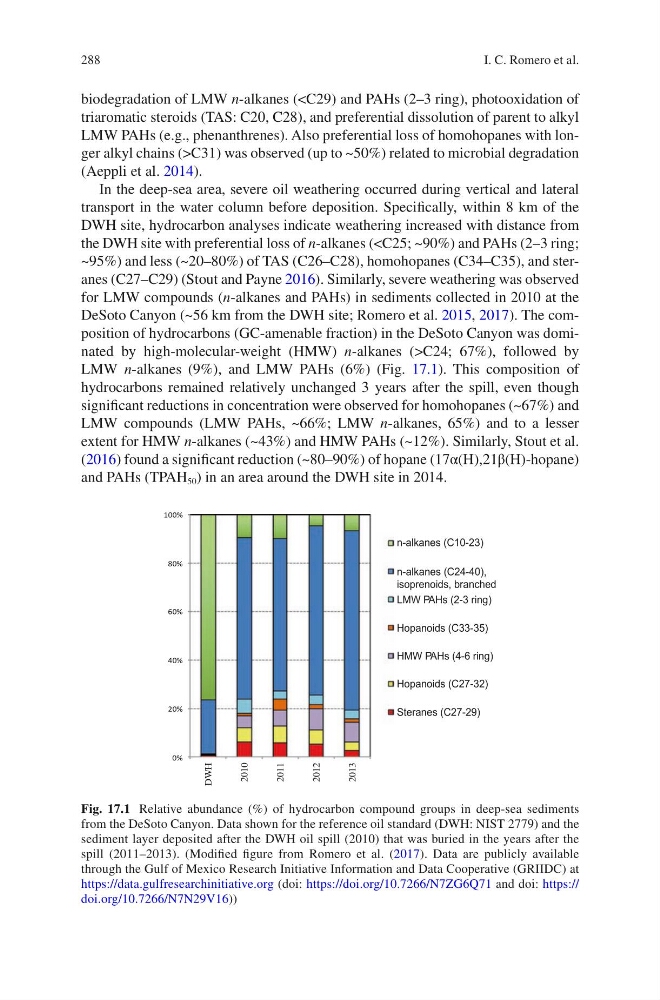
DeSoto Canyon (~56 km from the DWH site; Romero et al. 2015, 2017). The composition of hydrocarbons (GC-amenable fraction) in the DeSoto Canyon was dominated by high-molecular-weight (HMW) n-alkanes (>C24; 67%), followed by
LMW n-alkanes (9%), and LMW PAHs (6%) (Fig. 17.1). This composition of
hydrocarbons remained relatively unchanged 3 years after the spill, even though
significant reductions in concentration were observed for homohopanes (~67%) and
LMW compounds (LMW PAHs, ~66%; LMW n-alkanes, 65%) and to a lesser
extent for HMW n-alkanes (~43%) and HMW PAHs (~12%). Similarly, Stout et al.
(2016) found a significant reduction (~80–90%) of hopane (17α(H),21β(H)-hopane)
and PAHs (TPAH 50 ) in an area around the DWH site in 2014.
Ϭй
ϮϬй
ϰϬй
ϲϬй
ϴϬй
ϭϬϬй
':+
QDONDQHV&
QDONDQHV&
LVRSUHQRLGVEUDQFKHG
/0:3$+VULQJ
+RSDQRLGV&
+0:3$+VULQJ
+RSDQRLGV&
6WHUDQHV&
Fig. 17.1 Relative abundance (%) of hydrocarbon compound groups in deep-sea sediments
from the DeSoto Canyon. Data shown for the reference oil standard (DWH: NIST 2779) and the
sediment layer deposited after the DWH oil spill (2010) that was buried in the years after the
spill (2011–2013). (Modified figure from Romero et al. (2017). Data are publicly available
through the Gulf of Mexico Research Initiative Information and Data Cooperative (GRIIDC) at
https://data.gulfresearchinitiative.org (doi: https://doi.org/10.7266/N7ZG6Q71 and doi: https://
doi.org/10.7266/N7N29V16))
I. C. Romero et al.
biodegradation of LMW n-alkanes (
LMW PAHs (e.g., phenanthrenes). Also preferential loss of homohopanes with longer alkyl chains (>C31) was observed (up to ~50%) related to microbial degradation
(Aeppli et al. 2014).
In the deep-sea area, severe oil weathering occurred during vertical and lateral
transport in the water column before deposition. Specifically, within 8 km of the
DWH site, hydrocarbon analyses indicate weathering increased with distance from
the DWH site with preferential loss of n-alkanes (
for LMW compounds (n-alkanes and PAHs) in sediments collected in 2010 at the
DeSoto Canyon (~56 km from the DWH site; Romero et al. 2015, 2017). The composition of hydrocarbons (GC-amenable fraction) in the DeSoto Canyon was dominated by high-molecular-weight (HMW) n-alkanes (>C24; 67%), followed by
LMW n-alkanes (9%), and LMW PAHs (6%) (Fig. 17.1). This composition of
hydrocarbons remained relatively unchanged 3 years after the spill, even though
significant reductions in concentration were observed for homohopanes (~67%) and
LMW compounds (LMW PAHs, ~66%; LMW n-alkanes, 65%) and to a lesser
extent for HMW n-alkanes (~43%) and HMW PAHs (~12%). Similarly, Stout et al.
(2016) found a significant reduction (~80–90%) of hopane (17α(H),21β(H)-hopane)
and PAHs (TPAH 50 ) in an area around the DWH site in 2014.
Ϭй
ϮϬй
ϰϬй
ϲϬй
ϴϬй
ϭϬϬй
':+
QDONDQHV&
QDONDQHV&
LVRSUHQRLGVEUDQFKHG
/0:3$+VULQJ
+RSDQRLGV&
+0:3$+VULQJ
+RSDQRLGV&
6WHUDQHV&
Fig. 17.1 Relative abundance (%) of hydrocarbon compound groups in deep-sea sediments
from the DeSoto Canyon. Data shown for the reference oil standard (DWH: NIST 2779) and the
sediment layer deposited after the DWH oil spill (2010) that was buried in the years after the
spill (2011–2013). (Modified figure from Romero et al. (2017). Data are publicly available
through the Gulf of Mexico Research Initiative Information and Data Cooperative (GRIIDC) at
https://data.gulfresearchinitiative.org (doi: https://doi.org/10.7266/N7ZG6Q71 and doi: https://
doi.org/10.7266/N7N29V16))
I. C. Romero et al.