

280
16.4 Conclusions
Following the blowout, a substantial marine snow episode was recorded in NGoM
sediments which led to a large sedimentation pulse. Subsequent respiration of the
organic carbon associated with the marine snow resulted in reducing conditions, as
evidenced by downcore changes in redox-sensitive metals Mn and Re.
After the event, double Mn peaks are present in surface sediments consistent
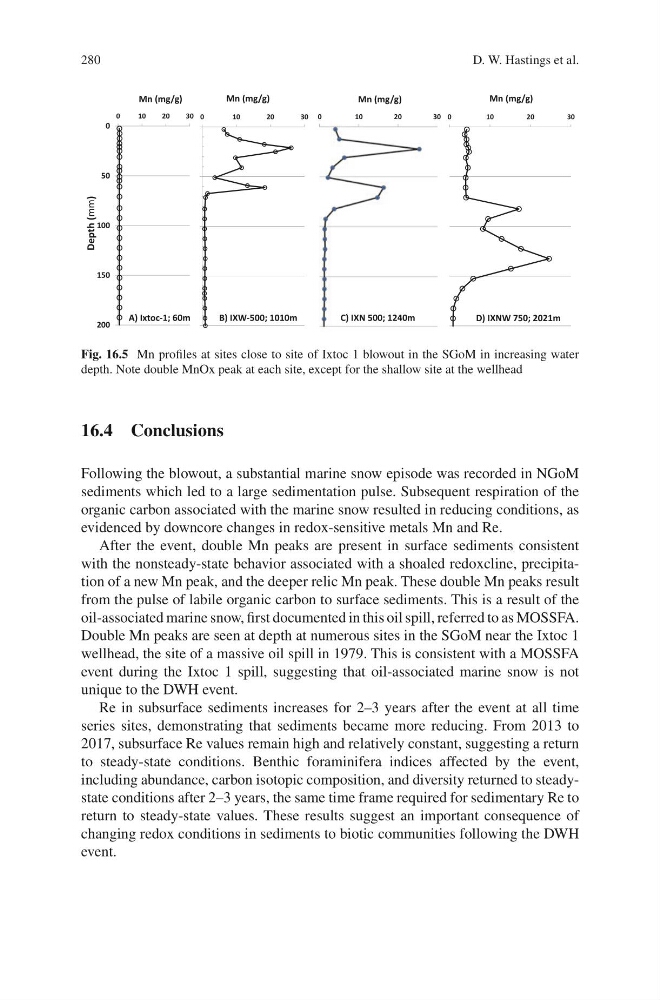
with the nonsteady-state behavior associated with a shoaled redoxcline, precipitation of a new Mn peak, and the deeper relic Mn peak. These double Mn peaks result
from the pulse of labile organic carbon to surface sediments. This is a result of the
oil-associated marine snow, first documented in this oil spill, referred to as MOSSFA.
Double Mn peaks are seen at depth at numerous sites in the SGoM near the Ixtoc 1
wellhead, the site of a massive oil spill in 1979. This is consistent with a MOSSFA
event during the Ixtoc 1 spill, suggesting that oil-associated marine snow is not
unique to the DWH event.
Re in subsurface sediments increases for 2–3 years after the event at all time
series sites, demonstrating that sediments became more reducing. From 2013 to
2017, subsurface Re values remain high and relatively constant, suggesting a return
to steady-state conditions. Benthic foraminifera indices affected by the event,
including abundance, carbon isotopic composition, and diversity returned to steadystate conditions after 2–3 years, the same time frame required for sedimentary Re to
return to steady-state values. These results suggest an important consequence of
changing redox conditions in sediments to biotic communities following the DWH
event.
Ϭ
ϭ Ϭ
Ϯ Ϭ
ϯ Ϭ
DŶ;ŵŐͬŐͿ
Ϭ
ϱϬ
ϭϬϬ
ϭϱϬ
ϮϬϬ
Ϭ
ϭ Ϭ
Ϯ Ϭ
ϯ Ϭ
DŶ;ŵŐͬŐͿ
ĞƉƚŚ;ŵŵͿ
Ϭ
ϭ Ϭ
Ϯ Ϭ
ϯ Ϭ
DŶ;ŵŐͬŐͿ
Ϭ
ϭ Ϭ
Ϯ Ϭ
ϯ Ϭ
DŶ;ŵŐͬŐͿ
Ϳ/džƚŽĐͲϭ͖ϲϬŵ
Ϳ/ytͲϱϬϬ͖ϭϬϭϬŵ
Ϳ/yEϱϬϬ͖ϭϮϰϬŵ
Ϳ/yEtϳϱϬ͖ϮϬϮϭŵ
Fig. 16.5 Mn profiles at sites close to site of Ixtoc 1 blowout in the SGoM in increasing water
depth. Note double MnOx peak at each site, except for the shallow site at the wellhead
D. W. Hastings et al.
16.4 Conclusions
Following the blowout, a substantial marine snow episode was recorded in NGoM
sediments which led to a large sedimentation pulse. Subsequent respiration of the
organic carbon associated with the marine snow resulted in reducing conditions, as
evidenced by downcore changes in redox-sensitive metals Mn and Re.
After the event, double Mn peaks are present in surface sediments consistent
with the nonsteady-state behavior associated with a shoaled redoxcline, precipitation of a new Mn peak, and the deeper relic Mn peak. These double Mn peaks result
from the pulse of labile organic carbon to surface sediments. This is a result of the
oil-associated marine snow, first documented in this oil spill, referred to as MOSSFA.
Double Mn peaks are seen at depth at numerous sites in the SGoM near the Ixtoc 1
wellhead, the site of a massive oil spill in 1979. This is consistent with a MOSSFA
event during the Ixtoc 1 spill, suggesting that oil-associated marine snow is not
unique to the DWH event.
Re in subsurface sediments increases for 2–3 years after the event at all time
series sites, demonstrating that sediments became more reducing. From 2013 to
2017, subsurface Re values remain high and relatively constant, suggesting a return
to steady-state conditions. Benthic foraminifera indices affected by the event,
including abundance, carbon isotopic composition, and diversity returned to steadystate conditions after 2–3 years, the same time frame required for sedimentary Re to
return to steady-state values. These results suggest an important consequence of
changing redox conditions in sediments to biotic communities following the DWH
event.
Ϭ
ϭ Ϭ
Ϯ Ϭ
ϯ Ϭ
DŶ;ŵŐͬŐͿ
Ϭ
ϱϬ
ϭϬϬ
ϭϱϬ
ϮϬϬ
Ϭ
ϭ Ϭ
Ϯ Ϭ
ϯ Ϭ
DŶ;ŵŐͬŐͿ
ĞƉƚŚ;ŵŵͿ
Ϭ
ϭ Ϭ
Ϯ Ϭ
ϯ Ϭ
DŶ;ŵŐͬŐͿ
Ϭ
ϭ Ϭ
Ϯ Ϭ
ϯ Ϭ
DŶ;ŵŐͬŐͿ
Ϳ/džƚŽĐͲϭ͖ϲϬŵ
Ϳ/ytͲϱϬϬ͖ϭϬϭϬŵ
Ϳ/yEϱϬϬ͖ϭϮϰϬŵ
Ϳ/yEtϳϱϬ͖ϮϬϮϭŵ
Fig. 16.5 Mn profiles at sites close to site of Ixtoc 1 blowout in the SGoM in increasing water
depth. Note double MnOx peak at each site, except for the shallow site at the wellhead
D. W. Hastings et al.