

273
sediments, resulting in the reduction of a series of electron acceptors, oxygen,
nitrate, Mn oxides, Fe oxides, and sulfate, in order of decreasing free energy per
mole organic carbon (e.g., Froelich et al. 1979; Emerson et al. 1980). After oxygen
is nearly depleted in these sediments, nitrate is reduced, followed by reduction of
solid Mn(IV) oxides to aqueous Mn(II). The dissolved Mn(II) diffuses upward, is
re-oxidized to Mn(IV) by pore water oxygen, and is then trapped within the sediment. Under steady-state conditions, this leads to the formation of a single Mn peak,
which typically defines the depth of the redoxcline (e.g., Burdige and Gieskes
1983). The redox state of surface sediments and the depth of the redoxcline is controlled by the flux of organic carbon to sediments, bottom water oxygen concentration, and how labile the carbon is (e.g., Emerson et al. 1985).
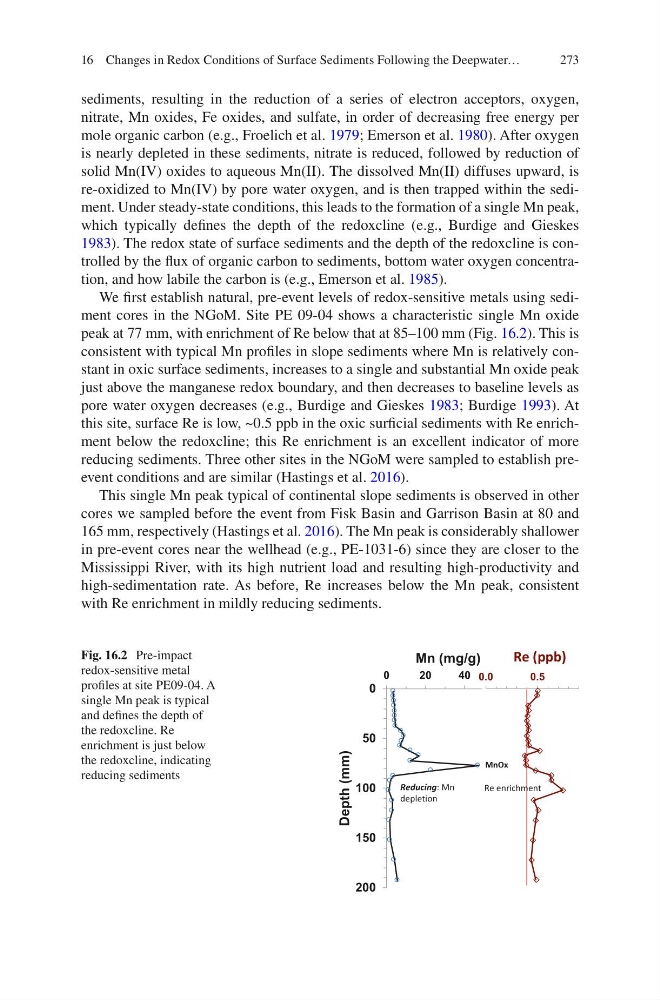
We first establish natural, pre-event levels of redox-sensitive metals using sediment cores in the NGoM. Site PE 09-04 shows a characteristic single Mn oxide
peak at 77 mm, with enrichment of Re below that at 85–100 mm (Fig. 16.2). This is
consistent with typical Mn profiles in slope sediments where Mn is relatively constant in oxic surface sediments, increases to a single and substantial Mn oxide peak
just above the manganese redox boundary, and then decreases to baseline levels as
pore water oxygen decreases (e.g., Burdige and Gieskes 1983; Burdige 1993). At
this site, surface Re is low, ~0.5 ppb in the oxic surficial sediments with Re enrichment below the redoxcline; this Re enrichment is an excellent indicator of more
reducing sediments. Three other sites in the NGoM were sampled to establish preevent conditions and are similar (Hastings et al. 2016).
This single Mn peak typical of continental slope sediments is observed in other
cores we sampled before the event from Fisk Basin and Garrison Basin at 80 and
165 mm, respectively (Hastings et al. 2016). The Mn peak is considerably shallower
in pre-event cores near the wellhead (e.g., PE-1031-6) since they are closer to the
Mississippi River, with its high nutrient load and resulting high-productivity and
high-sedimentation rate. As before, Re increases below the Mn peak, consistent
with Re enrichment in mildly reducing sediments.
0
50
100
150
200
0
2 0
4 0
Depth (mm)
Mn (mg/g)
0.0
0.5
Re (ppb)
Reducing: Mn
depletion
Re enrichment
MnOx
Fig. 16.2 Pre-impact
redox-sensitive metal
profiles at site PE09-04. A
single Mn peak is typical
and defines the depth of
the redoxcline. Re
enrichment is just below
the redoxcline, indicating
reducing sediments
16 Changes in Redox Conditions of Surface Sediments Following the Deepwater…
sediments, resulting in the reduction of a series of electron acceptors, oxygen,
nitrate, Mn oxides, Fe oxides, and sulfate, in order of decreasing free energy per
mole organic carbon (e.g., Froelich et al. 1979; Emerson et al. 1980). After oxygen
is nearly depleted in these sediments, nitrate is reduced, followed by reduction of
solid Mn(IV) oxides to aqueous Mn(II). The dissolved Mn(II) diffuses upward, is
re-oxidized to Mn(IV) by pore water oxygen, and is then trapped within the sediment. Under steady-state conditions, this leads to the formation of a single Mn peak,
which typically defines the depth of the redoxcline (e.g., Burdige and Gieskes
1983). The redox state of surface sediments and the depth of the redoxcline is controlled by the flux of organic carbon to sediments, bottom water oxygen concentration, and how labile the carbon is (e.g., Emerson et al. 1985).
We first establish natural, pre-event levels of redox-sensitive metals using sediment cores in the NGoM. Site PE 09-04 shows a characteristic single Mn oxide
peak at 77 mm, with enrichment of Re below that at 85–100 mm (Fig. 16.2). This is
consistent with typical Mn profiles in slope sediments where Mn is relatively constant in oxic surface sediments, increases to a single and substantial Mn oxide peak
just above the manganese redox boundary, and then decreases to baseline levels as
pore water oxygen decreases (e.g., Burdige and Gieskes 1983; Burdige 1993). At
this site, surface Re is low, ~0.5 ppb in the oxic surficial sediments with Re enrichment below the redoxcline; this Re enrichment is an excellent indicator of more
reducing sediments. Three other sites in the NGoM were sampled to establish preevent conditions and are similar (Hastings et al. 2016).
This single Mn peak typical of continental slope sediments is observed in other
cores we sampled before the event from Fisk Basin and Garrison Basin at 80 and
165 mm, respectively (Hastings et al. 2016). The Mn peak is considerably shallower
in pre-event cores near the wellhead (e.g., PE-1031-6) since they are closer to the
Mississippi River, with its high nutrient load and resulting high-productivity and
high-sedimentation rate. As before, Re increases below the Mn peak, consistent
with Re enrichment in mildly reducing sediments.
0
50
100
150
200
0
2 0
4 0
Depth (mm)
Mn (mg/g)
0.0
0.5
Re (ppb)
Reducing: Mn
depletion
Re enrichment
MnOx
Fig. 16.2 Pre-impact
redox-sensitive metal
profiles at site PE09-04. A
single Mn peak is typical
and defines the depth of
the redoxcline. Re
enrichment is just below
the redoxcline, indicating
reducing sediments
16 Changes in Redox Conditions of Surface Sediments Following the Deepwater…